
Cuba at Zero Hour
- Washington’s Endgame and Havana’s Breaking Point

Introduction
Cuba is facing its most perilous crisis in decades. A U.S.-led oil blockade has choked off vital fuel supplies, triggering nationwide power outages, transport paralysis, and deepening shortages of food and medicine. The Cuban economy, already weakened by years of mismanagement and sanctions, has been pushed to the brink after the U.S. capture of Venezuelan leader Nicolás Maduro in early January 2026, which abruptly ended the flow of subsidized oil and cash from Havana’s chief benefactor. In response, Washington has ratcheted up pressure: President Donald Trump’s administration has not only blocked virtually all oil shipments to Cuba but also hinted at dramatic interventions, even a possible “friendly takeover” of the island. As Cuban streets go dark and markets empty, U.S. officials’ remarks throughout February 2026 have grown from wary warnings to confident predictions of Cuba’s collapse – hints of decisive moves unfolding behind the scenes. This article examines how the rhetoric of President Trump and Secretary of State Marco Rubio has evolved in recent weeks, what these remarks signal, and the stark economic reality gripping Cuba. We will also explore potential scenarios for Cuba’s near future – from a worst-case confrontation to a negotiated transition – and assess the geopolitical context, including the role of Cuba’s few remaining allies and the ripple effect of global events like the sudden death of Iran’s leader in late February. Finally, we consider the special significance of Secretary Rubio’s Cuban exile background in shaping U.S. policy at this historic moment.
Historical Context of U.S. Policy Toward Cuba:
U.S. policy toward Cuba has been shaped by over six decades of tension, beginning with Fidel Castro’s 1959 revolution and the subsequent imposition of a comprehensive economic embargo in 1962. The policy’s core objectives have remained consistent: promoting democracy, human rights, and free-market reforms while isolating the communist regime and countering its regional influence. During the Cold War, efforts included covert operations like the failed Bay of Pigs invasion and assassination attempts on Castro. Post-Cold War, the embargo was codified into law through the 1992 Cuban Democracy Act and the 1996 Cuban Liberty and Democratic Solidarity (Helms-Burton) Act, which conditioned its lifting on Cuba meeting criteria such as releasing political prisoners, restoring freedoms of speech and association, and advancing toward multi-party elections. These laws limit presidential flexibility, requiring congressional action for full normalization.
Under President Barack Obama (2009-2017), policy shifted toward engagement, including diplomatic normalization in 2014, eased travel and remittance restrictions, and removal of Cuba from the State Sponsors of Terrorism (SSOT) list. However, this “thaw” was reversed during Donald Trump’s first term (2017-2021), which reinstated tougher measures: re-designating Cuba as an SSOT in 2021, tightening travel bans, limiting remittances, and allowing lawsuits against entities using properties confiscated post-1959 under Helms-Burton Title III. The Biden administration (2021-2025) maintained much of this framework but made minor adjustments, such as resuming limited flights and remittances, amid Cuba’s economic crises and 2021 protests.
Upon returning to office in January 2025, Trump intensified pressure on Cuba, framing it as part of a broader strategy to counter “malign” communist influences in the Western Hemisphere. A June 2025 National Security Presidential Memorandum (NSPM-5) directed agencies to strengthen U.S. policy, including tightening regulations on transactions, travel, and remittances to deny revenue to the Cuban military and government. Key actions included maintaining the SSOT designation, imposing visa restrictions on officials involved in Cuba’s labor export programs (accused of forced labor), and channeling humanitarian aid through NGOs to support the Cuban people while bypassing the regime.
The administration’s rhetoric, led by President Trump and Secretary of State Marco Rubio (a Cuban-American with exile roots), emphasized Cuba’s alliances with adversaries like Russia, China, Iran, Hamas, and Hezbollah, as well as its human rights abuses and regional destabilization efforts. Rubio, in particular, has described the regime as “incompetent” and “unsustainable,” arguing its survival depends on foreign subsidies rather than internal viability, and calling for sweeping economic reforms to address mismanagement and corruption.
The pivotal escalation came with the Executive Order “Addressing Threats to the United States by the Government of Cuba,” signed on January 29, 2026. Invoking the International Emergency Economic Powers Act(IEEPA), National Emergencies Act (NEA), and 3 U.S.C. § 301, Trump declared Cuba’s policies an “unusual and extraordinary threat” to U.S. national security and foreign policy. Key provisions include authorizing additional tariffs on U.S. imports from any country that sells or provides crude oil or petroleum products to Cuba, aiming to sever energy lifelines while promoting internal change. By late February 2026, as Cuba’s crisis deepened—with blackouts of 10–20 hours daily and economic contraction—the administration introduced calibrations, such as Treasury licenses allowing limited resales of Venezuelan-origin oil to Cuba’s private sector at market prices, excluding government entities, to mitigate humanitarian fallout without easing pressure on the regime.
Evolving U.S. Rhetoric: From Warnings to “Friendly Takeover”
In the wake of Maduro’s ouster on January 3, 2026, Washington’s tone toward Havana shifted dramatically. Secretary of State Marco Rubio, himself the son of Cuban exiles, quickly signaled that Cuba’s communist government might be the next domino to fall. “If I lived in Havana and I was in the government, I’d be concerned,” Rubio warned on national television just days after the Venezuela operation. At a White House press conference, Rubio bluntly described Cuba as “a disaster… governed by old and incompetent men” with an economy in ruins. “If I were in Havana and working in the government, I would be worried, at least a little bit,” he cautioned. President Trump echoed that confidence during the same early-January period: flying back from his holiday in Florida, he told reporters he doubted any direct U.S. action would even be necessary. “Without Maduro and the oil supplies Venezuela provided, Cuba looks like it’s ready to fall,”Trump remarked matter-of-factly. Indeed, news had spread that dozens of Cuban security personnel died defending Maduro in Caracas, a stark sign of how deeply Havana had tied its fate to Venezuela. The U.S. victory in Venezuela was immediately seen by Trump and Rubio as a stepping stone to regime change in Cuba – not just a side benefit, but an explicit “goal,” as the Washington Post observed.
Through mid-January, U.S. leaders’ comments grew more strident. Trump publicly urged Cuba’s leaders to “strike a deal before it’s too late,” suggesting behind closed doors talks might be underway and warning Havana of worse to come. On January 29, the administration escalated its campaign: With more than enough valid reasons, and perfect timing President Trump deftly seized the opportunity and declared a national emergency over Cuba and threatened punitive tariffs on any country or company that dared supply fuel to the island. This amounted to a de facto energy siege, an escalation to the long-standing U.S. embargo into an aggressive 21st-century blockade aimed at “cut[ting] the island off entirely” from oil. “Cuba now has no income. They got all of their income from Venezuela… They’re not getting any of it,” Trump gloated, characterizing the situation as a terminal chokehold. Rubio, for his part, openly welcomed the pressure. In a Senate hearing on January 28, he made clear the administration “would love to see the regime [in Cuba] change.” When asked if Washington would rule out forcing regime change, Rubio reacted with barely concealed impatience: “Oh no… we would love to see a change,” he said, calling an end to Cuba’s communist government “of great benefit to the United States.” He then excoriated the state of Cuba’s economy in unusually harsh terms, arguing it was “so badly mismanaged” as to be unrecognizable even as communist. “It has no functional economy,” Rubio declared, adding that “not even Lenin would recognize this version of communism” in Cuba. In his view, the country was “frozen and broken,” and its suffering was due not to U.S. sanctions but the regime’s incompetence – “they don’t know how to run an economy,” he insisted, noting absurd failures like Cuba importing sugar despite once being a leading sugar producer. These remarks underscored a narrative that Cuba’s system is inherently non-viable and on the verge of internal collapse once external life-lines are severed.
By February, Rubio’s tone turned from warning to something closer to ultimatum. Speaking at the Munich Security Conference in mid-February, he hinted at a narrow path for Havana to survive – namely, sweeping economic and political reforms. “Cuba needs to change. It needs to open up its economy,” Rubio suggested, implying that only by granting its people economic freedom and ending one-party rule could the regime hope for any easing of U.S. pressure. He noted Cuba’s socialist state-controlled model “has failed elsewhere in the world” and described the regime’s situation as “dire” precisely because “it has no subsidies coming from any other country” anymore. This was a pointed reference to the end of decades of dependency on foreign benefactors – first the Soviet Union’s aid until 1991, then Venezuela’s oil patronage in the 2000s. “The fundamental problem in Cuba is that it has no economy,” Rubio told Bloomberg News, arguing Havana’s rulers simply “do not know how to improve it” and have survived by living off outside support. In essence, Rubio was publicly spelling out that the status quo in Cuba is “unsustainable” – a word he used frequently in recent weeks – and that without dramatic internal change, the only outcome would be collapse (and presumably, regime change).
President Trump’s own rhetoric in February took an even more provocative turn. He began hinting that elements of Cuba’s leadership were secretly negotiating. Throughout the month, Trump claimed the “Cuban government is talking with us” behind the scenes and that “they’re in a big deal of trouble.” By February 27, standing on the White House lawn, Trump went so far as to raise the prospect of a “friendly takeover” of Cuba by the United States. In remarks that startled observers, he painted Cuba as a failing state desperate for U.S. help. “They have no money. They have no anything right now,” Trump said of Havana’s rulers, “and maybe we’ll have a friendly takeover of Cuba.” He emphasized that Rubio was handling Cuba policy “at a very high level,” suggesting Washington was already deeply engaged in shaping the island’s fate. These comments, coming as Trump departed for a campaign trip in Texas, marked the most explicit public acknowledgment that Washington envisions a post-communist Cuba under U.S. influence. Trump even mused that such a takeover could be “very positive” for Cuban Americans exiled since 1959, many of whom “want to go back to Cuba” and were “very happy with what’s going on” in terms of U.S. actions. The idea of a “friendly” U.S. intervention in Cuba represented a remarkable shift from even a few weeks prior. As The Guardian noted, this language was a “startling departure from previous public statements” and carried echoes of past U.S. domination that would not be lost on Cubans. It hinted that negotiations with certain Cuban insiders might already be underway – indeed, media reports revealed that U.S. officials (close to Rubio) had held secret meetings with Raúl Guillermo Rodríguez Castro, grandson of Raúl Castro, possibly to explore a transition plan. Trump’s quip of a friendly takeover, phrased in business terms, fueled speculation that Washington was pursuing an outcome akin to the Venezuela model: a deal where elements of the regime peacefully cede power or share it under U.S. tutelage, rather than a chaotic implosion.
Meanwhile, Rubio’s statements in late February grew more strident and even menacing in tone, reflecting an intent to keep maximum pressure on Havana. He repeatedly stressed that Cuba’s communist leadership was out of time and out of options. Rubio derided Havana’s hopes of muddling through as delusional, arguing that “the current status quo is not a viable path.” In one interview, he characterized Cuba’s plight bluntly: “They have no oil, no cash, and no future under the Castros’ old model” (a paraphrase of his remarks). He also flatly rejected the Cuban government’s habit of blaming U.S. sanctions for its woes, pointing instead to Cuba’s own paralysis and corruption. “How is it the fault of the U.S. embargo that Cuba… now imports sugar?” Rubio scoffed, noting the irony of a once-rich sugar economy now unable to feed itself. As tensions spiked due to a late February incident – in which a group of armed Cuban exiles from Florida sped into Cuban waters and traded gunfire with Cuban forces – Rubio publicly denied any U.S. involvement, but the confrontation underscored how combustible the situation had become. Cuban authorities killed several of the raiders, and Havana angrily accused the U.S. of fomenting terrorism. Rubio’s response was notably unapologetic: he insisted no U.S. personnel were behind the raid, but he did not condemn the exiles’ actions. The incident, coming on top of the strangling oil blockade, seemed to validate Cuban fears of an increasingly “permanent escalation” from Washington. Indeed, by the end of February, Rubio was openly praising the exile community’s resolve and framing Cuba’s turmoil as an historic opportunity. At a conference with Caribbean leaders, he intimated that Havana’s rulers were cornered and that regional neighbors should prepare for change in Cuba. Taken together, the evolving U.S. rhetoric – from “be worried” in early January to “maybe a takeover” by late February – suggests that Washington’s behind-the-scenes pressure and planning have intensified. The public remarks by Trump and Rubio hint that the U.S. is both willing to negotiate an exit for parts of the regime and prepared to tighten the screws further to ensure the collapse of communist rule. This calibrated messaging – carrot and stick – is a strong indicator that major developments may be imminent.
Economic Freefall: Oil, Hard Currency, and Daily Survival
While U.S. officials talk of Cuba’s collapse, the island’s economic reality lends painful credence to those predictions. Cuba’s economy is in freefall, largely due to the sudden loss of Venezuelan oil and the broader cutoff of foreign exchange. Before the current crisis, Cuba required approximately 125,000 barrels per day (bpd) of oil and refined fuel to sustain electricity generation, transportation, and basic economic activity.
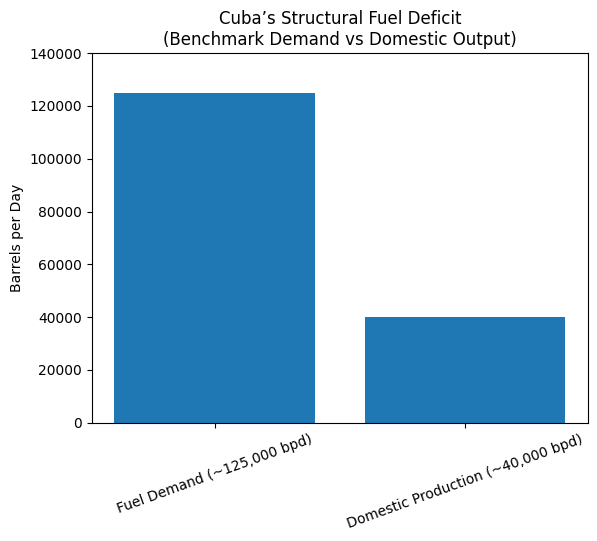
The scale of Cuba’s vulnerability becomes clearer when benchmark demand is placed alongside domestic production. Open-source data cited by Reuters places Cuba’s annual fuel demand near 125,000 barrels per day, while domestic extraction — largely heavy crude burned in thermoelectric plants — hovers around 40,000 barrels per day. Even before accounting for refining constraints, this leaves a structural import requirement of roughly 85,000 barrels per day. In other words, Cuba’s energy system is not marginally import-dependent — it is fundamentally so.
Domestic production is limited. Cuba extracts roughly 25,000–30,000 bpd of heavy, high-sulfur crude oil from onshore fields along its northern coast. This crude is low quality and is used primarily for fuel oil burned in thermoelectric power plants. It is not well suited for producing large volumes of gasoline or diesel without significant upgrading.
Refining capacity exists but is underutilized. Cuba’s refineries — principally Cienfuegos and smaller facilities in Havana and Santiago — have a combined nominal capacity of roughly 100,000–120,000 bpd, but they rarely operate anywhere near that level due to insufficient crude supply, maintenance issues, and financing constraints. In practice, refining throughput is often far below capacity because Cuba lacks enough imported crude to run the system consistently.
As a result, Cuba must import the majority of its usable fuels. Historically, 60,000–70,000 bpd of crude or refined products were needed from abroad to meet national demand.
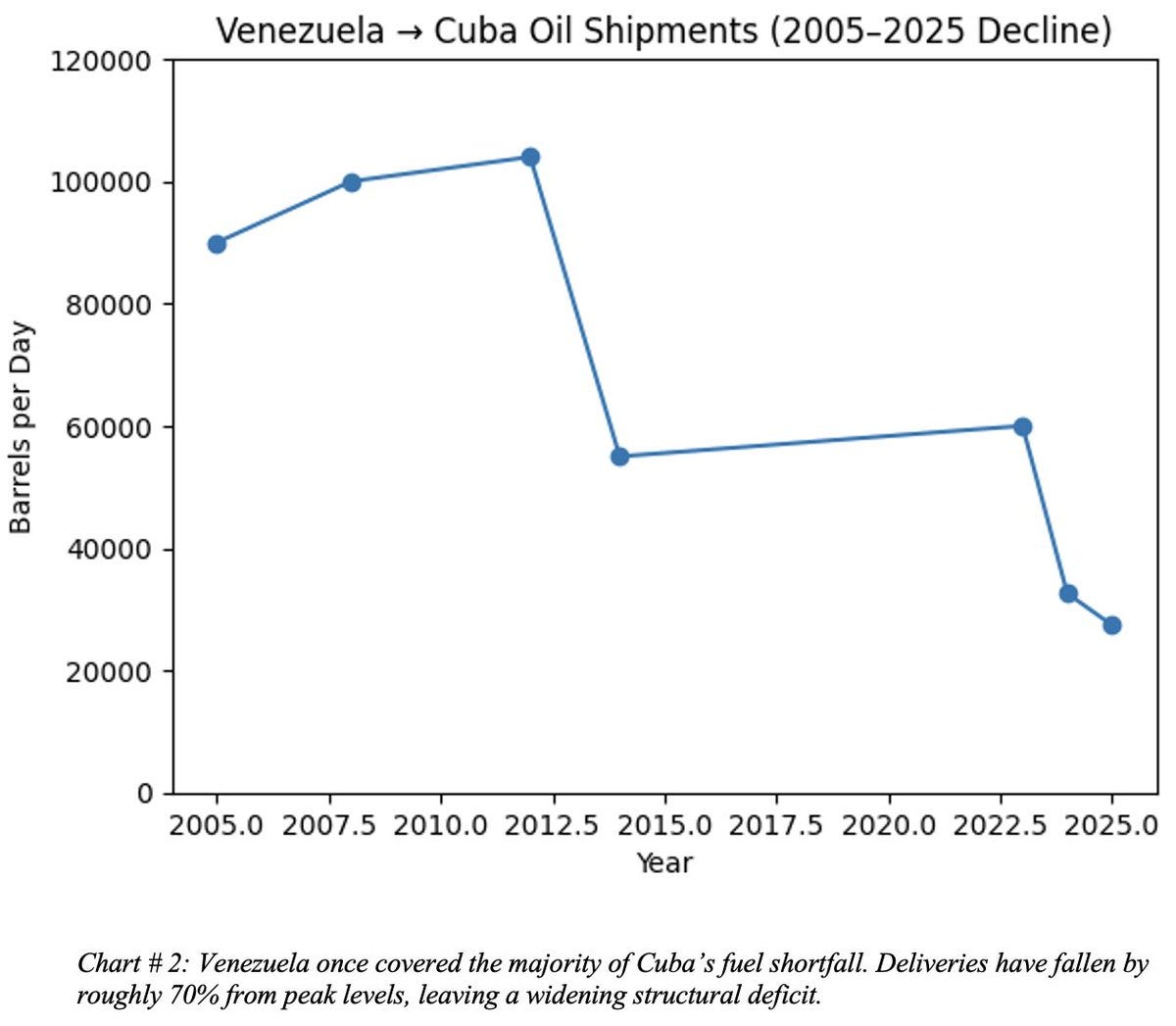
For years, Venezuela filled that gap. At its peak in the 2000s, shipments reached about 100,000 bpd, effectively covering Cuba’s shortfall. By 2025, however, Venezuelan deliveries had fallen to roughly 26,000–30,000 bpd. Mexico supplemented with an estimated 5,000–10,000 bpd, and occasional cargoes arrived from Russia, Algeria, and others.
Venezuela once bridged this structural gap. During the mid-2000s, shipments routinely approached or exceeded100,000 barrels per day, effectively underwriting Cuba’s electricity generation and transportation system. That era is now decisively over. By 2025, Venezuelan deliveries averaged just 27,400 barrels per day — a reduction of roughly 70% from peak levels. What was once a lifeline has become a trickle, leaving Havana exposed to market pricing and geopolitical leverage it cannot afford.
Even with these inflows, Cuba was operating at only 60–70% of the fuel required for economic stability. The consequences were immediate: rolling blackouts, stalled public transport, and repeated nationwide grid failures in 2025 tied directly to fuel shortages.
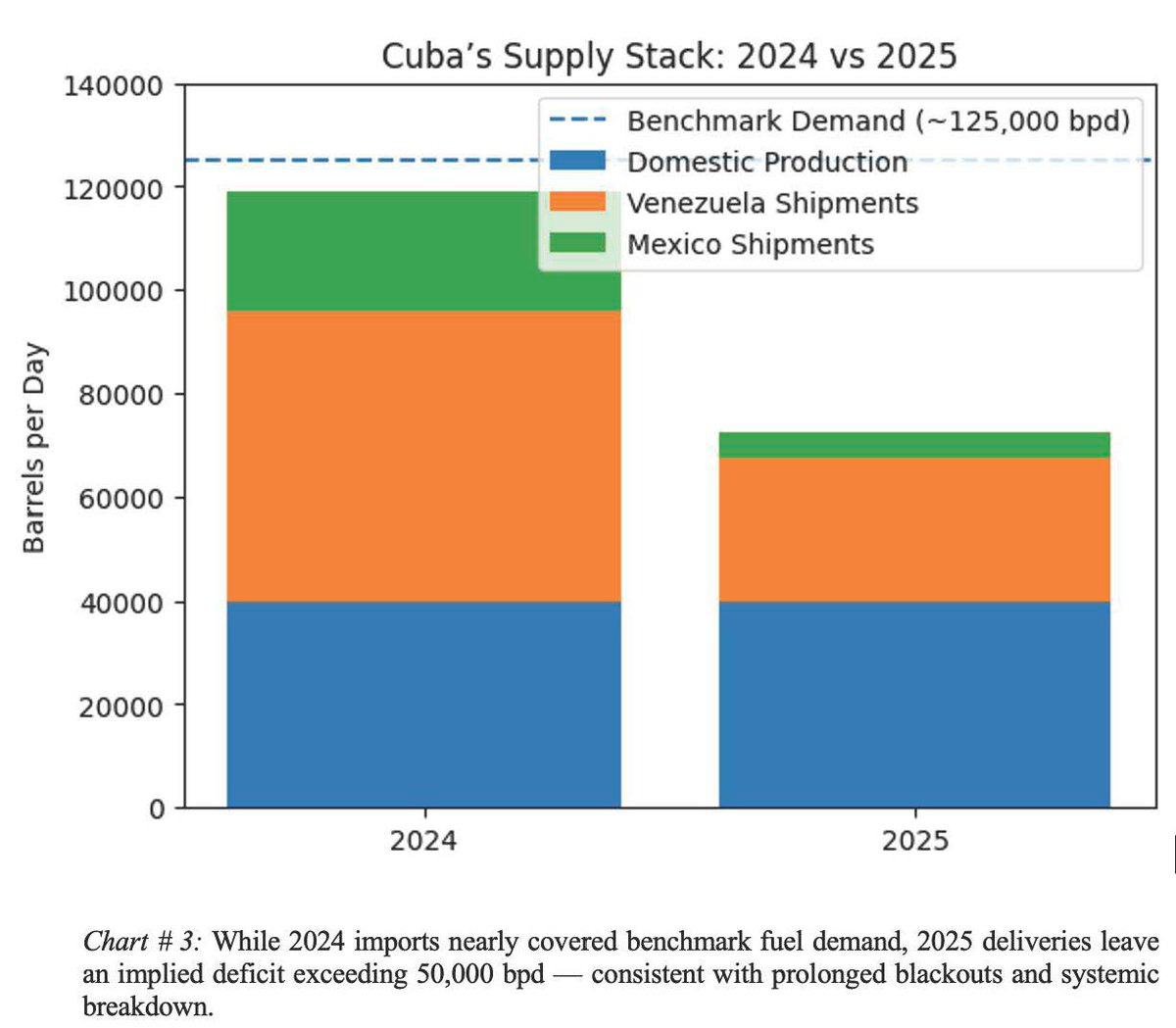
The arithmetic in 2025 marks a qualitative break from prior crises. In 2024, combined domestic production and external shipments nearly approached benchmark demand. In 2025, however, total supply from all origins fell to roughly 72,000 barrels per day against a system that historically required around 125,000. The implied shortfall — exceeding 50,000 barrels daily — is not cyclical volatility. It is a systemic supply gap large enough to explain rolling blackouts, transport paralysis, and industrial standstill without invoking speculation. The energy deficit alone now accounts for the breadth of economic contraction observed across the island.
In net terms, Cuba is not energy self-sufficient. It produces only about one-quarter to one-third of the crude it consumes, refines only what limited supply allows, and remains structurally dependent on foreign fuel to keep the lights on.
The total choke-off of oil deliveries since January has pushed Cuba into an acute emergency. By mid-January 2026, not a single Venezuelan oil tanker had arrived in a month, as the U.S. Navy and sanctions enforcement effectively sealed off Cuba’s oil lifeline. “Zero deliveries of oil from Venezuela” is a scenario even seasoned Cuba watchers find dire. “I just don’t see any light at the end of the tunnel… to survive the next few months,” said Jorge Piñon, a leading energy expert, in January, warning that the situation “is going to be catastrophic” if Cuba truly loses all Venezuelan fuel. The Cuban government has no easy alternatives: its reserve stocks are secret, possibly minimal, and allies are hesitant to defy U.S. threats. “No one is coming to Cuba’s aid, with the exception of maybe Mexico, in limited amount, and also Russia, in limited amount,” Piñon observed. Indeed, a small Mexican tanker did arrive in Havana in late January carrying ~85,000 barrels of fuel – a helpful but tiny drop in the bucket. Russia has discussed stepping up support, and in late February Moscow said it was considering emergency fuel shipments. However, both Mexico and Russia run the risk of U.S. retaliation under Trump’s January 29 executive order, which explicitly authorizes tariffs or sanctions on countries that provide oil to Cuba. This U.S. posture has a chilling effect: “There is a lot of fear… among shipping companies and countries that can supply us with fuel,” Cuban President Miguel Díaz-Canel admitted, noting that “almost no fuel” had reached Cuba in the new year. Washington’s use of modern surveillance and enforcement – “every tanker is visible, every course change is tracked” – means Cuba faces an unprecedented “siege” on energy that is far more effective than Cold War-era embargo efforts.
The hard currency crunch is just as severe. Cuba needs foreign currency to import not only fuel, but also food, medicine, spare parts – in fact, most essentials. Even before this crisis, Cuba’s import capacity had shriveled due to a lack of dollars. The country’s own peso is practically worthless on international markets (it plunged to a record low in informal trading), so Cuba relies on earnings from exports, tourism, and overseas aid to buy necessities. Under Trump’s first term sanctions (2017–2020), Cuba lost many of those revenue streams: American tourism and cruise travel ended, limits were placed on Cuban-American remittances, and foreign investors were scared off. By 2023–2024, Cuba’s economy was already on life support – suffering a 16% contraction since 2019 – and the government was desperately cutting imports to conserve cash. Now, with the tap from Venezuela abruptly turned off, Cuba not only loses the oil itself but also the financial subsidies that came with it. Caracas for years accepted payment in kind (Cuban doctors, teachers, and security advisers) rather than cash, effectively bartering oil for services. That arrangement meant Cuba didn’t have to spend hard currency on a large portion of its fuel. With Venezuela’s new U.S.-backed authorities halting oil exports to Cuba, Havana must somehow buy fuel on the open market – an impossible task under U.S. blockade without hard cash or credit. President Trump underscored this, saying “Cuba now has no income” since “all of their income” was coming from Venezuela. This is only slight exaggeration; Venezuela and prior socialist allies propped up Cuba for decades with cheap resources. During the Soviet era, Moscow’s aid (estimated at $5 billion annually in subsidies) kept Cuba afloat; when that ended in 1991, Cuba’s GDP collapsed and the 1990s “Special Period” brought extreme austerity and hunger. During the Chávez era in Venezuela, generous oil-for-services deals rescued Cuba from the worst of the 1990s hardship by the early 2000s. Now, for the first time since 1959, Cuba finds itself with no major patron at all – and a U.S. administration determined to prevent any rescue. As Rubio put it, Cuba has “no subsidies” left from abroad and must finally stand (or fall) on its own economic feet. The regime’s own economists have long warned that Cuba’s state-run, closed economy is fundamentally broken – unable to produce enough or earn enough to sustain 11 million people without external aid. That grim truth is now being laid bare.
On the ground, the effects of the oil and currency cutoff are dramatic. Rolling blackouts last year have turned into prolonged power outages in many provinces, forcing Cubans to cook with wood or charcoal and hospitals to ration generator fuel. “The lights are going out in Cuba – and people are organizing their lives around the outage schedule, “one report noted, describing families timing meals to the few hours when electricity returns. In rural towns, horse-drawn carts and bicycles have become vital as gasoline and diesel dry up. Even in Havana, which authorities try to spare from the worst cuts, residents line up for scarce public transport and endure water supply interruptions (as pumps fail without power). “It’s very stressful because we don’t know what decision the Cuban government will make or what actions the U.S. will take,” one Havana pensioner told Reuters, voicing the anxiety of a populace caught in uncertainty. At markets, food is growing scarcer and more expensive by the day. Vendors report that farms have produce available, but fuel shortages mean it cannot be transported to the cities. “Now there is no diesel for the trucks… They are using what they had stored up,” a vegetable seller explained, worrying that even those reserves were nearly gone. Without fuel, distribution networks are breaking down – a throwback to the 1990s when Cuban cities saw famine-like conditions when Soviet oil disappeared. Prices for staples have skyrocketed amid inflation and scarcity, at a time when Cuba’s currency is in free fall (the informal USD exchange rate has blown past 200 pesos per dollar, draining ordinary Cubans’ purchasing power). The United Nations has warned of a looming humanitarian catastrophe if fuel does not reach Cuba soon. UN Secretary-General António Guterres in February expressed “extreme concern about the humanitarian situation in Cuba,”joining several governments and NGOs in urging that life-saving supplies be allowed through.
Cuban officials call the U.S. actions a deliberate attempt to “starve the island of energy” and collapse its society. They have a point: the timing and intensity of the blockade, coming after years of attrition, suggest a final squeeze. Trump administration figures themselves describe the strategy bluntly. “The leverage we have is we control the flow of ... Venezuela’s oil. We control the flow of funds from oil,” U.S. Energy Secretary Chris Wright said in late January, explicitly linking Venezuela’s fate to Cuba’s. “The leverage over Venezuela is the lever on Cuba,” he explained. In Washington’s view, cutting off Cuba’s fuel is the quickest way to “force a breaking point” – essentially, to make daily life so unlivable that the Cuban people or elements of the regime revolt. As one Cuban academic, Carlos Alzugaray, noted, “cutting off the oil deliveries is going to put a huge squeeze on the humanitarian situation,” yet he doubted the regime would simply “cry uncle” in response. Cuba endured the Special Period once and did not surrender politically; regime hardliners may believe they can hunker down again. Indeed, Cuban authorities have imposed draconian energy-saving measures – shutting down factories, reducing working hours, decentralizing services to local levels so people can walk or bike instead of commuting. They have experience allocating scarcity: fuel for critical needs like hospitals and food transport is prioritized (though even hospitals are now in crisis, postponing surgeries due to generator fuel limits). “We have been here before and survived,” is a refrain heard in Havana, referencing how Cuba got through the 1990s with ingenuity and solidarity. People share rides, pool resources, and adapt – what one writer called “resilience under siege: a daily practice of collective discipline.” Still, there is an unmistakable sense that this time could be different. In the 1990s, Cuba had a lifeline emerge (Venezuela) and a less hostile geopolitical environment by the decade’s end (even the U.S. under Clinton and Obama eventually relaxed some pressure). Today, however, no savior is on the horizon – and the U.S. government is in the hands of officials overtly bent on Havana’s capitulation. As analyst Michael Bustamante noted, one can be skeptical that Havana will suddenly collapse purely from pain – “Cuba has been here before” – but “even [he] could be proven wrong” given the unprecedented convergence of pressures now. The coming months will test whether Cuba’s communist system can survive truly crippling isolation, or whether the combination of internal economic failure and external siege finally brings an end to an era.
How Long Can Havana Hold Out?
A key question lurking behind all analyses is how much longer can Cuba hold on under these conditions. Estimates vary, but many observers doubt the government can sustain this freefall through the end of 2026 (when the next U.S. presidential primaries and election season occur). Some experts warn of a breaking point within months, not years. Absent substantial new fuel inflows, the current supply trajectory suggests that system stress will intensify sharply through March and April, raising the probability of deeper economic contraction and social instability. As noted, energy expert Jorge Piñon sees no way for Cuba to survive “the next few months” without Venezuelan oil, barring a dramatic change. The UN’s humanitarian alarm, raised in February, implies that within a half-year or less, Cuba’s shortages could escalate to famine or health disasters. Cuba’s own actions – such as requesting emergency aid from allies like Mexico, Canada, and Russia – indicate the leadership knows the clock is ticking. Canada, for instance, just pledged a modest food aid package (~US$6.7 million) in late February, and Mexico sent several ships with food and medicine. These will alleviate some suffering but are nowhere near enough to stabilize the economy. Havana has also quietly unified its currency exchange rate and devalued the peso in an attempt to attract more hard currency into official channels. The black-market peso rate hitting 500:1 against the dollar (from 24:1 just a couple years ago) shows a desperate scramble for dollars inside Cuba. Such economic signals often precede political breaking points.
On the other hand, some Cuba watchers believe the regime might limp along longer than Washington hopes. The Cuban government still maintains a formidable internal security apparatus and has shown willingness to use repression to quell unrest. After unprecedented street protests in July 2021, the regime arrested hundreds and reasserted control, leaving the opposition decapitated or exiled. Any spontaneous uprising now would face the same crackdowns. “People who aspire to be opposition leaders are either in Miami or in jail,” points out William LeoGrande, an American University professor, underscoring that Cuba’s dissidents on the island remain disorganized and under watch. This suggests that even if misery increases, a popular revolt is not guaranteed – fear and state control are potent deterrents. Additionally, Cuban leaders have a track record of ideological stubbornness; as Juan Gonzalez (a former U.S. official) noted, “I don’t think the regime is going to cry uncle” simply because the economy is worse. They endured the Special Period without capitulating to U.S. demands. Cuba could resort to even harsher rationing, tighter energy blackouts (for instance, sacrificing most rural areas to keep Havana lit a few hours a day), and appeals to nationalistic defiance to rally the populace. Díaz-Canel struck that tone in January, declaring “Cuba is prepared to defend the homeland until the last drop of blood” if it comes to that. Such rhetoric signals the regime’s intent to resist rather than surrender, at least publicly.
However, it’s widely acknowledged that time is not on Cuba’s side. Even if mass protests do not erupt, the economic entropy could lead to quiet collapse – factories grinding to a halt, farms unable to harvest or transport goods, communities isolated by lack of fuel, and a surge in outward migration as people lose hope. In the last year alone, tens of thousands of Cubans have fled by raft or through third countries, and during the pandemic years an estimated 2 million Cubans left, over 10% of the population. This brain drain and labor loss further weaken the country. If trends continue, by late 2026 Cuba could be a shell of an economy, surviving on subsistence and emergency aid, with the government’s legitimacy eroded even if it clings to power. Washington’s apparent strategy is to accelerate this implosion to force either surrender or internal power change before the U.S. election cycle. Trump and Rubio likely also calculate that demonstrating a “win” in Cuba could bolster their own political fortunes going into 2028. Rubio in particular, as a Cuban American, has a personal stake in not letting the moment slip (more on that in The Rubio Factor below).
In sum, absent a significant change – such as the U.S. easing sanctions or a third-party stepping in with large-scale support – Cuba’s viability in its current state is measured in months, not years. It is telling that even the Trump administration has quietly started to hedge against the worst humanitarian outcomes: in early February they announced a small $6 million humanitarian aid package “to support the Cuban people” (channeled through NGOs and churches, not the government). And just in late February, the U.S. Treasury issued a special license to allow some Venezuelan oil to be resold to Cuba under strict conditions (the proceeds must aid the Cuban populace and not fill regime coffers). These moves suggest a recognition that a total cutoff could have chaotic consequences – possibly a “humanitarian collapse” or regional refugee crisis. In effect, even as Trump and Rubio tighten the noose, they are calibrating the pressure to avoid complete anarchy. Will Cuba make it to the U.S. primaries of late 2026 intact? The consensus among many analysts is “probably not, at least not under the same leadership.” Either Havana will capitulate to negotiations before then, or it will break in a way that forces outside intervention (friendly or otherwise). The coming 6–12 months are thus pivotal. Cuba is teetering on what one historian called “Cuba’s Berlin Wall moment,” suggesting that the collapse of the communist regime could come suddenly and soon. Yet, as history shows, authoritarian regimes can sometimes endure incredible hardship until virtually the moment they don’t. For now, Cuba endures – but the zero hour is drawing ever nearer.
Scenarios for Cuba’s Future: Three Paths
Given this fraught situation, it’s prudent to explore several scenarios for what might come next in Cuba. These range from the dire and violent to the orderly and hopeful. Below we outline three broad possibilities:
1. Worst-Case Scenario: Confrontation and Collapse. In this scenario, the pressure continues to mount unabated and the Cuban regime digs in rather than giving in. As fuel starvation and economic meltdown intensify, Cuba could slip into chaos and internal conflict. Widespread blackouts and shortages might spark spontaneous protests in multiple cities, potentially overwhelming the security forces. The government, led by President Miguel Díaz-Canel and hardline Communist Party figures, could respond with a harsh crackdown – mass arrests, deploying the military to the streets, even incidents of violence against protestors. Civil unrest might metastasize into something like an internal uprising. Sensing the regime’s weakness, the U.S. might ratchet up intervention overtly or covertly. A worst-case outcome would be a U.S. military intervention in some form. This could range from a limited action (e.g. a naval blockade or no-fly zone to force capitulation, or a strike to take out key regime targets) to, in the extreme, an invasion or peacekeeping operation if civil war erupts. President Trump’s talk of a “friendly takeover” hints it would be framed not as conquest but as a rescue or stabilization mission. Nonetheless, any U.S. armed action on Cuban soil would be extraordinarily risky – evoking historical ghosts (like the Bay of Pigs in 1961) and likely prompting international condemnation. Cuban hardliners could also choose a “Samson option” in desperation – for instance, rallying remaining loyalists to fight a guerilla war, or seeking to create a crisis (like a migrant exodus or even clashes at Guantánamo Bay) to deter a U.S. attack. In the absolute worst case, a direct U.S.-Cuba military conflict could occur, with loss of life and a messy aftermath. What could the U.S. do? Short of full invasion, Washington’s playbook might include supporting an internal coup (e.g. encouraging elements of Cuba’s military to depose the Communist Party in exchange for aid) or imposing a naval quarantine to physically bar any remaining fuel shipments (essentially an open-ended blockade). What could the Cubans do? The regime, in this scenario, might appeal for help from allies like Russia – even to the point of requesting a Russian naval presence as a shield, although Moscow might not oblige due to geopolitical calculations. Cuba could also unleash waves of migrants toward Florida (as seen in the 1994 Raft Exodus and the Mariel boatlift in 1980) as a form of pressure on the U.S. A full collapse could also lead to humanitarian disaster: mass hunger and medical crises, prompting a multinational relief effort in the chaotic aftermath. In summary, the worst-case path is violent regime collapse and possibly U.S. intervention – a scenario with unpredictable, likely tragic consequences for the Cuban people. U.S. officials, while saber-rattling, do not openly want an uncontrolled meltdown – Rubio himself has said he prefers change to come from within rather than U.S. Marines, but the fervor to “finally be free of the Castros” could override caution.
2. Grey Scenario: Negotiated Exit or Internal Reform (a Soft Landing). Between collapse and smooth transition lies a murky middle ground where the end of communist rule might come via internal fractures and negotiated change. This scenario might begin with secret talks – which, if reports are true, are already happening between U.S. intermediaries (possibly led by Rubio or his envoys) and certain Cuban insiders like Raúl Castro’s grandson. The Cuban leadership could become so alarmed by the prospect of collapse (or impressed by the fate of Maduro in U.S. custody) that a faction of the regime decides to seek an off-ramp. Perhaps figures in the military or younger Communist Party technocrats convince Díaz-Canel and the old guard that the only way to save the nation (and their skins) is to strike a deal with the Americans. Such a deal might involve the Castro/Díaz-Canel regime stepping down or sharing power with a transitional council, guarantees of safety or amnesty for current officials, and a roadmap to free elections and economic opening. In exchange, the U.S. would lift the oil blockade and provide massive economic aid to stabilize the country. President Trump’s comments about the Cuban government “talking with us” and a takeover being “friendly” hint at this kind of outcome. One could envision a scenario analogous to what reportedly happened in Venezuela: high-ranking officials flipping sides or agreeing to cooperate in return for retaining some role or avoiding prosecution. In Venezuela’s case, the U.S. secured a “promise of cooperation” from Maduro’s deputy to maintain continuity after Maduro was removed. A Cuban parallel might be getting someone like a Castro family member or a reformist general to assume interim leadership under U.S. auspices. This path would be messy but with less bloodshed than open conflict. There could be infighting in Havana – hardliners vs moderates – with some last-minute coup attempts or purges. But ultimately, if successful, Cuba could see a relatively peaceful handover: the communist party dissolves or transforms, and a transition government (possibly including exile community representatives or international observers) prepares the country for a new constitution. The U.S. role in this grey scenario is pivotal but more behind-the-scenes – nudging things along, offering carrots (sanctions relief, aid) and sticks (continued isolation for holdouts). Rubio’s recent remarks actually suggest this track: he spoke of economic openings and noted that the talk of “friendly takeover” coupled with Rubio’s comments “points to economic rather than political openings, all under the aegis of the U.S.” That analysis by one exile leader (Pedro Freyre) implies the U.S. might be pushing for a transition where Cuba’s system changes economically first (market reforms, perhaps even allowing private enterprise and foreign investment at scale) without an immediate purge of all communist officials. In other words, a negotiated reform process that is palatable to some regime members. What could the Cubans do in this scenario? Potentially, they could follow a path similar to late-1980s Eastern Europe or early-1990s Soviet Union – initiate top-down reforms to release pressure. For instance, Havana might announce the legalization of opposition parties, or invite international mediators (maybe from the UN or friendly nations like Canada) to facilitate dialogue with dissidents. They might also embrace a Chinese or Vietnamese-style reform (market liberalization while retaining political control) as a last resort to kickstart the economy. Rubio and Trump, however, seem intent that political change accompanies economic change, so it’s unclear if a half-measure would satisfy Washington. The grey scenario, in sum, is a controlled transition: it averts the worst humanitarian outcomes and violence, but it likely means Cuba’s sovereignty is heavily compromised in the process (with U.S. “supervision” of the transition, much as the U.S. now exerts huge influence in post-Maduro Venezuela). The Cuban people would get freedom and relief, but it might feel like change on Washington’s terms. Still, for many Cubans (on the island and in exile), this would be vastly preferable to chaos. It’s essentially the scenario that Trump alluded to by saying Cuban leaders “want our help” – implying a behind-scenes understanding could be reached.
3. Best-Case Scenario: Peaceful “Smooth” Transition to Democracy. In an ideal world, the crisis could end with Cuba undergoing a peaceful, internally driven transition – essentially the regime accepting its time is over and opening the door to the Cuban people to determine their future. This would look like the Cuban leadership voluntarily stepping down or significantly reforming without the need for force or extreme pressure. For example, Díaz-Canel and the Communist Party might call for an extraordinary congress and announce the end of one-party rule, inviting opposition figures (perhaps even from the diaspora) to form a provisional government. They could schedule free elections within a short period and request international monitoring. The transition could be accompanied by immediate economic liberalization – freeing prices, unleashing the private sector, inviting Cuban exiles to invest, and seeking an emergency IMF or international aid package (something Cuba has long avoided under communist ideology). The U.S., in this best-case scenario, would respond by lifting sanctions, ending the blockade, and marshaling an international “Marshall Plan”-style aid effort to rebuild Cuba’s economy and infrastructure. Rubio and Trump would claim victory but also likely support massive assistance to ensure Cuba’s stability in transition (after all, a failed state 90 miles from Florida is in no one’s interest). This smooth transition would mirror what happened in some Eastern European countries in 1989 – say, the velvet revolution of Czechoslovakia or the relatively peaceful opening of Hungary. There is historical precedent even in the Caribbean: the end of apartheid in South Africa (though not the Caribbean, it was a negotiated peaceful revolution). One might also compare it to the Cuban handover from Fidel to Raúl Castro in 2008 – that was a smooth leadership change, albeit not a systemic one. Here we’d be talking about dismantling the system smoothly. What would it require? Likely a consensus among Cuban elites that the jig is up and a patriotism that overrides their fear of losing power. Perhaps they could be persuaded that by yielding now, they can save some aspects of the revolution’s social gains and avoid bloodshed. The role of Cuba’s military (FAR) would be crucial – if the generals decide not to repress the population and instead back a transitional process, it could happen relatively peacefully. Notably, Cuba’s military has significant control over the economy (through enterprises run by GAESA, the military conglomerate). In a negotiated peaceful transition, arrangements would have to be made to perhaps respect some of their interests or at least not dismantle everything overnight, so that they consent rather than rebel. Geopolitically, a smooth transition would be applauded worldwide – even Russia or China might begrudgingly accept it if it’s clearly the will of Cubans and is not overtly a U.S. takeover. The Cuban people, in this scenario, would likely pour into the streets in celebration rather than protest – akin to the joy seen when other dictatorships ended. This scenario is admittedly optimistic. Given the current stance of Cuban officials (“Cuba is sovereign and no one dictates to it,” Díaz-Canel retorted to Trump), it might take a near-death experience economically to motivate such a voluntary change. But it’s not impossible – stranger things have happened. If we recall, in 1991 the Soviet Union’s Communist Party bowed out relatively quietly and dissolved itself, something unimaginable just a few years prior. Should Cuba’s leaders choose this path, history might judge it kindly as sparing Cuba a lot of pain. From the U.S. perspective, this best-case scenario achieves all their goals (regime change, democratization) without a shot firedand allows a positive legacy for Rubio (who could claim he helped free his ancestral homeland) and Trump. Rubio’s recent comments that Cuba “will need to give its people political and economic freedom for the U.S. to ease pressure” basically lay out this scenario: the regime reforms fundamentally, and the U.S. in turn helps Cuba prosper. In an ideal outcome, one could see Rubio standing in Havana someday, helping inaugurate a freely elected Cuban president – a full-circle moment for the Cuban-American community. It’s a vision many exiles have dreamed of, and for the first time in decades, they sense it could be within reach.
Each of these scenarios carries significant uncertainties. The worst-case could spiral out of control regionally (mass migration, instability), the grey scenario might lead to a semi-sovereign Cuba under U.S. tutelage (raising questions of legitimacy), and even the best-case would face the huge task of rebuilding Cuba’s economy and institutions after decades of communist rule. The path that unfolds will depend on decisions made in the next few weeks and months by players in Washington and Havana – and perhaps by fate and external events.
Geopolitical Backdrop: Allies, Adversaries, and Wild Cards
Cuba’s predicament does not exist in a vacuum – it has international backers and critics whose actions could influence the outcome. However, unlike during the Cold War or even the early 2000s, Havana today finds itself largely isolated. Over the last year, Cuba has been losing allies and support, tilting the geopolitical scales in Washington’s favor. Here’s a look at key players:
Venezuela: Once Cuba’s lifeline, Venezuela is now essentially “out of the game” as far as helping Cuba. With Nicolás Maduro captured and a U.S.-aligned interim government in Caracas, Venezuela’s new authorities have cut off oil exports to Cuba and even rerouted oil revenues into U.S.-controlled accounts. This was a devastating blow to Cuba. Venezuela under Hugo Chávez had been to Cuba what the USSR was in an earlier era – a patron providing billions in subsidized energy and cash. Now Venezuela has effectively become a U.S. client (Trump even said “the U.S. is in charge of Venezuela” after Maduro’s ouster). Not only is Cuba deprived of Venezuelan support, but Venezuela’s new regime might even cooperate with the U.S. against Cuba. For example, they could share intelligence on Cuban activities or influence left in Venezuela. This reversal of fortune – Havana’s close ally turning into a partner of its enemy – is one of the starkest geopolitical shifts underpinning Cuba’s crisis.
Russia: Moscow has historically had close ties with Havana and still sees Cuba as a symbolic ally. In the current crisis, Russia has voiced solidarity with Cuba, but so far its support has been mostly rhetorical and limited in scope. Russia’s deputy PM announced discussions on providing fuel to Cuba, and the foreign ministry promised “material supplies.” President Vladimir Putin condemned Trump’s oil blockade order as “unacceptable” in a recent meeting with Cuba’s foreign minister. This indicates Russia’s displeasure at the U.S. squeezing Cuba. However, Russia’s capacity to bail out Cuba is constrained. Russia itself is navigating sanctions and an uncertain economy (especially if the prompt in the question implies global tensions, e.g. something happening with Iran as well). Still, Russia could try to ship some oil or goods quietly. It has done so in the past on a small scale – e.g. sending emergency wheat shipments or a few tankers of diesel. But directly breaking a U.S. “embargo” is risky for Russia if it fears secondary U.S. sanctions on its companies. What Russia might do is more symbolic support: for instance, dispatching a few aging oil tankers or arranging a swap via third countries. In a worst-case showdown scenario, Russia might even use Cuba as a bargaining chip (echoes of the Cuban Missile Crisis) – but it’s unlikely to escalate to that point, as Cuba is not as strategically central to Moscow today as it was in 1962. Also, Russia is currently heavily involved in other theaters (possibly Ukraine, given ongoing conflicts up to 2026). For now, Cuba can count on Moscow for diplomatic cover – Russia will block any hostile action against Cuba in the UN Security Council, for instance, and might quietly advise Havana’s leadership. But materially, Russia’s help remains limited. Cuban officials have reportedly hoped for more – they’ve asked Russia for increased oil and maybe credit lines – but thus far, “Russia and China have so far avoided offering more than symbolic support.” If Cuba’s regime falls, Russia loses an old foothold in the Americas; but Putin may calculate it’s not worth a direct confrontation with the U.S. at this juncture to save it.
China: Beijing has significant financial ties to Cuba (Cuba owes China billions in loans) and has provided development assistance and investments over the years. However, China tends to be pragmatic. As of early 2026, China has been noticeably quiet on the Cuba issue. Reports say China, while sympathetic, has shown “little interest in helping” Cuba with its immediate fuel crisis. China’s priority is often its own economic interests and avoiding U.S. trade clashes. Coming to Cuba’s rescue by shipping oil would risk entangling Beijing in a fight with Washington that it may deem unnecessary, especially if China is already in trade negotiations or dealing with its own issues. That said, China wouldn’t mind if Cuba survives and remains a friendly communist state, but it appears unwilling to expend much political capital or money to make that happen right now. They might quietly provide some humanitarian aid or small-scale shipments (for example, China might send some solar panels or power generators to alleviate blackouts, or donate rice). But fundamentally, China is not acting as a “counterweight” to U.S. pressure on Cuba the way the Soviets once did. Chinese officials have for years encouraged Cuba to reform economically (much like Vietnam did), and they might view the current crisis as the unfortunate but inevitable result of Cuba ignoring that advice. If Cuba transitions, China might attempt to maintain good relations with a new government to recoup its loans and keep a foothold. If the regime somehow rides it out, China could step up later. But for the crucial coming months, Beijing is a distant actor, offering moral support but few lifelines.
Mexico: Mexico has emerged as one of Cuba’s few active supporters in this crisis. Under President Andrés Manuel López Obrador (AMLO) and now his successor Claudia Sheinbaum (as implied by late 2024 elections), Mexico’s government has maintained friendly ties with Havana. Mexico has been supplying some oil – around 17,000–20,000 barrels per day of crude and fuel in 2025, by some accounts – though at lower levels than Venezuela did. Even as the U.S. threatened tariffs, AMLO/Sheinbaum openly criticized the U.S. blockade as unjust. For instance, Mexican opposition figures have decried the secret oil aid, asking “when were the people of Mexico asked if we wanted to donate our oil to a dictatorship?”, indicating the controversy. As pressure increased, Mexico in February sent shipments of food and humanitarian goods, which is a way to help Cuba without directly flouting the oil embargo. However, Mexico’s role is constrained by its own dependence on the U.S. (economically and in security cooperation). Trump’s explicit targeting of any country aiding Cuba put Mexico in a tough spot. It’s notable that by late February, Mexico’s contributions were “a fraction of Venezuela’s former exports” and “far from enough to keep the lights on.” U.S. pressure is likely to increase on Mexico to not undermine the campaign against Cuba. We may see Mexico calibrate its aid – e.g., continue with humanitarian shipments (food, medicine) which the U.S. might tolerate, but quietly taper off oil shipments to avoid a clash with Washington. Mexico’s stance is also influenced by regional politics: AMLO’s government (and Sheinbaum if she follows suit) has an ideological affinity to Cuba’s sovereignty and has bristled at U.S. interventionism. Yet, Mexico will also want to avoid a humanitarian collapse next door that sends refugees streaming north. So Mexico could potentially play a behind-the-scenes mediator role – perhaps urging Havana to negotiate to avoid disaster. In summary, Mexico is a friend to Cuba but with limits. It provides some relief and diplomatic cover (Mexico has called for the U.S. to lift sanctions, for example), but it cannot fully offset the loss of Venezuela, and it likely won’t directly defy a U.S. naval blockade if it comes to that.
Other Latin America and Caribbean: The Western Hemisphere is divided. Caribbean nations (CARICOM) have been wary of U.S. aggression in the region. Some rely on Cuban doctors or have historically friendly relations with Cuba. They’ve called for dialogue and expressed concern about instability. However, many are also economically tied to the U.S. and fearful of crossing Washington. The recent CARICOM summit in St. Kitts (attended by Rubio) shows the U.S. actively engaging those neighbors, likely to reassure them and possibly get buy-in for a post-Cuba plan. If a refugee crisis occurs, nearby islands and Florida will be the first impacted. We might see some Caribbean states quietly support Cuba (e.g., through votes at the UN) but they lack capacity to help materially. Latin American governments are split along ideological lines. According to analysis, by 2026 a number of countries – Argentina, El Salvador, Peru, Ecuador, Honduras, Chile – are led by presidents who align with Trump’s hard line, whereas the “firm opposition” to U.S. moves comes from leaders of Mexico, Brazil, and Colombia. Brazil’s stance is crucial: under President Lula (if still in power) or a successor, Brazil might oppose U.S. intervention and call for respecting Cuba’s sovereignty, but Brazil is unlikely to send oil or break sanctions given its own interests. Colombia under a leftist (if Petro was still president by then, though by 2026 possibly not) might sympathize with Cuba but has little direct impact. Argentina and others that Trump counts as supportive might diplomatically isolate Cuba further. Nicaragua and Bolivia remain ideological allies of Cuba, but they are small and under pressure themselves. Nicaragua (Ortega regime) might offer asylum to Cuban leaders if they flee, or send small aid, but that’s marginal. In essence, Cuba’s traditional Latin American allies are dwindling and none can compensate for the loss of Venezuela. The regional climate has shifted toward the right by 2026 in this scenario, emboldening the U.S. approach. Cuban officials privately lament that “Cuba, clearly, has been losing allies” in the hemisphere. This means Havana can’t count on an anti-imperialist bloc to rescue it as it might have in the 2000s.
Iran and the Middle East angle: A surprising external factor is the event of February 28, 2026 – an Israeli and U.S. attack that killed Iran’s Supreme Leader and key officials. This development, though seemingly unrelated geographically, could have a significant psychological and strategic impact on Cuba. First, it signals that the Trump administration (in concert with Israel) is willing to take extremely bold and aggressive actions far from home. If Ayatollah Ali Khamenei and his inner circle in Tehran were indeed killed by U.S.-Israeli strikes, that is a seismic event. For Cuba’s leaders, who historically have had friendly ties with Iran as fellow U.S. adversaries, this is a stark reminder of U.S. reach and resolve. Cuban leadership behavior might be affected in two ways. On one hand, they could become more fearful and cautious. Seeing Iran’s regime literally decapitated overnight might convince Havana that Washington is “on a warpath” and no regime enemy is safe. They might infer that if Trump can eliminate Iran’s leader (a far more geopolitically significant foe than Cuba) and weather the fallout, he might not shy away from removing Cuba’s leaders too. This could push Cuban officials to more seriously consider negotiating or fleeing rather than fighting to the end. Essentially, Iran’s example might intimidate Cuba into compliance, which could grease the wheels for the Grey or Smooth scenarios (negotiated transition) as opposed to the Worst-case fight. On the other hand, the Iran attack could also harden Havana’s bunker mentality: they might double down on “defending sovereignty” rhetoric, seeing the writing on the wall that the U.S. is systematically destroying anti-U.S. governments (first Venezuela, then Iran, maybe them next). In that frame, Cuban hardliners might think their only chance is to dig in and hope for international pushback against the U.S. Cuba could, for example, rally what’s left of the Non-Aligned Movement or appeal at the UN alongside nations like China/Russia that the U.S. is destabilizing the world. However, those diplomatic moves likely won’t stop Trump’s campaign. Another angle: with Iran’s regime severely hit, any clandestine support Iran provided to allies (including possibly Cuba) could vanish. Iran might have quietly aided Cuba with oil in the past (it has sent tankers to Venezuela, for instance). Now Iran will be in disarray, unable to help anyone else. Conversely, the U.S. being embroiled in strikes on Iran could distract Washington’s attention and resources somewhat – but given how policy has been articulated, the U.S. seems capable of pressuring Cuba simultaneously (and some of the heavy lifting in Iran is done by Israel). If the Middle East flares up (retaliations by Iran, etc.), Cuba’s leadership might think the U.S. military is busy and that could buy them time or reduce the chance of a direct invasion. However, economic pressure on Cuba can continue regardless. In summary, the death of Iran’s leader is a double-edged signal: it underlines U.S. assertiveness (which should deeply worry Havana), but it might also stretch the U.S. thin or cause global controversies that Cuba could try to exploit. Net effect likely increases Cuban regime anxiety. Indeed, reports of the Tehran strike were already circulating in late February, and Rubio himself, at the CARICOM summit, could leverage that news to quietly tell Caribbean allies: “Look what we (the U.S.) just did in Iran – we mean business.” From Israel’s perspective, Iran was an existential threat, and from Trump’s viewpoint, eliminating enemy regimes seems to be a legacy goal (North Korea could be another, who knows). Cuba’s leaders must realize they are on that list of adversary regimes in Washington’s sights, arguably next in line now that Venezuela and Iran have been dealt with. This could either scare them straight to the negotiating table or embolden a fatalist stance of fighting to the death.
International Organizations: The United Nations and others have limited influence but are not entirely irrelevant. The UN can highlight the humanitarian toll – as seen with the Secretary-General’s warning of “humanitarian collapse” in Cuba if oil isn’t allowed through. This can create moral pressure on the U.S. to calibrate its actions (which might be why the U.S. offered some humanitarian exemptions). Regional bodies like the OAS (Organization of American States) are historically anti-Castro but also value stability; however, Cuba isn’t an active OAS member. The OAS likely supports a democratic transition but would be wary of endorsing an invasion. The Vatican could possibly play a mediating role (Pope Francis had helped the U.S.-Cuba rapprochement in 2014); maybe the Church channels some aid or dialogue. But overall, international diplomacy currently favors the U.S. position more than Cuba’s, due to Cuba’s dwindling allies.
In short, geopolitically Cuba is almost alone, with only tepid lifelines from a handful of friends. This is a stark contrast to the 1960s or even 1980s. Rubio and Trump have skillfully (or fortuitously) timed their push when Cuba’s benefactors are either gone, preoccupied, or unwilling to confront the U.S. The phrase “no backers, or lifeline in sight” in the user’s question is apt – Cuba today doesn’t have a USSR or a Chávez ready to write checks and send oil in defiance of Washington. The closest, Venezuela, is gone; the richest, China, is sitting on the sidelines; the loudest, Russia, is bogged in other conflicts. That leaves Havana with prayer and stubbornness as its shields.
The Rubio Factor: A Cuban-American at the Helm of U.S. Policy
One cannot fully understand this moment without examining the influence of Marco Rubio, the U.S. Secretary of State – and notably, the first Cuban American to ever hold such high office. Rubio’s personal background and decades-long stance on Cuba are central to why the U.S. is “trigger-ready” to seize the opportunity to topple the Castro regime. Rubio often says he owes his very existence in America to Cuba’s tragedy. His parents emigrated from Cuba in 1956, just before Fidel Castro’s revolution, and he grew up in Miami’s Cuban exile community. This community is largely composed of the “Bay of Pigs generation” and their descendants – those who fled Castro’s communism, many of whom actively attempted to overthrow it (as with the failed Bay of Pigs invasion in 1961, which remains a trauma and rallying cry for exiles). Rubio was raised on stories of lost homeland and the dream of a free Cuba. In his memoir “An American Son,” he recounts how his family fervently kept the anti-Castro cause alive. It’s said that Rubio entered politics with Cuba on his mind – indeed, he has built much of his career as a hardliner on Cuba policy, opposing any normalization and pushing for tougher sanctions at every turn.
Now, as Secretary of State in a second Trump administration, Rubio is uniquely positioned to finally act on those beliefs. It’s hard to overstate how extraordinary it is for a Cuban exile’s son to direct U.S. foreign policy toward Cuba at such a critical juncture. As one observer noted, Cuban leaders “are grimly aware that… particularly Rubio, are now gunning for them.” Rubio has indeed been described as having “maximal confrontation” in his approach. He sees the collapse of Maduro’s regime in Venezuela as a once-in-a-lifetime chance: “He understands better than anybody else, that if Venezuela falls, Cuba falls.” This logic, reportedly voiced in Rubio’s circles, reflects a long-held exile view that Castro’s Cuba exported communism to Venezuela, and thus removing Venezuelan support will bring down communism in Cuba – a poetic justice of sorts. Rubio himself pointed out that “much of Maduro’s secret police were staffed by Cuban agents,” illustrating how intertwined the two regimes were. With Maduro gone, Rubio likely feels vindicated and determined to finish the job by liberating Cuba.
Rubio’s recent statements give insight into his mindset. He has openly railed against the Cuban government, calling its 60+ year rule a failure and an anachronism. He emphasized that Cuba’s regime has survived only by leeching off patrons: first the Soviet Union (whose collapse led to Cuba’s “special period”), then Venezuela (now also effectively gone). “The regime has become increasingly isolated since the fall of the Soviet Union,” Rubio noted, adding that Havana “invested heavily in Venezuela as one of its only socialist allies.” To Rubio, Havana’s dependency is its Achilles’ heel – and he has positioned U.S. policy to exploit that. It’s no coincidence that the U.S. oil blockade strategy aligns perfectly with Rubio’s narrative that Cuba lives on “handouts.” By cutting the flow, he intends to force Cuba to face the reckoning of its own economic dysfunction.
Rubio’s personal stake is also perhaps driving a more uncompromising stance than a typical diplomat might take. Some analysts suggest Rubio is less inclined to negotiate a soft landing for the regime because of his background. Unlike, say, career diplomats who might be content with reforms and gradual change, Rubio likely wants an unequivocal victory – the end of the Castro/Díaz-Canel regime, full stop. This is reflected in how he bristled at the notion of ruling out regime change, essentially saying nothing short of the regime’s removal is acceptable. Rubio’s critics say he is “obsessed with toppling the Castro regime,” driven by a mix of ideological conviction and the emotional legacy of the exile community. A Progressive International statement even charged that “Cuban blood stains Marco Rubio’s hands,” blaming his hardline approach for inciting violence like the exile speedboat raid. Certainly, Rubio shows no sympathy for the Cuban government’s perspective – he dismisses their complaints about the U.S. embargo as excuses and has openly cheered measures that hurt the regime (for example, applauding when Cuba’s tourism income plummeted or when its foreign currency dried up, as he sees those as hastening change).
Rubio also enjoys a unique trust from President Trump on this issue. Trump, a dealmaker, might in some circumstances be tempted to strike a bargain even with adversaries (as he once did with North Korea’s Kim). But on Cuba, he appears to have largely outsourced strategy to Rubio, the expert and true believer. Trump’s own comments – such as “Marco Rubio is dealing on it at a very high level” – indicate that Rubio is the point man. Trump even joked at one point that Rubio “would one day be president of Cuba,” to which Trump quipped “that sounds good to me.” While said in jest, it reveals Trump’s confidence in Rubio’s leadership on Cuba policy. This effectively means U.S. policy is being guided by someone with a deeply personal mission. The “Rubio factor” thus increases the likelihood that the U.S. will not settle for half-measures in this crisis. If a window opens to truly end communist rule, Rubio will press to go all the way. He is unlikely to support any compromise that leaves the old guard in partial power or that doesn’t fundamentally remake Cuba’s system. In Rubio’s eyes, this is the culmination of a multi-generational struggle – the exiles’ revenge and return, the fulfillment of the dream that Cuba could be free and perhaps even prosperous like the Cuban-American enclave of Miami. Rubio often points out how Cuban exiles in Miami thrived once free of communism – building a vibrant community – implying that if only the island were rid of the Castros, Cubans there could similarly flourish. Now he has a chance to test that thesis on the grand stage.
It is also worth noting Rubio’s political calculus: Being at the forefront of “liberating” Cuba would cement his hero status among Cuban-Americans and many Latinos in Florida. It could boost a future presidential run for himself (he ran unsuccessfully in 2016, but this achievement could revive prospects). Rubio no doubt recognizes this – as does Trump, who surely sees the electoral advantage in Florida of taking a hard line on Cuba. Florida’s votes can hinge on the Cuban exile community’s sentiments. In 2020 and 2024, tough talk on socialism helped Republicans. Delivering the fall of Havana’s communist regime before the 2028 election would be a historic trophy.
That said, the Rubio factor could also inject rigidity into U.S. policy. Some observers worry that Rubio’s personal zeal might blind Washington to nuance – for example, if a negotiated solution arises that leaves some communists in place temporarily, Rubio might reject it even if it avoids bloodshed. In the Guardian piece, an expert noted that Rubio’s orchestration of the takedown was “impressive,” but also questioned if Trump’s and Rubio’s “acquisitive” approach (friendly takeover, economic control) might “go down badly in Miami” if it appears too lenient. Indeed, hardcore exiles in Miami might oppose any deal that isn’t total surrender. Rubio has to balance being firm enough to satisfy that constituency with being pragmatic enough to actually achieve change. So far, his public posture has been absolute (no easing pressure until freedom comes).
In practical terms, Rubio’s background also means he understands the Cuban regime’s tactics intimately. He won’t be easily fooled by half-step reforms or sympathetic narratives from Havana. For instance, Cuban officials often blame the U.S. embargo for all ills; Rubio counters with detailed examples of internal failures (like the sugar industry collapse) to discredit that. He also is likely coordinating closely with Cuban exile networks that have intelligence on Cuba’s internal happenings. Having a Cuban-American in charge possibly means better human intelligence (since exiles have contacts on the island). Rubio’s office might be where plans from exile groups (some of whom in the past even plotted armed actions) intersect with official policy. It’s noteworthy that Rubio quickly denied U.S. involvement in the exile speedboat incident, but the fact that such an attack happened shows the blurred lines – an exile “militia” attempted an armed incursion, something reminiscent of the Bay of Pigs era. Rubio’s critics fear he tacitly encourages these actors with his incendiary rhetoric, even if he doesn’t directly coordinate with them.
Ultimately, Rubio’s ascendancy to the helm of U.S. diplomacy is a nightmare for Cuba’s regime and a dream come true for the exile community. The Cuban government has long complained of “Miami mafia” influence on U.S. policy; Now, a stalwart of the Cuban diaspora is setting U.S. policy—literally. This convergence – of Rubio’s personal mission and U.S. national policy – is what makes the current moment so singular. The Cuban leadership likely finds Rubio far less approachable than previous U.S. envoys. During the Obama era, for instance, there was engagement and negotiation. With Rubio, Havana faces an adversary who “has every reason to want our own information. We don’t make decisions on the basis of what [Cuba says],” he remarked in one interview, underscoring his distrust. They know he won’t settle for cosmetic changes. Rubio, for his part, probably feels destiny has placed him here at the final act of a drama that began in 1959.
As we stand at this inflection point, the “Rubio factor” means the U.S. will push as hard as it can for a definitive end to communist Cuba, seizing the opportunity created by external and internal collapse. It adds a personal and historical passion to U.S. actions that is rarely present in foreign policy. And it suggests that if a smooth transition is to happen, it will likely require the Cuban regime’s total capitulation on Rubio’s terms – because he will not be the one to flinch. Rubio’s own words perhaps sum it up best: “The time has come … for the Castro communist regime to be held accountable and for the Cuban people to finally be free.” In 2026, he finds himself in a position to make that happen. The coming days will reveal if that long-awaited dream for some – and nightmare for others – will materialize in Cuba at last.
Conclusion
Cuba’s situation in early 2026 is nothing short of existential. A perfect storm of economic meltdown and external pressure has brought the island to the brink of historic change. Throughout February 2026, the escalating remarks from President Trump and Secretary Rubio have not only tracked the worsening crisis but arguably propelled it. What began as veiled warnings and hopes that Cuba might “get the message” has turned into open talk of Cuba’s government in past tense – as if its demise is a foregone conclusion. Washington’s messaging suggests that something is imminently shifting behind the scenes, whether through secret negotiations or the final strangulation of Havana’s resources. Meanwhile, Cuba’s 11 million people are living through a nightmare of scarcity reminiscent of the darkest days of the 1990s, but with even less certainty about tomorrow.
This moment is profoundly different from past low points in U.S.-Cuba relations. In the Special Period after the Soviet collapse, Cuba was economically devastated but the world (and even the U.S. to an extent) eventually stepped in with some relief – and crucially, the U.S. was not actively trying to topple the government at that time, preferring containment. Today, by contrast, the U.S. explicitly seeks the end of Cuba’s Communist regime. The Rubio-led strategy of maximum pressure is betting that there will be no “second Special Period” survival. Without oil, without cash, and without allies, Cuba’s communist experiment faces an unprecedented test of endurance. As one Cuban professor noted, “the emboldened second Trump administration presents an entirely new threat to Cuba’s leaders” – one that may well succeed where six decades of sanctions did not, by engineering the conditions for collapse from within.
Of course, Cuba’s story has defied many predictions before. The Castros outlasted ten U.S. presidents. The Cuban people have endured hardship with resilience and ingenuity that surprise outsiders. It is possible, however improbable, that the current leadership might find a way to muddle through – perhaps by grudgingly implementing long-postponed economic reforms to at least alleviate some suffering, or by leaning on nationalist sentiment to maintain control until external political winds shift. Yet, looking around the global stage, there is no savior on the horizon for Havana this time. If anything, the global context is turning more hostile: even as Cuba’s crisis unfolds, its fellow regimes in Caracas and Tehran have been struck down or put on notice. The death of Iran’s supreme leader in a U.S.-Israel strike on Feb 28, 2026 was a symbolic bookend to the month, underscoring that the old order of anti-U.S. holdouts is crumbling. In Havana’s corridors of power, that news must land with a chill – the realization that “there but for the grace of God go I.”
As we consider Cuba’s immediate future, it likely boils down to a binary choice for its leadership: negotiate a transition or face ruin. The remarks of Trump and Rubio throughout February – from Rubio’s warning “I’d be worried if I were in Havana” to Trump’s “they want our help… maybe a friendly takeover” – serve as both threat and invitation. They hint at a back-channel message: surrender on our terms and Cuba can be helped, resist and you will lose everything. The coming scenario could thus be some mixture of the ones outlined: perhaps an ugly standoff that then gives way to a negotiated exit at the 11th hour, or a partial collapse that forces the regime’s hand. What seems increasingly unlikely is the status quo persisting for long. Even those within Cuba’s government know the “unsustainable” reality – as Raúl Castro himself warned years ago, “we are walking on the edge of the abyss” if nothing changes. Now that edge is crumbling beneath their feet.
Geopolitically, the hemisphere (and indeed the world) is watching closely. A post-communist Cuba would reverberate through Latin America, likely emboldening U.S.-aligned governments and demoralizing remaining leftist movements. Allies like Russia and China will lament the loss of an old comrade, but likely adapt to the new reality pragmatically. For the U.S., it would mark a dramatic victory and a close to one of the last chapters of the Cold War. One cannot help but reflect on the human dimension as well: millions of Cubans, on the island and abroad, stand on the cusp of possibly the greatest change in their lives. The older generation of exiles in Miami – the *“fervent Cuban nationalists that built Miami,” as the user phrased – may finally see the dream of returning to a free Cuba within reach. And the younger generation in Cuba, who have known only austerity and authoritarian rule, might have a chance at a different life. But between here and there lies a perilous path.
Late February 2026 Update – “Zero Hour in Plain Sight”
By late February, on-the-ground conditions in Cuba are no longer hypothetical extensions of longstanding shortages — they have become systemic breakdowns of basic services and fuel availability, with analysts warning that the island’s already tenuous lifelines could be exhausted within weeks.
The U.S. Treasury’s late-February decision to authorize Venezuelan oil resales to Cuba’s private sector — chiefly through global trading houses — is intended to blunt the most extreme shortages. But the volumes licensed so far are minuscule compared with Cuba’s estimated 60,000–80,000 barrels-per-day deficit, and private firms remain constrained by financing, logistics, and bureaucracy.
Fuel availability has continued to deteriorate. Blackouts remain pervasive — with rolling outages lasting well over 12-20 hours daily — while aviation and truck transport have ground to a near halt in some regions due to a lack of diesel and jet fuel. Food distribution systems, already fragile, are unraveling as tanker trucks sit idle, and the peso continues to lose ground against hard currency on the informal market.
International aid has begun to trickle in: Canada has pledged millions in food support through the United Nations, and Mexico has dispatched additional humanitarian shipments. These gestures, while critical for basic sustenance, do not reverse the acute fuel shortage that is undermining essential services.
Independent analysts and humanitarian observers now assess that Cuba’s fuel reserves and critical infrastructure support could be depleted within weeks if substantial new imports do not materialize. The United Nations and regional diplomats have repeatedly cautioned that without a sharp turnaround in energy inflows, a broader humanitarian collapse — affecting hospitals, sanitation, and food security — is likely to accelerate through March and into April 2026.
In conclusion, Cuba’s immediate future holds three intertwined threads – crisis, opportunity, and uncertainty. The crisis is evident in every blackout and empty store shelf in Havana. The opportunity, as seen by Washington (especially Rubio), is to finally bring democracy (and American influence) to Cuba after 67 years. The uncertainty is how we get from the former to the latter: through conflict, through collapse, or through cautious negotiation. February 2026 was a watershed month where the U.S. all but signaled the endgame had begun. As we move into March and beyond, the world will find out if this high-stakes gamble pays off. Cuba is at a crossroads unlike any since 1959 – one road leads to a potentially violent implosion, another to a difficult but peaceful rebirth. What is clear is that the status quo is no longer an option: the dramatic evolution of U.S. rhetoric and actions over the past month have made sure of that. The Cuban government’s own spokesman perhaps put it best, albeit in unintended terms: “Cuba is…prepared to defend the homeland until the last drop of blood.” It is a chilling promise – and yet also a poignant acknowledgement that this is a fight to the finish. The world prays that finish can come without the spilling of blood, through reason and humanity prevailing in the eleventh hour. One way or another, Cuba’s future is being written now, in bold strokes and with many eyes watching.
Erasmus Cromwell-Smith II
March 1st. 2026
Sources:
Al Jazeera. (2026, February 11). Beyond pressure: What is the Trump administration’s endgame in Cuba?
Al Jazeera. (2026, February 27). Trump suggests a “friendly takeover” of Cuba amid US fuel blockade.
Associated Press. (2026, February 27). Trump raises the possibility of a “friendly takeover” of Cuba coming out of talks with Havana.
Financial Times. (2026, February 27). Donald Trump floats “friendly takeover” of Cuba.
Fox News. (2026, February 10). Trump administration pressed to close Cuba embargo loophole with oil set to run out within days.
Havana Times. (2026). Who from Cuba is the United States talking to?
Progressive International. (2026, February 27). “Cuban blood stains Marco Rubio’s hands.” Statement from the Cabinet of the Progressive International.
Reuters. (2026, February 23). Rubio travels to meet Caribbean leaders as US squeezes Cuba, Venezuela.
Reuters. (2026, February 25). Rubio urges Caribbean leaders to cooperate on gangs as Cuba worries grow.
The Guardian. (2026, February 27). Trump suggests US could carry out “friendly takeover” of Cuba.
The Nation. (2026, February 17). Cuba hunkers down as a US oil blockade brings a humanitarian crisis.
The Washington Post. (2026, January 6). Trump team puts a target on Cuba, with threats and oil blockade.
The Washington Examiner. (2026, January 28). Five takeaways from Rubio’s testimony to Congress.
U.S. Department of State, Office of the Spokesperson. (2026, February). Secretary of State Marco Rubio: Remarks to Press.
The White House. (2026, January 29). Addressing threats to the United States by the Government of Cuba (Executive Order).
The White House. (2026, January). Fact Sheet: President Donald J. Trump addresses threats to the United States by the Government of Cuba.
U.S. Department of State, Office of the Historian. (1960). Foreign Relations of the United States, 1958–1960, Volume VI(Document 570).
American Society of Civil Engineers (ASCE) Cuba Database. (1995). The Special Period and the Environment.
EBSCO Research Starters. (n.d.). Cuban dependency on foreign energy.