
The April Verdict
The Country Speaks. The Stall Holds.

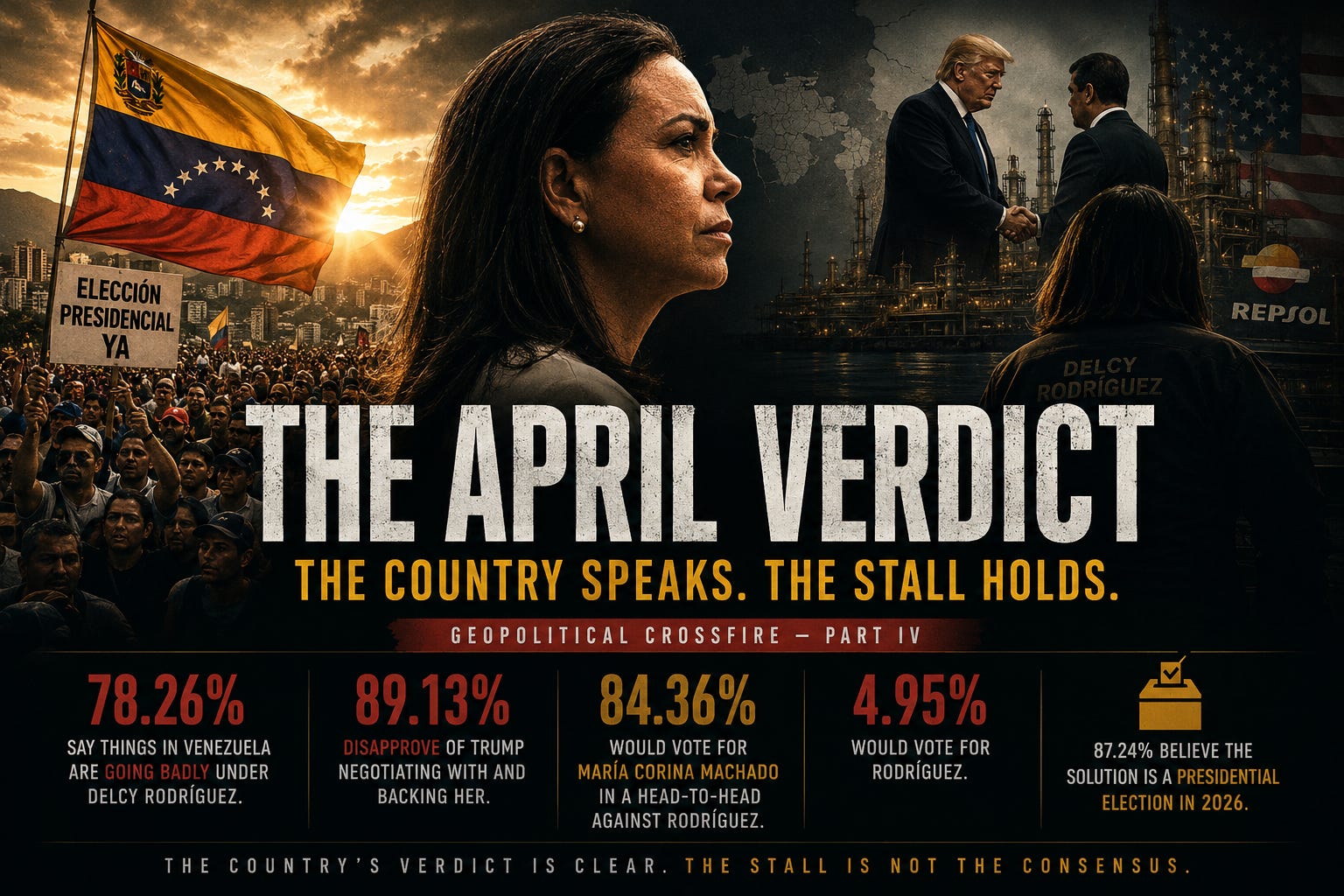
GEOPOLITICAL CROSSFIRE — PART IV
A week after The Caracas Stall went to press, Venezuela answered it. Not Washington. Not Caracas. Not the embassy. The country itself.
Between April 13 and April 20, 2026 — the same week American Airlines was opening Miami–Caracas tickets, Repsol was signing its expansion deal, and General Padrino López was being quietly reseated in the cabinet — the polling firm Meganálisis ran 11,871 phone calls into 1,113 households across the Capital District and all twenty-three states. The result is the most coherent expression of Venezuelan public opinion in the year of the transition. It is also the most damning audit yet of the stall.
Three numbers carry the weight of the report:
78.26% say things in Venezuela are going badly under Delcy Rodríguez.
89.13% disapprove of Trump negotiating with and backing her.
84.36% would vote for María Corina Machado in a head-to-head against Rodríguez. 4.95% would vote for Rodríguez.
That is not a margin. That is a verdict.
The verdict’s shape matters as much as its size. It is not a mood. It is not a venting of grievance against a hated incumbent — Venezuelans have done that for years. It is a piece of structured political reasoning: the country has identified the problem (the regime’s continuity in new clothing), the solution (a presidential election), the candidate (Machado), the timing (now, or by December at the latest), the obstacle (a coalition of political and business actors monetizing delay), and the reason for the obstacle (Washington’s preference for stability and oil over democracy and inconvenience). Every line of the report assembles into a single argument. The argument is that the stall is not the consensus position. The stall is a Washington–Caracas duopoly position imposed on a country that is, by overwhelming margins, saying something else.
This is Part IV. The 45-Day Test asked whether the post-January transition would survive its first six weeks. Venezuela’s March 2026 Reckoning documented the choices made in the second six. The Caracas Stall described the architecture that emerged in April: oil flows restored, the embassy installed as the operational layer, the political calendar postponed indefinitely, and Machado still abroad. The April Verdict is the country’s response to that architecture. It is not a polite one.
I. The Verdict in Numbers
The methodology deserves a brief note before the substance, because the numbers in this report are not soft and the design is not friendly to the result. The sample is 1,113 — comfortable for a national poll, sized against a registered electorate of 21.485 million, with a margin of error of ±2.94% at 95% confidence. Calls were made by CATI to residential and mobile lines across all operators in the country, drawn by simple random sample with proportional allocation across all 24 federal entities. The largest state contributions are Zulia (150), Miranda (114), Carabobo (87), and the Capital District (72). The smallest are Amazonas (7) and Delta Amacuro (7). One response per household.
Within that frame, the picture is the following.
On the present. 78.26% say things are going badly. 6.11% say they are going well. 15.63% don’t know. The bad-to-good ratio is 12.8-to-1. By way of comparison, Maduro’s late-cycle disapproval was rarely above 70%. The interim government is now more unpopular than the regime it replaced.
On the household economy. 70.17% expect their family economy to empeorar mucho — worsen significantly — if Rodríguez stays in power. Another 12.40% expect it to worsen somewhat. Only 4.40% expect any improvement. Aggregate: 82.57% expect deterioration. This is a question about the future, not the past, and the country is answering it with the math of someone who has lived through three currency redenominations and is not interested in being told that things are getting better when they are not.
On the gestión across critical sectors, the disapproval is institutional rather than partisan:
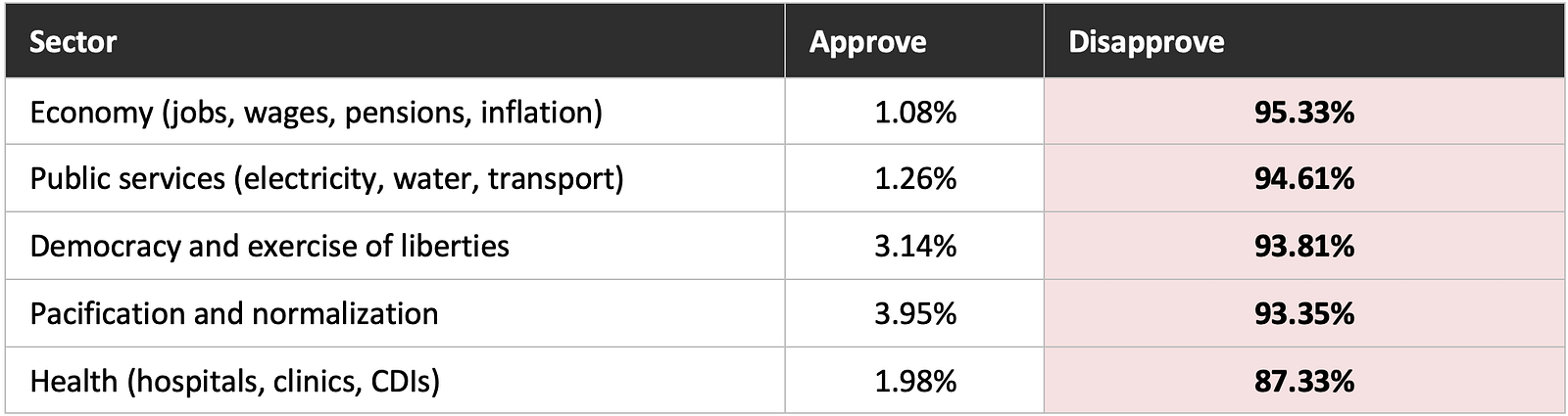
The arithmetic mean of disapproval across the five sectors is 92.89%. This is not a government with a popularity problem. This is a government with a legitimacy problem the size of the country.
On the path forward. 87.24% believe the solution is a presidential election in 2026. 77.27% identify the presidential election as the most urgent of all possible electoral events — ahead of municipal (3.68%), regional (5.03%), and parliamentary (6.92%) contests by an order of magnitude. 79.96% want the vote held in the second half of 2026–21.74% in July–September, 58.22% in October–December. Only 6.11% are willing to wait until 2027. 2.34% say “never”.
On the obstacle. 83.38% perceive a coalition of political and business actors operating with a plan to argue that Venezuela cannot hold elections. The question was open-ended; respondents arrived at this on their own. The coalition is not named, but the perception is that it exists, and that its narrative — that Venezuela isn’t ready, that conditions aren’t right, that more time is needed — is being engineered, not observed. The country reads the stall as a campaign.
These are the prior conditions for everything that follows.
II. The Consolidation of María Corina Machado
There is no precedent in Venezuelan polling for what Machado’s numbers now look like.
In an open-ended ballot — whom would you vote for?, no list provided — 71.25% volunteer her name unprompted. Juan Pablo Guanipa, the next-highest opposition figure, registers 4.13%. Rodríguez registers 3.95%. Diosdado Cabello registers 0.72%. The remaining ten named figures collectively pull 1.98%. The undecided/no-response is 17.97%.
In a closed-list ballot — names read aloud — Machado climbs to 76.28%. Rodríguez ticks up to 3.86%. Capriles, Márquez, López, Cabello, and Jorge Rodríguez are each below 1%.
In a forced binary against Rodríguez — only between these two, who — Machado reaches 84.36% (76.01% definitively, 5.12% probably, 3.23% leans). Rodríguez consolidates at 4.95% (2.07% definitively, 2.34% probably, 0.54% leans). 8.89% pick neither. 1.80% are indecisive. MCM’s lead is 17-to-1.
These three numbers — 71.25%, 76.28%, 84.36% — are not three measurements of the same thing. They are a sequence. The first measures organic recall. The second measures organic recall plus prompted recognition. The third measures willingness to choose her under polarized conditions. The slope from one to the next is the slope of a population that has not merely chosen her but is hardening around her. The more constrained the choice, the higher she climbs. This is the polling signature of a candidate the country has already decided on and is now waiting for the system to allow them to elect.
The complementary finding is structurally important. 73.23% say MCM’s return to Venezuela is “very important.”Another 10.42% say “somewhat important.” Only 6.11% say “nothing important.” 74.03% believe her physical return would shorten Rodríguez’s and chavismo’s time in power. 60.29% want her back now. 13.21% in two months. 9.07% within the year. 6.83% never.
Read the last line carefully. 6.83% — fewer than one in fifteen Venezuelans — does not want María Corina Machado to ever return. That number is the floor of regime loyalism plus active opposition to her personally. It is the core of the chavista voting base, the dependents of the carnet de la patria network, the colectivos, the enchufados. It is everyone in the country who has a reason — economic, ideological, security-related — to want her permanently outside. And it is 6.83%.
The political non-entity in this picture, by every measure, is Delcy Rodríguez.
III. The Political Ghost
Rodríguez is not a popular interim president. She is also not an unpopular one in the conventional sense, because to be unpopular in the conventional sense one must first be perceived as a politician. The country does not perceive her as a politician. The country perceives her as an administrator of a stall.
This is the most striking feature of her numbers. Her open-ballot vote share — 3.95% — is below the noise floor of Venezuelan polling for a sitting head of state. Her name-recognition disapproval across five gestión categories averages 92.89%. Her two-way matchup against Machado yields 4.95%. In every framing — open, closed, polarized — Rodríguez polls within the margin of error of her own floor. She is not gaining ground. She is not losing ground. She is not contesting ground. She is occupying an office.
The gulf between her formal authority and her political weight is the defining anomaly of the post-January period. She signs the laws. She receives the U.S. envoys. She announces the oil deals. She fires and reinstates the defense minister. She remains, as of April 1, the only chavista figure removed from the OFAC SDN list. By every external measure of state power, she is the president of Venezuela. By every internal measure of political consent, she is a placeholder the country is waiting out.
This is not contradiction. This is exactly the architecture The Caracas Stall described. Rodríguez is the CEO the bankruptcy trustee keeps in place because replacing her would disrupt operations. Her political weakness is, from Washington’s perspective, a feature: a strong interim president would have a domestic constituency, a bargaining position, a willingness to push back on embassy compliance demands. Rodríguez has none of those things. She does what the file requires. She is, in every sense that matters to the U.S. operational layer, governable.
The country knows this. Hence 4.95%.
The structural risk in the arrangement is also visible in the data. A government polling at 4.95% in a binary cannot survive a free election. The only way for Rodríguez to remain in power past 2026 is for the election not to happen, or to happen under conditions the regime controls. Both pathways are visible to the population. Both pathways are why the 83.38% perceive a coalition working to inhibit the electoral route. The country is not paranoid. It is reading the system correctly.
IV. The Gratitude Collapse
The most consequential finding in the Meganálisis report is not about Venezuela. It is about the United States.
Four months ago, in January 2026, 92.2% of Venezuelans expressed gratitude toward Donald Trump. That number was, in context, almost certainly underestimating his actual standing — Trump had just orchestrated the removal of Maduro, the U.S. military operation that bracketed it, the safe-conduct, the appointment of Rodríguez, the prisoner releases, and the first wave of sanctions easing. He was, for the better part of January, the single most popular public figure in Venezuelan history. The 92.2% measurement was less a survey than a thank-you.
By February the number was 82.9% (–9.3%). By March, 74.5% (–8.4%). By April 13–20, it was 47.08%. That is a single-month drop of 27.42 points and a four-month cumulative collapse of 45.12 points. Disapproval is now 6.02%; the rest — 46.90% — has migrated to no sabe / no responde, which in Venezuelan polling rarely means genuine ignorance. It means I don’t want to say.
A loss of forty-five points of gratitude in four months is not friction. It is a structural collapse. Meganálisis, in its conclusions, attributes the collapse to four causes, and they are correctly identified:
1. Discursive inconsistency — Trump’s public praise of Rodríguez, his silence on new episodes of repression, and the apparent normalization of chavismo in power.
2. Unmet expectations — no advances on political prisoners (Foro Penal still counts 477 as of April 6), no exit of major regime figures (Cabello in place, Padrino reinstated), and no defined electoral calendar.
3. Socioeconomic null impact — services, economy, infrastructure, and oil investment have not visibly improved at the household level despite the January announcements.
4. Perception of extractivism — the rising conviction that U.S. interest in Venezuela prioritizes energy access over democratic outcomes.
Each of these maps directly onto something concrete in The Caracas Stall. The discursive inconsistency is the embassy choosing operational continuity over political clarity. The unmet expectations are the postponement of every political milestone — the calendar, the prisoner releases, the Cabello question — that would have validated the January promise. The socioeconomic null impact is the gap between a macro narrative of recovery (1 million bpd, BCV sanctions lifted, IMF reintegration) and the micro reality of a household whose grocery bill has not changed. The extractivism perception is the diaspora’s reading of every Repsol headline, every Chevron asset swap, every CITGO extension: the oil is moving. The democracy is not.
Here is the harder reading. The four-point collapse is happening not despite Trump’s policy choices but because of them. The same choices that have delivered a managed, low-conflict, high-revenue normalization are the choices that look, from a Venezuelan kitchen table, like a betrayal of the January promise. Washington cannot have both: the stall and Trump’s standing in Venezuela are now inversely linked. Each additional week of stall costs another point of gratitude. The trajectory says zero is reachable by July.
This is the part of the report that should worry the West Wing.
V. The Iran Effect
There is one further variable, and it is the variable that explains why the stall has been allowed to take the shape it has taken.
Between April 12 and April 20 — the precise dates of the Meganálisis fieldwork — the U.S. national security focus was almost entirely elsewhere. Iran sucked all the air out of the room. The post-strike consolidation of the Gulf, the verification negotiations over the residual nuclear program, the realignment of the Axis of Resistance, the management of oil-price spillover into the global economy, the recalibration with Israel, the political demands on Saudi Arabia and the UAE, the hostage and prisoner exchanges, the question of what exactly comes next in Tehran — all of it has consumed the bandwidth of the Trump administration’s foreign-policy team to a degree that makes Venezuela, by comparison, look like a closed file.
This is not paranoia. It is calendar. The same envoys who in January and February treated Caracas as the showcase deliverable are now in Riyadh, Doha, Vienna, and Tel Aviv. The same Treasury team that drafted GL-51, GL-52, GL-56, and GL-57 is now reconstructing the Iranian sanctions architecture. The same Senate committees that should be holding hearings on the Venezuelan electoral calendar are holding hearings on the Iranian oil-shipping enforcement regime. Venezuela has become the foreign-policy file no one needs to look at because no one is making noise about it.
That is precisely why the stall works. It is precisely why Rodríguez is governable, why Padrino can be reinstated without consequence, why the Foro Penal number can move from 526 to 477 over six weeks instead of to zero in six days, why the calendar can be missing without the press corps demanding it. The geopolitical attention deficit is the operational lubricant of the stall.
The Venezuelan population does not have a national security council briefing book. It does have eyes. It can see that Trump, who in January was on every Venezuelan television in the country, is now visible primarily in clips of him speaking about Iran. The 47.08% is, in part, a measurement of that absence.
VI. The Midterm Calculation
This is where the question raised in the framing of this article becomes the central question of the next six months.
Is the Trump administration calculating that the optimal political timing for a Venezuelan electoral resolution is not “as soon as possible” but “as close to the November 2026 U.S. midterms as possible”?
The hypothesis is not cynical. It is structural. Foreign-policy victories age out of voter memory at a rate roughly proportional to news velocity. A Venezuelan election in July 2026 — with a Machado victory, a Rodríguez exit, a normalization concluded — would be a triumph in the news cycle for approximately three weeks. By August it would be an asterisk. By October, when Cuban-American voters in Florida, Venezuelan-American voters in Texas, and the broader Hispanic electorate in Arizona, Nevada, and Pennsylvania were making turnout decisions, the Venezuelan transition would be a memory, not a motivator.
Conversely, a Venezuelan election held in late September or October 2026 — Machado’s name on the ballot, the regime’s formal departure visible on every Spanish-language network, the Caracas embassy producing daily images of returning diaspora members lining up at consulates — would be in peak salience precisely as voters made their midterm decisions. The freshness window aligns with the political cycle. Hispanic voter turnout, particularly in the three states that decide the Senate — Florida, Texas, Arizona — would be running on a current event, not a memory.
The hypothesis explains things that are otherwise difficult to explain.
It explains why Washington is content to let Foro Penal’s number drop from 526 to 477 instead of to zero. A faster pace would resolve the prisoner question by July. Slower pace pushes the photo opportunity into October.
It explains why no electoral calendar has been published despite repeated congressional testimony — including Kozak’s — that one will exist. A premature calendar locks the date too early. A late calendar — announced in July, executed in October — is a dramatic September news cycle.
It explains why Machado’s return has been coordinated in slow motion. Her arrival in Caracas in May produces a domestic political event that fades by September. Her arrival in August or September produces a launch pad. Her presence on the streets of Caracas during the U.S. midterm advertising window is, from the perspective of Trump’s electoral strategists, the highest-value Venezuelan asset in the file.
It explains the discursive inconsistency the Meganálisis respondents identified — the praise of Rodríguez, the silence on repression. From Washington, those are not contradictions of the January promise. They are the bridging languagerequired to keep the operational layer cooperative until the political payload is detonated at the right moment.
If the hypothesis is correct, the stall is not aimless. It is timed.
The hypothesis has three weaknesses. First, it assumes a degree of strategic discipline within the U.S. inter-agency process that the past four months have not always demonstrated. Second, it assumes that the Venezuelan situation will not break in unexpected ways — a Cabello move, a Machado decision to enter unilaterally, a regime spasm of repression — that would foreclose the timing. Third, it assumes that the political dividend of a late-cycle Venezuelan victory exceeds the political cost of the gratitude collapse the Meganálisis report documents. The 92.2% to 47.08% trajectory suggests the cost is being underestimated.
But the hypothesis also explains why nothing the report identifies as urgent — the calendar, the return, the prisoner release, the Cabello question — is being treated as urgent. Urgency is a function of political timing, not human suffering. The 477 prisoners are not on the November ballot. The Venezuelan voter is not on the November ballot. The Cuban-American voter in Hialeah is.
VII. What the Stall Is Buying and What It Is Costing
Take the hypothesis as the working frame. The next six months become legible.
What the stall is buying: an October–November electoral resolution timed to maximize Hispanic-vote salience for the U.S. midterms. A Caracas in which the embassy infrastructure is fully bedded down by election day. A revenue regime in which Chevron, Repsol, Eni, and Maurel & Prom are operating at scale before any political risk re-enters the calculation. A diaspora corridor — Miami–Caracas, daily AA service, $1,500 fares — that doubles as a voter-mobilization circuit through Florida. A neutralized Cabello, kept in Interior because his exit is more disruptive than his presence and his removal can be deferred to the post-election period.
What the stall is costing: the Trump administration’s most valuable asset in Venezuela, which is its standing with the Venezuelan people themselves. 92.2% to 47.08% in four months. The trajectory says the floor is below 30% by July if the four determinants are not addressed. A Machado who, every additional week she remains in exile, accumulates moral leverage against Washington for whom she is now visibly waiting. A 477-person political-prisoner population that includes children and minors and that, with each additional day, hardens into the file Trump’s domestic critics will use against him in October. A coalition of “political and business actors” — 83.38% of the country sees them — whose narrative of Venezuela is not ready slowly becomes self-fulfilling as the stall becomes the new normal. A regime that, given enough time, will recover the institutional confidence to push back on the embassy’s compliance demands.
The arithmetic is asymmetric. The benefits accrue to a specific date in November 2026. The costs accrue daily.
There is one further cost the report does not measure, and it is the one that makes the hypothesis hardest to defend on its own terms. The stall is teaching Venezuelans that the U.S. transition was conditional. Conditional on oil access. Conditional on social calm. Conditional on the political calendar of a foreign country. Conditional, ultimately, on someone else’s vote in November. That lesson, once learned, will outlive the timing of any electoral payoff. It is the lesson Cubans learned in 1961 and have not unlearned. It is the lesson Iranians learned in 1953 and have not unlearned. It is the lesson the 6.83% who say Machado should never return are counting on the rest of the country eventually learning too.
VIII. Es Ahora o Nunca
The Caracas Stall closed with a phrase from a woman in La Vega, recorded by The Economist: “¡Es ahora o nunca!” — it is now or never. April’s report measures, with statistical precision, what the country meant.
60.29% want María Corina back now. 77.27% want the presidential election before any other vote. 79.96% want it before December. 84.36% will vote for her against Rodríguez. 89.13% reject Trump backing the woman they will defeat by 17 to 1. 92.89% disapprove of Rodríguez’s gestión across every category that matters. 6.83% is the loyalist floor of a regime that holds the formal apparatus of state and is supervised by a foreign embassy operating as the new G2.
Each of those numbers is a vote. Together they are a verdict.
The verdict is the country saying it is ready — ready to vote, ready to receive Machado, ready to close the chapter, ready to assume the costs of a real democratic transition rather than a managed normalization. The verdict is the country saying it sees the stall, sees who benefits from it, sees who is paying for it, and is no longer willing to confer gratitude on the foreign sponsor of an arrangement that increasingly resembles a prolongation by other means.
Whether Washington listens is a different question. The midterm hypothesis says it will not — not yet, not until the calendar of someone else’s election makes Venezuelan democracy strategically convenient. The stall’s architects are, in this reading, calculating that the gratitude collapse is recoverable, that 47.08% can be rebuilt to 70% with a single October dividend, and that the woman in La Vega will, in the end, vote for the candidate Washington also wants to win.
They may be right. The arithmetic of October is real. So is the arithmetic of grievance. Both are accumulating. The midterm clock and the patience clock are not synchronized, and the gap between them — measured in political prisoners, in deferred returns, in unpublished calendars, in a 45-point gratitude collapse that is still falling — is the territory where the stall will either pay off or break.
The April Verdict says the country is no longer waiting for Washington’s signal. The country has already given its own.
Whether Washington has the political wisdom to harvest that verdict on Venezuelan time, or only on its own — that is the question the next six months will answer. The Meganálisis report is, in effect, an invoice. It can be paid in October. It can be paid in July. It cannot be deferred to 2027.
The 6.83% would like it to be.
The other 93.17% would not.
IX. Extremely worrisome recent events
Víctor Hugo Quero Navas, 51, a Caracas merchant detained by the DGCIM in January 2025, died in state custody on July 24, 2025 — a fact the Ministry of Penitentiary Services confirmed only on May 7, 2026, nine months and fourteen days after the death. He was buried on July 30, 2025 at Jardín La Puerta, in an unmarked plot, without his family. His 82-year-old mother, Carmen Teresa Navas, had spent the intervening sixteen months going from prison to prison demanding proof of life. The Defensoría del Pueblo told her in October 2025 that her son “remained” in El Rodeo I. By that date he had been dead for three months. On April 18 the Inter-American Commission on Human Rights granted precautionary measures for him and his mother. On May 7, the regime took her to a patch of bare ground covered with a sheet of metal bearing his name. She requested a DNA test.
This is the file the Foro Penal counter does not capture and the Meganálisis polling cannot reach. The IACHR’s revised April figure stands at 454 (44 women, 1 adolescent, 286 civilians, 186 military). It is the human shape of that number, and it is the precise case the midterm hypothesis sketched in The April Verdict could not afford to inherit. A single such case ages the file faster than ninety days of sanctions licenses can rebuild it.
On May 6 — the day before the official admission — the Inter-American Commission, addressing the OAS Permanent Council, characterized the Venezuelan detention regime not as “an isolated excess” but as “a state policy, sustained and deliberate.” Política de Estado is the language used in international jurisprudence as a precursor to crimes-against-humanity findings. The same week the regime’s newly appointed ombudswoman, Eglée González — herself a product of the Citizen Power capture — was forced to call publicly for an investigation into Quero Navas’s death. The architecture is beginning to disagree with itself.
The juxtaposition that frames the week is not editorial. It is calendar. On May 5, President Trump met with senior officials of Chevron and ExxonMobil at the White House to discuss Venezuela. On May 6, asked about the country, he told reporters: “People are very happy. They are dancing in the streets because a lot of money is coming in thanks to the major oil companies that are setting up. Last night I was with ExxonMobil and we talked about Venezuela. Everyone wants to go there.” On the morning of May 7, Carmen Teresa Navas was laying flowers on a sheet of metal in a Caracas cemetery. The Meganálisis report identified four causes for the gratitude collapse from 92.2% to 47.08%; discursive inconsistency was first on the list. There has not, in four months of measurement, been a cleaner specimen of it.
Two structural shifts compound the optics.
First, the Iran lubricant began to drain. Between May 5 and May 7, Steve Witkoff, Jared Kushner, and Iranian negotiators converged on a one-page, fourteen-point memorandum of understanding that, if signed, would end the active phase of the war and open a thirty-day window for a final accord on enrichment, sanctions, and the Strait of Hormuz. Trump, on May 6, posted that “Great Progress has been made toward a Complete and Final Agreement.” The operational fact, regardless of outcome, is that the Iran file is moving toward a closure rather than an escalation. An Iran file that closes is a Venezuela file that reopens. The geopolitical attention deficit The April Verdict identified as the operational lubricant of the stall has a sell-by date, and the date is now visible on the calendar.
Second, the right flank of Trump’s coalition stopped holding its tongue. On May 4, Senator Rick Scott called Rodríguez a “cartel boss.” On May 8, citing the Quero Navas case, he formally demanded the immediate reimposition of sanctions against her, charging that “the brutality of Maduro’s dictatorship, now led by Delcy Rodríguez, knows no bounds.” On May 5, Secretary of State Marco Rubio, asked whether the Cabello bounty remained in force, answered in Spanish that “U.S. policy on this issue has not changed. When it does, we will let you know.” Two voices, two messages, one direction. The political cover for the stall is no longer airtight on the right. The midterm hypothesis assumed it would be.
The architecture has not broken. The oil flows continue — Chevron and ExxonMobil were in the Cabinet Room precisely to accelerate them, with crude exports already up from 100,000 bpd in December 2025 to 300,000 bpd in March 2026, and the United Nations now projecting $22 billion in Venezuelan oil revenue for 2026 against $14.7 billion in 2025. Machado, as of May 7, has still not entered Venezuelan territory. The 454 are still detained. The calendar is still missing. Cabello is still at Interior, mocking the opposition on prime-time television and reiterating that “there are no political prisoners in Venezuela.”
But a mother’s grief, an Iran ceasefire, a Republican senator’s break, an oilman’s photo-op, and a presidential boast about dancing in the streets are not five separate stories. They are five tributaries of the same trajectory. The Meganálisis report measured 47.08% on April 13–20. None of the events of this week is the kind that arrests a slope. Each is the kind that steepens it.
The April Verdict said the country had given its signal. The nine days that followed said the world is beginning to read that signal back to Washington — through the IACHR before the OAS, through Senator Scott on the floor, through Tehran’s negotiators in Islamabad, and through a sheet of metal in eastern Caracas inscribed with a date — July 27, 2025 — that is three days off from the date the regime now claims.
The gap between the midterm clock and the patience clock closed by a measurable interval this week. It will not stop closing.
Erasmus Cromwell-Smith II
May 8th, 2026
Sources and Further Reading
• Meganálisis, Encuesta CATI Verdad Venezuela — Resultados Públicos, April 13–20, 2026 (sample 1,113; population base 21,485,000; margin of error ±2.94%; confidence level 95%)
• Foro Penal, Political Prisoners in Venezuela as of April 6, 2026, April 9, 2026
• The Economist, “Hype but also hope” (Briefing) and “The Caracas condition” (Leader), April 18, 2026
• UPI, “Venezuela reinstates Maduro ally despite $15M U.S. reward,” April 14, 2026
• OFAC, Removal of Specially Designated Nationals: Delcy Rodríguez Gómez, April 1, 2026
• OFAC, General Licenses 56 and 57, Venezuela Sanctions Program, April 14, 2026
• Reuters / U.S. News, “Chevron Agrees to Asset Swap in Venezuela,” April 13, 2026
• Euronews, “Repsol agrees Venezuela deal to boost oil production,” April 16, 2026
• CBS Miami / WLRN, American Airlines Miami–Caracas Resumption, April 20–22, 2026
• Caracas Chronicles, “In Madrid, María Corina Claimed the Great Return Has Begun,” April 20, 2026
• Erasmus Cromwell-Smith II, Beyond the Interim; Venezuela Post-Maduro: The 45-Day Test; Venezuela’s March 2026 Reckoning; The Caracas Stall — Normalization Without Transition (Geopolitical Crossfire, Parts I–III), 2026
• Ministerio para los Servicios Penitenciarios de Venezuela, Statement on the death of Víctor Hugo Quero Navas, May 7, 2026
• Inter-American Commission on Human Rights (IACHR), Resolution 27/2026, Precautionary Measures for Víctor Hugo Quero Navas and Carmen Teresa Navas, April 18, 2026; OAS Permanent Council statement, May 6, 2026
• AFP / France 24, “Venezuela admits death of political prisoner in custody nearly one year later,” May 8, 2026
• MercoPress / Reason, Coverage of the Víctor Hugo Quero Navas case, May 7–8, 2026
• Reuters / U.S. News, “Trump Met With Chevron and ExxonMobil on Tuesday to Discuss Venezuela,” May 6, 2026
• White House transcript, Remarks by President Trump at Military Mother’s Day Event (“dancing in the streets”), May 6, 2026
• Axios, “U.S. and Iran closing in on one-page memo to end war,” May 6, 2026; Al Jazeera and Times of Israel coverage of the 14-point MOU, May 6–7, 2026
• Sen. Rick Scott, statements via X demanding reimposition of sanctions on Delcy Rodríguez, May 4 and May 8, 2026
• Sec. Marco Rubio, White House press conference remarks on the Cabello bounty, May 5, 2026
• Infobae / La Tercera, Diosdado Cabello on “Con el Mazo Dando,” May 6, 2026 (“there are no political prisoners in Venezuela”)
• United Nations, Economic projection on Venezuelan oil export revenue for 2026, late April 2026
• Foro Penal, Updated political-prisoner count (454 as of late April 2026, per IACHR figures); Foro Penal cumulative deaths-in-custody data
• OFAC, Federal Register publication of Venezuela Sanctions Regulations Web General Licenses 46, 46A, and 46B, May 7, 2026