
The Fracture
The May 10 — June 7, 2026 Window

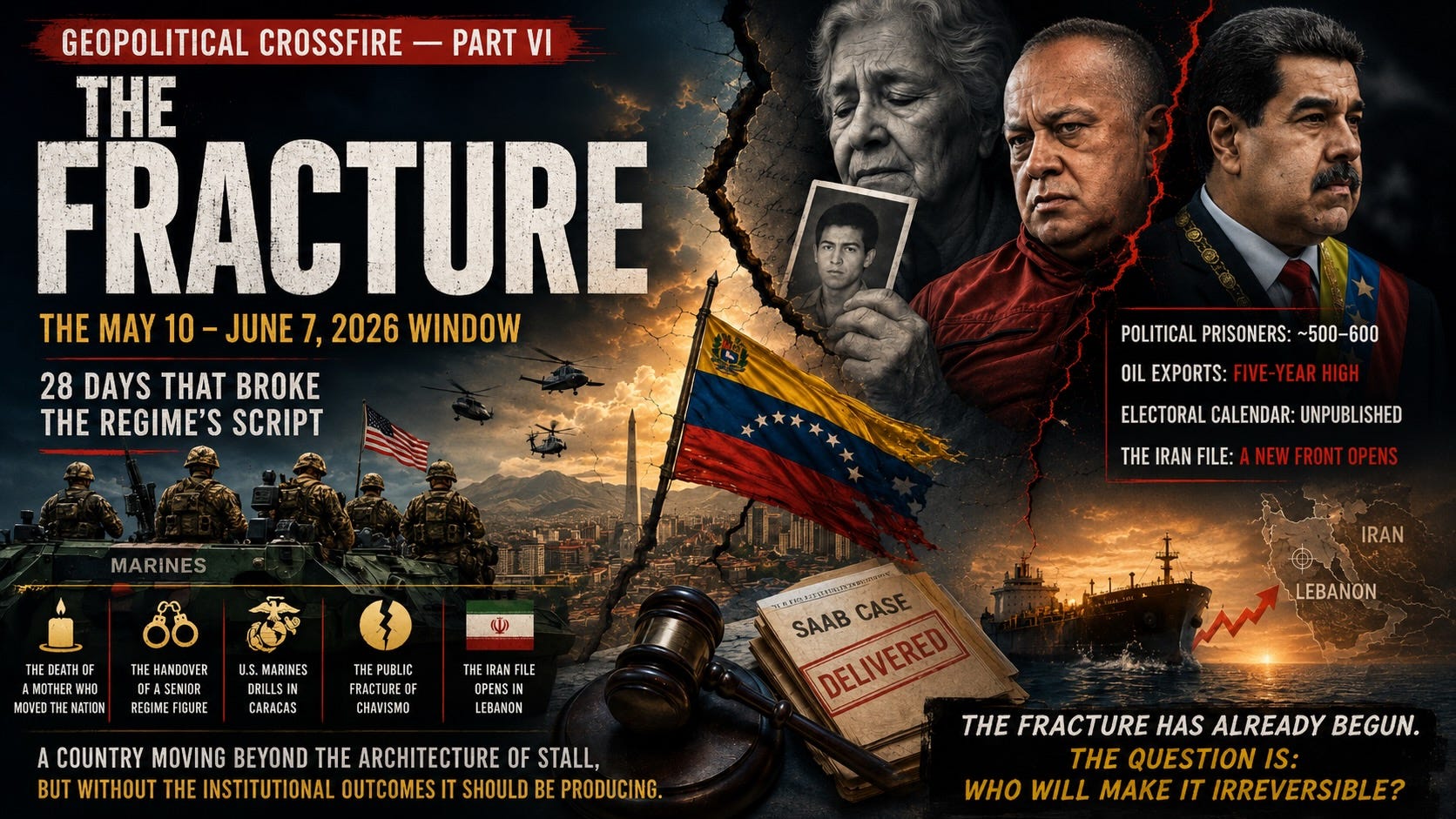
GEOPOLITICAL CROSSFIRE — PART VI
Twenty-eight days have passed since The Maternal Clock went to press. The period contained five things the architecture of the stall was designed never to produce in proximity: the death of a mother whose grief had become a national symbol; the surrender of a senior regime figure to U.S. custody; a U.S. Marine Corps operational exercise inside Caracas; the public fracture of the Chavista coalition on state television and in opposition podcasts; and the failure of the Iran file to close on the timeline that The Maternal Clock projected.
Each of these was forecastable. None was scheduled. The cumulative effect has been a country that, by June 7, is moving — slowly, unevenly, and visibly — outside the architecture The Caracas Stall described, but without any of the institutional outcomes that architecture was supposed to be holding back. Oil exports hit a five-year monthly high. The political-prisoner counter dropped marginally. The electoral calendar remained unpublished. Machado remained in Washington. Cabello remained at Interior. And the Iran file — instead of closing — opened a new front in Lebanon.
This is the inventory of where things stand, and a forensic look at where they are heading.
I. THE INVENTORY: 28 DAYS, ITEMIZED
The Quero Navas / Carmen Navas thread
• May 8 — Body of Víctor Hugo Quero Navas exhumed at Jardín La Puerta. Carmen Teresa Navas, 82, visually identifies remains. DNA testing requested.
• May 11 — Attorney General Larry Devoe — the Citizen Power-capture appointee documented in The Maternal Clock — opens criminal investigation. Statement: “The investigation aims to clarify the facts in a timely and impartial fashion.” He commits to “prompt exhumation,” already completed three days earlier.
• May 12 — National Assembly issues statement of “absolute and unconditional support” for the AG investigation. No debate is scheduled, no subpoenas issued, no summonses to El Rodeo I or the Military Hospital. The body limits itself to expressions of sympathy.
• May 15 — Mass for Quero Navas at Iglesia La Candelaria, Caracas. Carmen Navas attends.
• May 17 (Sunday) — Carmen Teresa Navas dies, 10 days after the regime confirmed her son’s death. Her death is confirmed to CNN by her caretaker. Foro Penal describes her as “tireless in demanding truth and justice.” Machado posts: “Today Venezuela bids farewell to Carmen Teresa Navas. It was not just a mother who died; a woman who transformed pain into courage and despair into denunciation was silenced.” Senator Rick Scott responds: “The Venezuelan regime KILLED Carmen Navas through torture, cruelty, and the evil they inflicted on her and her son.” He calls it “a crime against humanity.” The Venezuelan Bishops’ Conference issues a pastoral statement.
• Throughout May–early June — Observatorio Venezolano de Prisiones (OVP) documents at least 16 deaths of detainees in state custody between April and the first half of May 2026. This is on top of the Quero Navas case. The Foro Penal cumulative count of political-prisoner deaths in custody since 2014 stands at at least 27.
The political-prisoner thread
• May 18–19 — Samantha Sofía Hernández Castillo, 16, is conditionally released from the Antímano Detention Facility after almost half a year in custody. She had spent more time imprisoned under Delcy than under Maduro. Her case was cited by the Norwegian Nobel Committee Chair in the December 2025 ceremony. The Hernández sister Aranza, 19, remains detained.
• As of late May / Foro Penal–IACHR consolidated figures — Approximately 500–600 political prisoners remain detained, including roughly 187 military, 43 women, and at least one adolescent (Aranza). Amnesty International estimates the figure at the upper bound of that range. The regime claims 8,616 amnesty releases since the law’s enactment; Foro Penal has verified 768.
• Aging cases — Emirlendris Benítez, Juan Carlos Marrufo (urgent medical), Jorgen Guanares (unknown whereabouts). The Hernández pattern of Sippenhaft family detention continues unabated.
The Saab “deportation”
• February 5 — Joint U.S.–Venezuelan operation arrests Alex Saab. Months of negotiations follow.
• May 16 — Venezuelan government, through SAIME, announces the “deportation of Colombian citizen Alex Naim Saab Morán” to the United States. The semantic choice is constitutional: Article 69 of the Venezuelan Constitution bars the extradition of Venezuelan nationals; SAIME categorizes Saab as Colombian to evade the prohibition. He had been a Venezuelan minister, voted in the 2024 elections, and held Venezuelan citizenship under a Maduro-granted naturalization that Rodríguez’s government has now retrospectively dis-recognized.
• May 17 — Saab arrives in the U.S. under DEA custody.
• May 18 — Saab appears in federal court, Southern District of Florida (Miami), on charges of money laundering, conspiracy, and concealing the origin of funds. The case is built around CLAP food-program corruption and PDVSA contracts between 2015 and 2026. Saab is the CLAP architect, the bagman, and the witness Maduro could not afford to face. He has now been delivered.
• Internal effect — Mario Silva (former state-TV propagandist removed from the airwaves after Maduro’s capture) calls Saab’s deportation unconstitutional in a livestream and accuses Rodríguez of governing“from the U.S. Embassy.” Daniella Cabello, Diosdado’s daughter and current Minister of Tourism, remains in cabinet but has not commented publicly on the Saab transfer. Cabello himself, conspicuously, was the minister who announced the deportation. He delivered the surrender of his own associate.
The U.S. Marine drill — May 23
• The Rodríguez government formally authorizes the exercise, framing it as a “medical and catastrophic contingency drill.” This is the operational point that matters: the host government invitedthe operation.
• Two MV-22B Osprey aircraft, accompanied by U.S. Navy surface vessels in Venezuelan Caribbean waters, conduct a rapid-response exercise at the recently reopened U.S. Embassy.
• Gen. Francis Donovan, head of U.S. Southern Command, personally oversees the exercise in Caracas and holds meetings with embassy staff and Venezuelan government officials.
• Chavista activists protest with chants of “Yankee go home!” and “No to the drill!” The Mariela Machado–led Movement of Residents calls it “interference in a free and sovereign country.” The optics: the regime’s own base is publicly disowning the regime’s own diplomatic choices.
The Machado / Panama / González track
• May 22–25 — Machado convenes a closed-door meeting in Panama City with the majority of Venezuela’s opposition parties — traditional and independent — flown in from Spain, Caracas, Maracaibo, Bogotá, and the United States.
• May 23 — Machado addresses the Venezuelan diaspora in Panama. She announces, “I will be a candidate.” She estimates an internationally supervised election would require seven to nine monthsof planning after a new electoral council is appointed.
• May 24 — She makes the move public to AP: she will run for president and return to Venezuela “before the end of 2026.”
• May 25 — Machado meets with Panamanian President José Raúl Mulino at the Presidential Palace. Mulino reaffirms support for Venezuelan democracy.
• May 30 — Edmundo González Urrutia, from exile in Madrid, publicly calls for presidential elections to be scheduled. He asserts he remains “the guardian of the mandate” given to him by Venezuelan voters in July 2024. His public re-emergence ends his four-month dormancy on policy questions.
The internal Chavista fracture (June 1)
The Associated Press, in a Washington Post–syndicated piece dated June 1, 2026, documents what the regime’s information apparatus has been unable to suppress:
• Lawmaker Iris Varela — among the most ideologically pure Chavistas in the legislature — tells a podcaster: “Of course there’s a betrayal. Every Christ has a Judas. If our Lord Jesus Christ knew he was going to be betrayed and yet he let Judas kiss him on the cheek… won’t a traitor emerge for Maduro?”
• Manuel Caicedo, a visiting Colombian leftist seated in the live audience of Cabello’s Con el Mazo Dando (which ran its final broadcast February 18 — Cabello’s removal from television was itself an under-noted episode), stood and confronted Cabello publicly: “We’ve seen a very weak campaign for Cilia and Nicolás’s freedom.” Cabello, on camera, was visibly stunned.
• Mario Silva, the long-time state-TV propagandist removed after Maduro’s capture, livestreams: “The imperialists don’t negotiate. They conquer, test and probe — until our country shatters. Nobody is safe right now. And that is a concrete, terribly dangerous fact.” He explicitly accuses Rodríguez of making decisions “in the U.S. Embassy.”
The AP characterizes it without euphemism: “Venezuela’s ruling party is facing internal divisions after 27 years of unity.” The slogan ¡Unidos venceremos! — United we will win — has, for the first time since 1999, become rhetorically empty in the very mouths obligated to chant it.
The Maduro thread
• May 5 — U.S. District Judge Alvin Hellerstein postpones the third hearing in USA v. Nicolás Maduro Moros and Cilia Flores to June 30, 2026, at noon, Southern District of New York. Both defendants remain at the Metropolitan Detention Center, Brooklyn.
• Outstanding — Maduro’s legal-fee question remains unresolved (U.S. sanctions prevent Venezuelan-state payment; defendants claim no personal funds). Saab’s transfer into the same federal system is now a co-defendant problem the defense will have to absorb.
The oil thread
• May 1 — ExxonMobil’s Darren Woods signals re-entry to Venezuelan operations (already noted in The Maternal Clock).
• May 1 — Chevron Q1 2026 earnings disclose continued operations in Venezuela; April 2026 Venezuelan crude exports reach 1.23 million bpd, the highest monthly figure since 2018.
• June 1 — Reuters reports May 2026 Venezuelan oil exports at 1.25 million bpd, the third consecutive monthly increase. U.S. is the top destination at 445,000 bpd, with India’s Reliance Industries and European refiners absorbing the rest.
• U.S. Energy Secretary Chris Wright confirms in a June 4 statement that Venezuelan exports are “three times more than before the start of the U.S. military operation.” Venezuelan oil ministry projects1.37 million bpd by year-end 2026, a level not seen since the sanctions era began in 2019.
The Iran thread (the lubricant that did not drain)
The April 8 conditional two-week ceasefire — originally pegged to expire mid-April — has been extended five times. The Strait of Hormuz remains, effectively, closed. Brent crude has traded as high as $140, the highest since 2008. WTI crossed $112 in early April. As of June 5, Brent has settled around $100, WTI near $92 — both well above the levels that made the Trump administration’s January oil-deal triumphalism plausible.
• April 16 — Israel–Lebanon ceasefire (separate, 10-day) takes effect.
• May 28 — U.S. and Iranian negotiators agree on a tentative 60-day MOU framework: extension of the ceasefire, demining of the Strait of Hormuz within 30 days, new nuclear talks. Trump withholds final signature.
• May 30–31 — U.S. carries out “self-defense” strikes inside Iran. Iran fires toward an unnamed U.S. base in Kuwait. Trump requests changes to the MOU language: tougher language on enrichment, on Hormuz reopening, and on Iran’s nuclear stockpile.
• June 1 — Iran suspends talks in protest of Israeli strikes in Lebanon. Trump tells ABC News a deal is reachable “over the next week.”
• As of June 7 — Deal not signed. Hormuz not fully reopened. Iranian uranium stockpile not surrendered. The Iran file is not closing.
II. THE STATUS OF THE PRINCIPAL CHARACTERS
Inside Venezuela
Delcy Rodríguez — Position: significantly stronger commercially, significantly weaker politically. She has secured 1.25 million bpd in oil exports, sanctions relief on her own person (April 1), Saab’s removal as a potential domestic embarrassment, the Citizen Power capture, the unilateral termination of the Amnesty Law, and the U.S. military’s choice to conduct an Osprey drill on territory she controls. But: her own party is fracturing in public, the maternal narrative has detached from her, the IACHR has formally characterized her detention regime as a política de Estado, and her own loyalists (Iris Varela, Mario Silva) are accusing her of governing from the U.S. Embassy. She has approximately $22 billion in projected 2026 oil revenue to redistribute, and a base that is asking whether the cost of getting it has been her party’s soul.
Diosdado Cabello — Position: nominally strong, materially weakening. He remains Minister of Interior. The $25-million bounty remains in force (Rubio reaffirmed May 5). Con el Mazo Dando ended February 18 — the loss of his weekly television megaphone has not been replaced. He delivered Saab personally to the U.S. (announcing the deportation in his ministerial capacity), an action that contradicts his stated position. He was visibly stunned on live television when Caicedo confronted him. His political asset — the loyalty of the radical Chavista base — is the asset that the Varela/Silva/Caicedo public statements are most directly eroding. The hypothesis of The April Verdict — that Cabello’s bounty plus the IACHR record makes him the structural ceiling on the architecture’s stability — is now confirmed: the architecture wobbles whenever his name is invoked.
Jorge Rodríguez — Position: stable but quiet. President of the National Assembly. Continues to run the legislative track of the architecture (amnesty rollback, oil-reform law, mining law). Notably absent from the family-spat that has consumed his sister’s coalition.
Gen. Gustavo González López — Position: Minister of Defense since March 18 (replacing Padrino), Commander of the Presidential Honor Guard, formerly Director of SEBIN. Under U.S. sanctions. He is now the operational commander of the armed forces that did not resist the January 3 U.S. operation and the armed forces that authorized the May 23 Osprey drill. His position is the literal embodiment of the architecture: U.S.-sanctioned, U.S.-cooperating.
Vladimir Padrino López — Position: demoted but absorbed. Defense Minister for 12 years; replaced March 18. Now Minister of People’s Power for Agriculture and Land (since April 13). Still in cabinet, still under indictment in U.S. federal court for narco-terrorism (May 2019 D.C. grand jury), still sanctioned, no longer commanding troops.
Larry Devoe — Position: highly visible. Attorney General since the Citizen Power capture. He spent years defending the Venezuelan state at the IACHR; he now opens an investigation against his predecessor’s apparent cover-up of the Quero Navas death. The institutional contradiction is now structural, not episodic.
Eglée González Lobato — Position: ombudswoman of a state whose detention regime the IACHR has formally classified as a political crime against humanity precursor. She has, on the record, met with Carmen Navas (May 4) and pledged to “activate institutional mechanisms.” Three days later, Carmen learned her son had been dead nine months.
Tarek William Saab — Position: removed from the AG role in the Citizen Power capture (replaced by Devoe). His name still appears in the AP/PBS coverage from February as the AG who requested Guanipa’s house arrest — but the Devoe substitution is now complete. He is the legal authority of record for the period in which the Quero Navas case was prosecuted, denied, and concealed. His exposure to the ICC investigation is now individualized.
Daniella Cabello — Position: Minister of Tourism since February 2. Sanctioned by the U.S. Treasury since November 2024. Continues in cabinet, has not commented on her father’s delivery of Saab.
Outside Venezuela
María Corina Machado — Position: politically reinforced, structurally exposed. Panama conclave (May 22–25) re-confirmed her unilateral leadership of the opposition coalition. She has announced she will be the candidate, with return by year-end and elections feasible 7–9 months after CNE appointment. The contradiction she identified in her own El País interview — that her return depends on U.S. coordination — has not been resolved. The diaspora pressure is mounting. The Mothers’ Campaign has not abated; Carmen Navas’s death added moral weight Machado could not avoid invoking. She is closer to home than at any point since December, and also further from being able to set the date.
Edmundo González Urrutia — Position: re-emerged from public quiescence. May 30 call for elections is his first substantive policy intervention since January. The CNN profile (Feb 15) of his moderate, sidelined posture is partially obsolete: he has now publicly asserted that he remains the “guardian of the mandate” from July 2024. A factual reminder that the U.S. government has never withdrawn its November 2024 recognition of him as the legitimate winner of that election.
Nicolás Maduro — Position: in MDC Brooklyn. Next hearing June 30. Legal-fee question unresolved. Plea: not guilty on narco-terrorism, cocaine importation, weapons charges. Saab is now in the same federal system. The case is, by Hellerstein’s explicit ruling, not subject to dismissal.
Cilia Flores — Position: co-defendant. MDC Brooklyn.
Alex Saab — Position: Southern District of Florida, in pre-trial detention. He is the regime’s most valuable potential cooperating witness against Maduro, against Cabello, and against the network of PDVSA-CLAP corruption. His “deportation” — engineered by the Rodríguez government — was the most consequential single political act of May 2026.
The Mothers’ Campaign principals
Carmen Teresa Navas — Deceased, May 17, 2026, at age 83. The figure who turned the Quero Navas file from a statistical entry into a national symbol. Funeral attended by students who clashed with police afterward. Bishops’ Conference issued formal pastoral statement.
Samantha Sofía Hernández Castillo — Released May 18–19. Conditional. Restrictions undisclosed in detail. Cannot leave the country; subject to periodic check-ins. Her sister Aranza, 19, remains detained.
III. THE IRAN FILE: WHY THE LUBRICANT HAS NOT DRAINED
The Maternal Clock predicted that the closing of the Iran file would reopen the Venezuela file — that “an Iran file that closes is a Venezuela file that reopens.” The prediction holds in direction. It has not held in pace.
The reasons are now clear:
One: The Iran-Israel war did not end with the April 8 ceasefire. It opened a separate Lebanon front. The Israel–Lebanon ceasefire (April 16, 10 days) collapsed almost immediately. Hezbollah resumed rocket fire. Israeli operations continued in Beirut and southern Lebanon through May. The Iran framework cannot close while the Lebanon framework burns.
Two: The Strait of Hormuz remains effectively closed. Brent crude has hovered between $90 and $140 for the entire post-strike period. This is the single largest reason Venezuelan oil exports could rise from 300,000 bpd to 1.25 million bpd in five months: the global market was structurally short heavy crude. Venezuela’s barrels — which would have been suppressed by competitive Iranian, Saudi, and Iraqi flows — entered a market with no buffer.
Three: The economic context flips Trump’s January oil-deal triumphalism on its head. Gas prices in the U.S. have risen, not fallen. The “biggest oil deal” narrative now competes with “Americans paying more at the pump.” The midterm-hypothesis dividend of The April Verdict assumed lower energy costs. The opposite has occurred.
Four: Trump’s negotiating posture has hardened. The May 28 tentative MOU framework included Iranian uranium surrender, Hormuz demining within 30 days, sanctions relief contingent on verification, and explicit no-toll language on Hormuz. Trump’s May 30 changes hardened the language further; Bessent’s public statement insisted: “It is a multifaceted agreement and nothing is going to be on the table until we see the Strait of Hormuz open and the Iranians agree that they have to turn over the highly enriched uranium, and that they can’t have a nuclear program.” The Iranian counter-position remains incompatible with these conditions.
Five: Iran’s June 1 suspension of talks over Israeli Lebanon actions added a third condition the negotiations must satisfy. The framework is no longer bilateral; it is trilateral, including a non-participating actor (Israel) the U.S. cannot directly bind.
The operational implication for Venezuela: The Iran absorption of Washington bandwidth that The Caracas Stall identified as the operational lubricant of the architecture continues. It is now likely to continue through at least Q3 2026. The Venezuela file will not get its full Washington attention until either Hormuz reopens or Iran’s enriched-uranium question is settled. Both remain unresolved as of June 7.
IV. WASHINGTON’S FOOTPRINT: EVERY ACTION, STATEMENT, TRIP
The U.S. presence in Venezuela between May 10 and June 7 was unusually visible and operationally significant. The events, in chronological order:
May 5 — Trump meets with Chevron and ExxonMobil senior officials at the White House to discuss Venezuela operations. The meeting is unannounced in advance, confirmed by Reuters the next day.
May 5 (separately) — Secretary of State Marco Rubio, at a White House press conference, responds in Spanish to a direct question about whether the Cabello bounty remains in force: “La política de Estados Unidos sobre ese tema no ha cambiado. Cuando cambie, se lo haremos saber.” No softening. The bounty stays.
May 6 (Wednesday) — Trump at the Military Mother’s Day event: “People are very happy. They are dancing in the streets because a lot of money is coming in… Last night I was with ExxonMobil and we talked about Venezuela.”
May 8 — Senator Rick Scott demands the immediate reimposition of sanctions on Rodríguez. Scott had previously intervened by name on Samantha Hernández (March) and now invokes the Quero Navas case. He calls Rodríguez “the brutality of Maduro’s dictatorship, now led by Delcy Rodríguez.” The Republican right-flank break is structural.
May 10 (Sunday — Mother’s Day) — Trump on Sharyl Attkisson’s Full Measure: “Venezuela is a very happy country right now… they were miserable and now they are happy. It is well managed. The oil that is coming out is enormous.”
May 16–17 — Alex Saab “deportation.” Coordinated between U.S. DEA and Venezuelan SAIME. The Rodríguez government delivers Saab voluntarily.
May 17 — Rick Scott on Carmen Navas’s death: “The Venezuelan regime KILLED Carmen Navas through torture, cruelty, and the evil they inflicted on her and her son. Delcy Rodríguez and every thug involved in this crime against humanity WILL be brought to justice.”
May 18 — Saab in Miami federal court. New money-laundering, conspiracy, and concealment charges unsealed.
May 22 — Venezuelan Foreign Ministry authorizes U.S. Embassy drill scheduled for May 23.
May 23 — U.S. Marine Corps MV-22B Osprey drill at U.S. Embassy in Caracas, with U.S. Navy surface vessels in adjacent Caribbean waters. General Francis Donovan, head of U.S. Southern Command, on the ground, oversees the exercise, and meets with Venezuelan government officials and embassy staff. The U.S. Embassy publicly describes the exercise as “a demonstration of emergency preparedness and mission readiness… both here in Venezuela and around the world.” The political signal — projecting U.S. military reach inside the Venezuelan capital with the host government’s authorization — is read everywhere from Beijing to Tehran to Havana.
June 1 — AP/Washington Post syndicates the “ruling party cracks” story. The story is amplified through embassy and diaspora channels.
June 4 — Energy Secretary Chris Wright publicly confirms Venezuela exports “three times more than before the start of the U.S. military operation.” He frames it as policy success.
The pattern
Washington’s footprint in this window had three distinct registers:
• Commercial — Trump’s Chevron/ExxonMobil meeting, Wright’s triumphalism, the oil-flow numbers, the proceeds-controlled-in-U.S.-accounts mechanism announced in January.
• Performative-military — The Osprey drill, Donovan’s visible presence, the surface vessel positioning.
• Punitive-symbolic — Scott’s amplification of the Quero/Navas tragedy, Rubio’s refusal to soften on Cabello, Saab’s federal court appearance, the maintained bounty.
The three registers are operating against each other. The commercial register requires Rodríguez to remain a viable counterparty. The performative-military register requires her to host U.S. force projection without political cost. The punitive-symbolic register requires her colleagues — Cabello, Saab, eventually the rest — to face the federal justice system. No coalition government in modern history has been asked to simultaneously enable, host, and prosecute itself. The Rodríguez government is being asked exactly this, and the public statements from Iris Varela, Manuel Caicedo, and Mario Silva indicate that the coalition it leads is beginning to fracture under the weight.
V. WHERE THINGS STAND, JUNE 7, 2026
The architecture The Caracas Stall described is now simultaneously holding and visibly cracking — a configuration the architecture’s designers did not anticipate, because they assumed that holding would be silent.
What is holding
• The Rodríguez interim presidency
• Cabello at Interior
• The unpublished electoral calendar
• The oil flows (rising sharply)
• The cooperation framework with Washington
• The Citizen Power capture
• The OFAC sanctions relief for Rodríguez personally
What is cracking
• The PSUV’s internal narrative discipline (Varela, Caicedo, Silva)
• The public legitimacy of the “Maduro returns victorious” frame (the “very weak campaign” charge from inside)
• The political-prisoner cover (Quero Navas, Carmen Navas, the 16 OVP-documented deaths in 6 weeks)
• The institutional silence of Citizen Power (Devoe’s investigation, González Lobato’s perfunctory call)
• The geographic monopoly of the regime (Marine drill in Caracas)
• The right-flank Republican coalition for Trump’s strategy (Scott)
• The diaspora’s tolerance of Machado’s absence (Panama pact, return commitment)
What has not yet broken
• The basic deal structure (oil flows, sanctions relief, normalization of Rodríguez)
• The 1.25-million-bpd commercial reality
• The U.S. midterm calendar
• The Iran absorption of Washington’s primary attention
What has been transferred to other systems
• The ICC investigation track (now feeding off the IACHR’s política de Estado finding and the Carmen Navas symbolism)
• The Saab federal prosecution (now able to be conjoined with Maduro’s case)
• The mothers’ moral capital (now distributed across Spain, Italy, the U.S. diaspora, and the Vatican)
The country, as of June 7, has produced a configuration that The April Verdict did not contemplate and The Maternal Clock anticipated only in part: the architecture is being kept on its feet by external forces (Iran absorbing U.S. attention, the oil price floor, Cabello’s residual military leverage), while being eroded from inside by its own loyalists. The next inflection point will depend on which of those external forces moves first.
VI. THREE SCENARIOS
Each of the following carries an estimated probability range based on the current data. None is independent of the Iran file or the U.S. midterm calendar. All assume Maduro’s June 30 hearing produces no dramatic disposition (most likely outcome: another postponement).
Scenario A — Controlled Stabilization (estimated 40–50% probability)
The Iran file produces an MOU in late June or July. Hormuz partially reopens. Brent settles toward $80. The “oil dividend” begins to feel like price relief at U.S. pumps in late summer. Rodríguez’s interim status is gradually formalized through a CNE-managed late-2027 election scenario — exactly the Energy Secretary’s January framework (“during Trump’s administration”). Machado returns in Q4 2026 under U.S.-coordinated terms but is excluded from the ballot through judicial means (the Saab–Maduro federal cases set a precedent: convictions of regime figures become exchangeable currency). The architecture survives in its core form: normalization without transition — The Caracas Stall hypothesis confirmed.
Indicators that would confirm this scenario in the next 30 days: Iran-U.S. MOU signed in June; Hormuz demining begins in July; Rodríguez visits Washington formally; CNE appointment process publicly initiated; Cabello quietly resigned or sidelined; Samantha Hernández-style conditional releases continue (10–30 per month) without an electoral calendar.
Scenario B — Calibrated Transition (estimated 25–35% probability)
The combination of the Saab cooperation potential, the maternal narrative’s continued moral pressure, the Republican right-flank break (Scott), and the Chavismo internal fracture (Varela, Caicedo, Silva) forces Washington to add political conditionality to the next sanctions-relief tranche. The U.S. demands a CNE appointment by Q3 2026 and an election in H1 2027. Rodríguez accepts under pressure but ensures that Machado’s return is contained (limited travel, ankle monitor equivalent, “moral re-establishment” without legal restoration). Cabello is pushed out by a combination of Saab’s cooperation and Rodríguez’s own consolidation. The result is a Venezuelan election in early-to-mid 2027 — but one whose conditions Machado considers genuinely contestable. This is The Maternal Clock’s “the architecture cannot outwait three clocks” thesis playing out: the maternal clock, the ICC clock, and the diaspora clock collectively force a calendar.
Indicators: Machado returns Q3 or Q4 2026; the CNE is reconstituted with at least one independent rector; the OFAC General License framework includes electoral benchmarks; the 187 military prisoners are released; the Cabello bounty is allowed to be acted upon or quietly retired through indictment.
Scenario C — Coalition Collapse (estimated 15–25% probability)
The fracture documented on June 1 deepens. Cabello, sensing that he is the next Saab, either flees, fortifies, or moves against Rodríguez. A faction of the military (the Padrino-loyal element absorbed into Agriculture) sides with the radical Chavista line (Varela, Silva). The U.S. Embassy becomes the de facto co-governance center. The Rodríguez government either consolidates by force (with U.S. backing — note that the Osprey drill rehearsed exactly this scenario), or collapses under internal pressure. A second U.S. operation is not inconceivable; the Iran absorption of Washington bandwidth makes it less likely than in January, but the U.S. force-projection signaling of May 23 was not casual. Machado returns under emergency conditions, possibly as part of a power-sharing transitional government. Elections happen earlier (Q1 2027) but under conditions that are less competitive than Scenario B.
Indicators: Cabello quits or disappears from public view; military leadership change within 60 days; a second wave of senior-figure “deportations” to U.S. federal jurisdiction; U.S. announcement of “transitional authority” framework; emergency electoral calendar announced.
What all three scenarios share
• Maduro remains in U.S. federal custody throughout.
• Saab cooperates; Saab’s cooperation becomes the exchange currency for additional figures.
• The IACHR / ICC track continues, slowly but irreversibly building the crimes-against-humanity case file.
• The maternal narrative does not abate. The OVP-documented 16 deaths in 6 weeks suggest the file is generating new Carmens at a rate of approximately three per month.
• Oil flows continue at or above 1.25 million bpd, providing fiscal space the architecture needs.
• The 187 military prisoners are the gating constraint — their release is the single largest signal that genuine political transition is occurring; their continued detention is the single largest signal that it is not.
What no scenario contemplates
• A return to the pre-January 3 status quo ante. The Maduro presidency is irrecoverable. Saab’s transfer made it doubly so.
• A scenario in which Machado does not run. She announced. She will. The question is whether the ballot exists when she does.
• A scenario in which the Iran file closes in June. The June 1 talks suspension and Trump’s continued demand for changes make a near-term close structurally implausible.
VII. THE VERDICT
The April Verdict documented the country’s signal. The Maternal Clock documented the country’s voice. The Fracture documents the architecture’s internal contradiction: a regime that has chosen normalization without transition is being asked, by the actor that compelled the normalization, to also surrender the figures whose survival the regime needs in order to remain a regime.
The week of May 16 was the inflection point: a regime delivered Alex Saab to the federal justice system that already holds its former president, hosted a U.S. Marine drill inside its capital, buried the mother of a man it murdered in custody, and watched its own legislator say in public that “every Christ has a Judas.”
Carmen Teresa Navas died on May 17. Iris Varela invoked Judas on or about May 31. Between those two dates, the country produced an inventory that no architecture of normalization without transition has, in modern Latin American history, survived intact.
The Rodríguez architecture has not yet broken. It is, in the calendar of the next 90 days, structurally constrained in ways it was not before May 10:
• Constrained by the Iran file, which has refused to close on the timeline that would have allowed Washington to refocus.
• Constrained by Saab’s value as a witness, which makes his prosecution a long-running source of federal-court revelation.
• Constrained by its own loyalists, who are saying out loud what the architecture required them to keep silent.
• Constrained by the maternal narrative, which converted Carmen Navas into a martyr the regime cannot defame.
• Constrained by Machado’s Panama declaration, which transferred the question from “if she returns” to “when, and on whose terms.”
• Constrained by the right flank of the U.S. coalition, which is now openly demanding what the architecture’s normalization was designed to forestall.
The fracture is not the collapse. It is the audible signal that the structure is bearing more weight than its supports were designed to carry.
The Caracas Stall identified the architecture. The April Verdict measured the dissent. The Maternal Clock gave the dissent its faces. The Fracture documents the first audible cracks in the structure itself.
By the next Meganálisis fieldwork — sometime in the third week of June, if the institute holds to its monthly cadence — the gratitude floor identified at 47.08% in April will, on the evidence of these 28 days, be measurably lower. The question for the next installment in this series will not be whether the trajectory has continued. It will be whether the architecture can absorb another 28 days like the ones just past — and which of the three scenarios above the next 28 days will resemble.
The answer, in all probability, will not be Scenario A.
The answer, in some combination, will be the calendar.
Erasmus Cromwell-Smith II
June 7, 2026
Sources and Further Reading
• Ministerio para los Servicios Penitenciarios de Venezuela, statement on the death of Víctor Hugo Quero Navas, May 7, 2026
• Office of the Attorney General (Larry Devoe), opening of criminal investigation into the Quero Navas case, May 11, 2026
• UPI / CNN / Foro Penal, death of Carmen Teresa Navas, May 17–18, 2026; Venezuelan Bishops’ Conference pastoral statement
• Sen. Rick Scott, X posts on the death of Carmen Navas and on Delcy Rodríguez as responsible for crimes against humanity, May 17, 2026
• Observatorio Venezolano de Prisiones (OVP), report of 16 documented deaths in state custody between April and the first half of May 2026
• Amnesty International, Urgent Action on Venezuelan political prisoners: 500–600 arbitrarily detained as of late May 2026 (including Aranza Hernández)
• Wikipedia / cubaheadlines.com, conditional release of Samantha Sofía Hernández Castillo on May 18–19, 2026
• SAIME / Venezuelan Ministry of Justice, statement on the “deportation” of Alex Naim Saab Morán, May 16, 2026; Saab’s appearance in federal court of the Southern District of Florida, May 18, 2026
• Mario Silva, livestream questioning the legality of the Saab deportation, May 2026
• AP / Washington Post / ABC News, “Venezuela’s ruling party unity cracks as Delcy Rodríguez shifts Chávez-era policies,” June 1, 2026
• Lawmaker Iris Varela, podcast statements on alleged “betrayal” from within the regime, late May 2026
• AP / Reuters / People’s Dispatch / MercoPress, coverage of the U.S. Marine Corps MV-22B Osprey exercise at the U.S. Embassy in Caracas under the supervision of Gen. Francis Donovan, May 22–23, 2026
• Newsroom Panama / PBS / AP, Venezuelan opposition conclave in Panama, Machado–Mulino meeting, announcement of presidential candidacy and return commitment by year-end 2026, May 22–25, 2026
• Washington Post / AP, Edmundo González Urrutia’s call for presidential elections and defense of “the mandate” from July 2024, May 30, 2026
• Judge Alvin Hellerstein, Southern District of New York, postponement of the third hearing in USA v. Maduro/Flores to June 30, 2026, May 5, 2026
• Venezuelanalysis / Reuters, Venezuelan oil exports: 1.23 million bpd in April; 1.25 million bpd in May; official Venezuelan projection of 1.37 million bpd by year-end 2026, May–June 2026
• Chevron Corp., Q1 2026 results and 10-Q filing, May 1, 2026; statements by Energy Secretary Chris Wright on Venezuelan exports, June 4, 2026
• Axios / PBS / CNN, tentative 60-day U.S.–Iran MOU framework announced on May 28–29, 2026; Trump’s requested changes of May 30–31; Iran’s suspension of talks on June 1 over Israeli actions in Lebanon
• House of Commons Library (United Kingdom), briefing on the 2026 Israel/U.S.–Iran conflict and the situation of the Strait of Hormuz, June 2026
• OFAC, Venezuela General License framework (5V, 46/46A/46B), January–May 2026; removal of Delcy Rodríguez from the SDN list, April 1, 2026
• Erasmus Cromwell-Smith II, Beyond the Interim; Venezuela Post-Maduro: The 45-Day Test; Venezuela’s March 2026 Reckoning; The Caracas Stall — Normalization Without Transition; The April Verdict; The Maternal Clock (Geopolitical Crossfire, Parts I–V), 2026