
TIME TO GO
Llegó la hora de que se vayan!

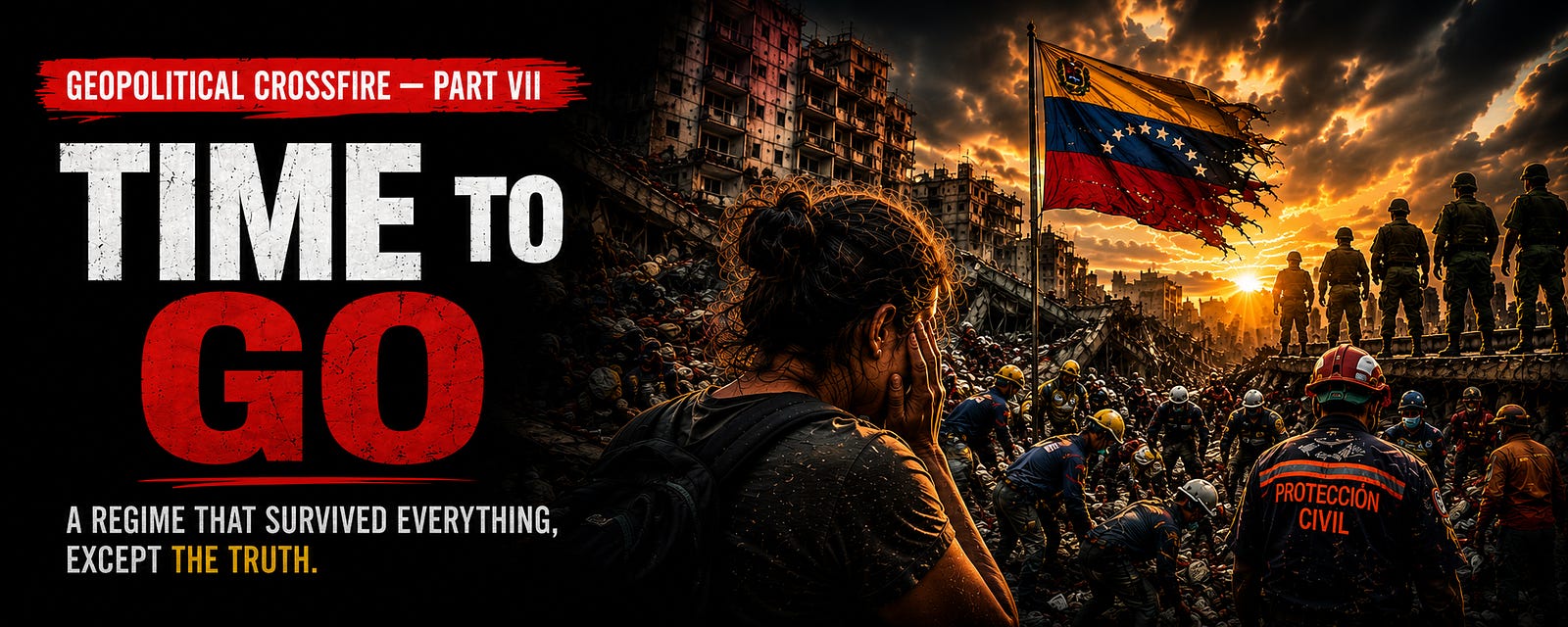
GEOPOLITICAL CROSSFIRE — PART VII
Three days. Three earthquakes. One thousand four hundred and thirty dead — that they will admit to. Sixty-eight thousand nine hundred missing — that the families are counting. Six million seven hundred and sixty thousand affected — that the United Nations has measured. The math is unforgivable. The verdict is not analytical anymore. The verdict is over.
On Wednesday, June 24, 2026, at 6:51 in the evening — on the national holiday commemorating the Battle of Carabobo, the day Venezuelans were home and not at work — two earthquakes of magnitudes 7.2 and 7.5 struck Venezuela thirty-nine seconds apart. The epicenter was in Yaracuy state. The coastal state of La Guaira, the same forty-kilometer strip that the December 1999 mudslides erased from the map, was hit hardest. More than four hundred and thirty aftershocks have followed. The U.S. Geological Survey issued its highest-level PAGER red alert and estimates a probabilistic distribution of fatalities: 28% between one thousand and ten thousand; 44% between ten thousand and one hundred thousand; 23% above one hundred thousand.
This is the deadliest natural disaster in modern Venezuelan history. It is also the moment at which the analytical register of this series — the polling matrices, the OFAC license tables, the IACHR resolutions, the federal court calendars — yields to the only register that remains: the moral one.
From The Caracas Stall through The April Verdict, The Maternal Clock, and The Fracture, this series has documented an architecture of normalization without transition. It has measured the slow accretion of moral debt that no oil deal could refinance. It has named the mothers — Carmen Navas, Ámbar Castillo, Marisela Parra, Blanca Guerrero — whose grief the regime treated as administrable cost.
On June 24, the architecture met the limit that no calendar could absorb. The buildings the regime built — the buildings on whose construction Alex Saab personally pocketed $159 million in materials that were never delivered — fell down on the people the regime had relocated into them. The mothers who searched El Rodeo I for their imprisoned children are now searching the rubble of the Urbanismo Hugo Chávez for their crushed ones. The Civil Protection rescue teams that arrived forty-eight hours late arrived with cellphone flashlights. The military that the regime deploys against protestors was, on the ground in La Guaira, absent from the rubble and assigned, instead, to checkpoint the road in.
This is the article that the previous six were building toward, and the one we did not want to write. It is a plea to the United States government. It is a call to action to the Venezuelan people. It is the verdict on a regime that survived its capture, survived its loyalists’ fracture, survived its Mothers’ Campaign, and survived The Fracture — but cannot survive a country digging through the rubble of its own corruption with bare hands while soldiers ten yards away polish their riot shields.
Time to go.
LIVE TRACKING — DART Mission Monitor: Venezuela Earthquake Response
venezuela-dart-monitor.vercel.app
A live, public dashboard tracking the U.S. DART/USAR deployment, SOUTHCOM assets in Venezuelan waters, the $150-million U.S. aid package allocation, and the full international response to the Venezuela earthquakes. Refreshes every hour. Most of the operational figures referenced throughout this article — USAR team rosters, USGS PAGER probability distributions, fatality and missing-persons counts, foreign contingents on the ground, official statements from U.S. and Venezuelan governments — are drawn from this monitor and verifiable against it in real time.
I. WHAT WE KNOW, AND WHAT THEY DO NOT WANT US TO KNOW
The official toll, as published by Acting President Delcy Rodríguez and National Assembly President Jorge Rodríguez on state television Saturday, June 27, at 1:00 a.m. local time:
• 1,430 dead.
• 3,238 injured. More than 7,500 in hospitals.
• 3,142 families lost their homes. The actual figure is, almost certainly, an order of magnitude higher.
• 432 seismic events total — the two main quakes and 430 documented aftershocks. One of magnitude 4.9 struck on June 27 itself.
• More than 51,000 missing — and on Saturday afternoon, the Foreign Ministry quietly revised that figure to 68,900.
The unofficial toll — assembled by citizen platforms, foreign correspondents, the WhatsApp groups Venezuelan families have built in the absence of state response — is not contained in any of the figures above.
• The Desaparecidos Terremoto Venezuela platform, launched within forty-eight hours of the quakes by volunteers, was reporting 40,223 missing by June 25. By June 27 the figure had crossed 50,000, with only 2,843 located so far.
• One independent database identified 11,200 missing in La Guaira state alone — a state whose pre-quake population was approximately 350,000.
• The USGS PAGER estimates — based on building stock, population density, and seismic intensity — assign a 44% probability that the final death toll will be between 10,000 and 100,000, and a 23% probability that it will exceed 100,000.
• The UNDP estimates direct economic damages at $6.7 billion as a floor, with a projected ceiling of up to $100 billion.
• Venezuela’s nominal 2026 GDP per the IMF World Economic Outlook is approximately $111 billion. The UNDP floor estimate therefore represents approximately 6% of one year’s Venezuelan economic output; the ceiling represents approximately one full year of GDP. For comparison, the Rodríguez interim government’s announced reconstruction fund — $200 million — is less than 0.2% of annual GDP, less than 3% of the damages floor, and less than one-fifth of one percent of the ceiling. The 6.76 million people affected, per the IOM, represent approximately 24% of Venezuela’s population of 28.6 million. Roughly one in four Venezuelans has been touched by this catastrophe.
The disparity is not statistical noise. It is the most consequential single data point of the disaster, and it is the regime’s first lie. In a country whose information apparatus — Mario Silva’s removed program, Diosdado Cabello’s silenced Con el Mazo Dando, the X-platform suppression maintained since August 2024 — was already operating below capacity, the gap between 1,430 and 68,900 is the gap between a state that admits a tragedy and a state that is burying it.
The architecture this series described in The Caracas Stall had a number to which it had to lie: 47.08% gratitude. The architecture it described in The Fracture had a number it had to lie about: 187 military prisoners. The architecture this article describes has a number it cannot lie about, because every Venezuelan family knows the name of at least one of the missing it contains: between forty thousand and one hundred thousand.
II. THE BUILDINGS THAT FELL, AND THE NAMES ON THEIR CORNERSTONES
The regime’s own figures acknowledge more than 1,400 structures damaged, including 13 hospitals. More than one hundred buildings collapsed entirely across Venezuela between Wednesday evening and Sunday morning. The geographical distribution is the indictment.
In Caracas, the Petunia Building — twenty-two stories, in the eastern municipality of Chacao — totally collapsed. Thirty-five deaths confirmed at that single address. The neighborhood’s mayor, Gustavo Duque, reported sixteen documented injuries beyond the Petunia and two additional structural collapses in the same municipality. In the Altamira neighborhood, three buildings collapsed including a separate twenty-two-story tower; thirty additional buildings were severely damaged. The buildings housing the French Embassy and the Venezuelan Red Cross headquarters sustained severe structural damage. In Baruta, at least two buildings collapsed with three confirmed dead in the immediate aftermath. In Pinto Salinas, two killed in a structural collapse.
Why Chacao: the same neighborhood that fell in 1967
The concentration of damage in Chacao — and specifically in the Los Palos Grandes-Altamira (LPG-A) corridor — is not chance. It is the same soil-building-code interaction that produced the collapse of four medium-rise residential towers in the same neighborhood during the 1967 Caracas earthquake. The seismic engineers of Venezuela’s Universidad Central have documented it for fifty-eight years. The 2026 quakes simply reactivated the geometry.
Three factors compound:
• Soil amplification. The LPG-A corridor sits on dense sediments up to 360 meters deep, with VS30 of 300 m/s — classified as intermediate soil in the official Caracas microzonification (Schmitz et al., 2011). The spectral acceleration ratio between this deep soil and bedrock is approximately 3.5× in the 1-to-2-second period range — the exact resonant band for medium-rise reinforced-concrete buildings of ten to twenty-two stories. Petunia (22 stories), Don Pepe, and Obelisco fall squarely within that resonance window. The soil itself amplified the destructive frequencies directly into the structural period of those buildings.
• Pre-1967 building stock. The 1967 Caracas earthquake (M6.6, July 29, 1967, ~250 dead) damaged 20% of LPG-A buildings structurally and affected nearly half of the buildings in the neighborhood. Four medium-rise residential towers — the Neverí at Plaza Altamira, the San José on First Transversal Los Palos Grandes, the Mijagual (10 stories, where a party that night killed all the invitees), the Palace Corvin on Avenida Luis Roche — collapsed in the same blocks where Petunia, Don Pepe, and Obelisco fell in 2026. Venezuela introduced its modern anti-seismic code (COVENIN) only after the 1967 quake. The buildings designed between 1950 and 1967 with the insufficient seismic norms of that era were the ones that fell — both times. Mayor Duque confirmed it explicitly on La FM: “Probably because of the date of the buildings, they did not comply with the present need to meet the anti-seismic requirement.” Post-1967 buildings in Chacao resisted.
• The doublet effect. The June 24 event was a doublet — the M7.2 quake at 6:51 p.m. weakened structures; the M7.5 thirty-nine seconds later collapsed them. People had no time to evacuate between the two ruptures. Pre-1967 buildings that had absorbed and survived the 1967 single-event shaking — and even the lesser tremors of subsequent decades — finally yielded to the cumulative damage of a near-simultaneous double impulse.
In a different city, in a different soil column, with a different building-code history, the same magnitudes would have produced a different geography of damage. In Caracas — and specifically in Chacao — the catastrophe found the architecture of its 1967 rehearsal. The lesson of 1967 was published in engineering journals. It was not retrofitted into the buildings.
In La Guaira, the destruction was — and remains — categorical. The Catia La Mar district, which contains nearly two hundred housing towers, sustained near-total damage; one resident described it on AFP camera as “everything, everything collapsed.” The seaside town of Macuto — the first stop on Delcy Rodríguez’s June 26 propaganda tour — was photographed on satellite imagery before and after by Planet Labs PBC; the Hotel Eduard and adjacent waterfront developments are recognizable in the “before” image and absent in the “after” one. The Nautilus Building in La Guaira — where a Spanish Military Emergency Unit team pulled a twenty-nine-year-old woman alive seventy hours after the quakes — is referenced in news reports as a structure that no longer exists as a building. Caraballeda, Maiquetía, Naiguatá. The same towns the 1999 mudslides buried.
In Yaracuy, the epicenter state, San Felipe reported thirteen heavily damaged homes. In Cocorote — and this detail is the indictment in miniature — two buildings under construction collapsed. In Independencia, walls cracked. In Trujillo, Carabobo, Aragua, Miranda — collapses confirmed.
The pancake collapse: the chavista signature in concrete
There is a structural fact that no political framing can erase, and that the next paragraphs of this Part VII must record before they proceed: more than one hundred buildings do not collapse pancake-style by accident. Pancake collapse — the failure mode in which a multi-story reinforced-concrete building falls straight down on itself, slab on slab, with no lateral displacement, leaving the floors stacked like compressed pancakes and almost no survivable air pockets in between — is the single most lethal and the most diagnostic failure mode in earthquake engineering. It is the failure mode that produced the bulk of the 53,000+ deaths in the 2023 Kahramanmaraş earthquakes in Turkey. It is the failure mode that buried tens of thousands in the 1985 Mexico City quake, the 1999 İzmit quake, the 2010 Haiti quake. And the international engineering literature is unambiguous about what causes it.
A building does not collapse pancake-style because the earthquake was strong. A building collapses pancake-style because it was built wrong. The technical term is “non-ductile reinforced concrete frame.” The mechanism is “strong beam, weak column” — the inverse of what every modern seismic code on Earth has required since the 1960s. In a correctly designed reinforced-concrete building, columns are detailed to be stronger than beams; in an earthquake, the beams yield first, dissipating energy through controlled cracking, while the columns hold their axial load and the building remains standing even if heavily damaged. In a building that pancake-collapses, columns are weaker than the beams above them; in an earthquake, the columns shatter under axial load before the beams can yield, and the floors fall straight down. The identifiable construction defects that produce this inversion are well documented in international engineering literature: inadequate column cross-section relative to load, substandard concrete mixes with insufficient cement and contaminated aggregates, transverse reinforcement (stirrups and ties) at column-beam joints that is missing or undersized or improperly spaced, longitudinal rebar of smaller diameter than specified, insufficient cover, soft-story ground floors with open-plan commercial use and no shear walls, and the absence of any seismic detailing whatsoever. These are not natural phenomena. They are the signature of construction by people who either did not know better, did not care, or were not paid for the materials they were supposed to install.
Now consider the Venezuelan field evidence. By Saturday June 27, the Asamblea Nacional president Jorge Rodríguez had acknowledged 1,423 affected structures including 383 buildings, 13 hospitals, 25 shopping centers, and 1,002 immovable properties — predominantly in La Guaira. Field photography from AFP, Reuters, Getty Images, and Planet Labs satellite imagery from the first seventy-two hours documents dozens of confirmed pancake-style collapses: the Petunia, Don Pepe, and Obelisco in Chacao; the Hotel Eduard’s in Macuto (vanished entirely between Tuesday and Thursday satellite frames); the Nautilus Building in Caraballeda; Residencias Rita, Moisés, and Marama in San Bernardino; Bloque 5 in Pinto Salinas; multiple towers of the Urbanismo Hugo Chávez complex (Suma Playa Grande and others); the Catia La Mar near-bicentennial-tower zone where Mayor Duque’s Chacao colleagues estimate that nearly two hundred structures sustained near-total damage. A pancake-collapse rate at this density is not a randomly distributed phenomenon. It is a population statistic — and population statistics in catastrophe engineering have causes.
Here the necessary distinction must be drawn. The pre-1967 buildings of Chacao that collapsed — the Petunia (built in 1965), the Don Pepe, the Obelisco — are explicable by the framework established earlier: soil amplification in the Los Palos Grandes corridor, pre-COVENIN seismic norms, the doublet effect. Those collapses are historically traceable to a building stock that predated the chavismo by three decades. The 1967 quake produced the same outcome in the same neighborhood for the same reasons. What is not explicable by the 1967 framework are the post-1999 pancake collapses. The Misión Vivienda towers built after 2011, the Urbanismo Hugo Chávez complex completed in stages between 2012 and 2019, the Nautilus Building and the Caraballeda towers, the San Bernardino residence blocks Rita and Moisés and Marama (all post-2005 reconstruction), the near-two-hundred-tower Catia La Mar zone that was substantially post-1999 reconstruction under the same federal program that Saab’s missing $156 million was meant to supply — these were not pre-COVENIN. They were post-COVENIN. They were built, in many cases, during the years when the Venezuelan seismic code was at its most stringent on paper. They collapsed pancake-style anyway. The code existed. It was not enforced. The materials existed in the budget. They were not delivered. The inspectors existed in the regulatory chart. They did not inspect. This is the chavista signature in reinforced concrete.
The connection to the Saab indictment is now structural, not metaphorical. The May 18, 2026 federal court filing in the Southern District of Florida documents that the 2012-2013 housing-materials import contract awarded to Alex Saab’s Fondo Global de Construcción for $159 million yielded approximately $3 million in delivered materials. The other $156 million disappeared. The buildings that did not receive those materials — the GMVV buildings, the Misión Vivienda blocks, the Urbanismo Hugo Chávez towers — are the same buildings that this week pancake-collapsed on their occupants. The federal cooperation file that the Department of Justice will produce as Saab’s plea-bargaining process advances will name the inspectors who approved the substandard concrete, the contractors who used the inadequate rebar, the engineers who signed the falsified seismic certifications, the bureaucrats who waived the column-confinement requirements. Each name on that file is connected to a body under a pancake-collapsed slab. The Saab indictment is the first installment of a corruption-and-construction-defect prosecution. The earthquake of June 24 is the second. The federal cooperation file will be the third. And the engineering forensics — when peace-time conditions permit them — will be the fourth.
This pattern extends beyond construction. It is the operational truth of twenty-five years of chavista governance: PDVSA production collapsed 80 % (3.3 million barrels per day in 2003 to under 700,000 in 2020); nine national blackouts between 2019 and 2024; the food production system reduced to the carnet de la patria loyalty distribution that produced 80 %+ poverty rates; maternal mortality quintupled between 2012 and 2023; the UCV budget systematically destroyed and 30,000 professors fled; the diplomatic service replaced by G2 operatives whose foreign-policy output included the Tren de Aragua transnational expansion; the judiciary instrumentalized to produce 1,915 political prisoners by January 2026. Everything the chavismo has touched in twenty-five years, it has either destroyed or handled with absolute incompetence. The pancake-collapsed buildings of June 24 are not the exception in this record. They are the latest installment in it.
What is buried beneath the pancake-collapsed slabs of La Guaira and Caracas is not just the dead. It is the cumulative consequence of twenty-five years of state contracts awarded to loyalists, of regulatory waivers granted to friends, of inspections falsified, of materials stolen, of corners cut at every level of construction by a regime whose operational logic was political control rather than infrastructural competence. The doublet of June 24 was the trigger. The pancake failures are the result. But the cause — the deep cause, the cause that the forensic engineers and the federal prosecutors will document over the next decade — is the chavista mode of government itself. The earthquake did not build those buildings. The chavismo built them. The earthquake merely revealed what they were always going to do when shaken. And the chavismo has now buried under them the people who trusted those buildings to protect them.
The corner of the construction sign
The single most consequential image to emerge from the rubble in the seventy-two hours since the quakes was photographed by Getty Images on Friday, June 26, in La Guaira state. It shows the wreckage of a Misión Vivienda housing complex. The corner of one of the surviving panels bears a name: “Urbanismo Hugo Chávez (Suma Playa Grande).” In the same frame, the corner of an adjacent collapsed building — a six-story residential block — is visible behind a relief volunteer. Both buildings were built between 2012 and 2014 under the Gran Misión Vivienda Venezuela (GMVV), the Bolivarian government’s flagship housing program.
The GMVV was launched by Hugo Chávez in 2011 with the stated goal of building 350,000 homes by the end of 2012. By 2024, Nicolás Maduro was claiming the program had delivered 5.1 million homes. The reality was always smaller, opaquer, and structurally compromised. Between 2011 and 2017, the program received an estimated $76 billion in expenditures whose final allocation remains unaccounted for — a figure published by Transparencia Venezuela and never refuted by the government.
Of that unaccounted $76 billion, one fragment has now arrived in U.S. federal court. Between 2012 and 2013, Colombian businessman Alex Saab — currently in pre-trial detention at the federal courthouse of the Southern District of Florida, delivered by the Rodríguez government to the United States on May 16, 2026 — received $159 million from the Venezuelan government for the importation of housing materials. He delivered approximately $3 million worth of materials. The case is part of the federal indictment against him.
The architecture of normalization that The Caracas Stall identified, and the federal prosecutorial architecture that The Fracture tracked, now converge at a single point: the buildings the regime did not build, with the money the regime did not spend, are the buildings that fell on the Venezuelan people on June 24, 2026. The witness against the architecture is, today, in a Miami federal detention facility. The victims of the architecture are, today, under thirty feet of rubble in Catia La Mar.
The warnings, and the warners
The structural fragility of GMVV buildings was warned about — repeatedly, publicly, and by Venezuela’s most authoritative voices — for fifteen years. The warnings were ignored, then suppressed, then forgotten. They are no longer forgotten.
Enzo Betancourt, President of the Engineers Association of Venezuela, declared as early as 2013: “The Venezuelan Engineers Association does not have official information on the structural calculations of Misión Vivienda. That is a state secret. Only the people of the mission and the builders know. What is known is what has been denounced by all the media, of buildings with cracks, fissures, or leaks.”
Alfredo Cilento, researcher and co-founder of the Instituto de Desarrollo Experimental de la Construcción at the Universidad Central de Venezuela: “We believe that there is vulnerability in the Misión Vivienda buildings. In some areas it is more or less evident. We know that the quality of the soil studies is not clear, or if they were done at all.”
Gustavo Izaguirre, Dean of the Faculty of Architecture and Urbanism of the Universidad Central de Venezuela, warned explicitly that “there have been construction elements that make the buildings vulnerable in the event of an earthquake.”
On August 30, 2017, a 4.5-magnitude tremor struck Tanaguarenas, in what was then Vargas state. Cracks in a Misión Vivienda building grew larger; residents publicly feared collapse. The government denied any structural concern. Nine years later, those same buildings, in the same coastal strip, fell at 7.5 magnitude.
Of the approximately one hundred buildings that collapsed in the June 24 quakes, an unknown majority were Misión Vivienda constructions — and the entirety of the housing stock in Catia La Mar’s nearly two hundred-tower zone was post-1999 reconstruction, much of it under the same federal program that Saab’s missing $156 million was meant to supply.
This is not bad luck. It is not act of God. It is the structural failure of corruption made physical. The 1999 mudslides killed between 10,000 and 30,000 because they were a 1,000-year rainfall event in a geomorphologically unforgiving terrain. The 2026 earthquakes have killed an unknown number — but a meaningful proportion of those dead are buried beneath buildings that did not need to fail. They were structurally pre-broken by the people who built them. The 1999 dead died from the mountain. Many of the 2026 dead died from the buildings.
III. THE FORTY-EIGHT HOURS OF SILENCE
Acting President Delcy Rodríguez declared a state of emergency on Wednesday night and announced a $200 million reconstruction fund. For context: that fund is less than 0.2% of Venezuela’s 2026 GDP ($111 billion per IMF), less than 1% of what the GMVV is estimated to have absorbed in unaccounted spending, and less than 3% of the UNDP’s floor estimate for direct economic damages from these quakes alone. The Interior Minister, Diosdado Cabello, made his first on-camera statement on Wednesday night. His instruction: “People must understand that they cannot remain inside houses or buildings. They should not expose themselves. Go out into the street and wait calmly.”
That was the first instruction the regime gave its people in the first hours after the earthquake. Not get to the rubble. Not we are deploying. Not here is what we are doing. Wait.
Civil Protection — Venezuela’s state emergency-response agency, which by international convention should be the first organized rescue presence at any disaster site — was photographed on Wednesday night, and on Thursday morning, and into Friday afternoon, doing rescue work at the Petunia building using cellphone flashlights because the agency had neither industrial illumination, nor the generator capacity to run it. The image was reposted by Venezuelan media until it could no longer be suppressed and entered the global newswire.
José Pacheco, operations chief of the United Rescue Group of Venezuela, with thirty years of experience, told AFP on Thursday: “I have never seen anything like the aftermath of these earthquakes.” He said La Guaira needed, above all, “technical help” — specialized rescue teams. The Venezuelan state had none to send.
Mother of three Dayana Delgado, searching for her eight-year-old son in Catia La Mar, told CNN: “I want to know where my child is, if he’s trapped or in a shelter.” She added — and this sentence will outlast the regime — “Where is the heavy machinery the government promised? The residents are the ones digging through the buildings.”
Mileidy Romero, searching in Caraballeada on Saturday morning, told AP: “There’s a pile of bodies over there from last night. Newborn babies. At 8 p.m. yesterday there were people alive down there, and they haven’t bothered to rescue them. We’ve located several bodies, and they haven’t helped us recover them either. What are they waiting for?”
Yilsmaris Blanco, surveying her neighborhood in Catia La Mar — the nearly-two-hundred-tower district built on the alluvial fans that buried the towns of Carmen de Uria and Cerro Grande in 1999, then rebuilt under the GMVV between 2011 and 2017 — told AFP: “Everything, everything collapsed.”
Jonny Montoya, 62, with his panicked 84-year-old mother in El Rosal, Caracas, told the Jefferson City News-Tribune: “This government is a criminal gang that has done worse than an earthquake. If the international community sends aid, the state will steal it. The firefighters don’t have gasoline; they don’t have any tools to solve the problem.”
The fourteen thousand military and police that Delcy Rodríguez announced on Saturday were “patrolling the area” were not pulling people from rubble. They were not running heavy machinery. They were not staffing field hospitals. They were patrolling. Photographed at checkpoints. Cordoning off Delcy’s visit. Polishing riot shields ten yards from women digging with their hands.
On Friday evening, Cabello announced, on the state-television channel VTV, that effective at 8:00 p.m. that night, “access to the state of La Guaira is restricted.” Anyone wanting to enter “must register at the Poliedro de Caracas” — a stadium on the south side of the capital, roughly forty kilometers and at least one regime checkpoint from where rescue work needed to happen — “to receive an entry permit. Authorities along the route will make decisions to prevent entry by unauthorized individuals.”
The state’s first organizational instinct, seventy-two hours after the earthquakes, was to bureaucratize access to the dead. Venezuelans driving from Caracas with bottled water, food, generators, and stretchers were told to register at a stadium first.
On Friday, Delcy Rodríguez visited Macuto. State television documented the visit. Behind the cordon, dozens of residents and victims’ families chanted: “Enough of making a political campaign out of a tragedy like this!” Others: “The government isn’t doing anything for the people!” When her motorcade arrived at the Petunia building in Chacao, soldiers cleared the street and stopped the heavy machinery that had been clearing rubble so that her entourage could pass. A woman with someone trapped under that rubble screamed “My family! My family!” while the machine sat idling. The crowd captured the moment on phones. It went viral within an hour.
Patient lists at Hospital Miguel Pérez Carreño — eight handwritten pages, photographed by a doctor and circulated on WhatsApp because the hospital’s own records system had collapsed — listed the names of pediatric patients with no family member present. At Hospital José María Vargas, the dead were stacked outside on the dirt of a parking lot because the morgue had filled by Thursday afternoon.
The Havana protocol: a playbook designed for the wrong emergency
None of this is random incompetence. Every behavior the Venezuelan state has displayed in the seventy-two hours since June 24 is the operational signature of a methodology institutionalized in Venezuelan security services across two and a half decades: the Havana protocol — the political-control playbook of the Cuban Dirección General de Inteligencia (G2), exported to Caracas under the October 30, 2000 Convenio Integral signed by Chávez and Castro and deepened by the 2008 secret military memorandum of understanding that the United Nations Independent International Fact-Finding Mission on Venezuela has formally reviewed.
The UN Mission, the Organization of American States, the CASLA Institute under Tamara Sujú, Human Rights Watch, Amnesty International, and the testimonies of exiled Venezuelan generals — General Manuel Ricardo Cristopher Figuera (head of SEBIN until 2019), General Antonio Rivero, General Clíver Alcalá Cordones — converge on the same finding: Cuban G2 advisers are embedded throughout SEBIN, DGCIM, the Defense Ministry, Foreign Ministry, PDVSA, the Strategic Operational Command, the airports, the ports, and the identification authority. In the words of Rocío San Miguel, director of the Venezuelan NGO Control Ciudadano: “Cuba today directs the country’s destiny. The situation room where the most important strategic decisions are made — political, military, but also economic and social — is in Havana.”
The Havana methodology is designed for the political control of a population. Its instinctive reflexes — information suppression, movement restriction, military deployment to crowd-control function, theatricalization of leader presence, removal of opposition voices, dismissal of independent citizen organization as suspect — are tuned for one purpose: keeping a regime in power against the will of its people. The methodology was developed inside Cuba between 1959 and the present, exported to Sandinista Nicaragua between 1979 and 1990, and refined inside Venezuela across the 2002 attempted coup, the 2014 guarimbas, the 2017 protests, and the post-July 2024 electoral repression that resulted in 1,915 political prisoners by January 2026.
In each of those contexts, the methodology worked, in the cynical sense: it kept the regime alive. But an earthquake is not a protest. The dead under the rubble are not opponents. The volunteer with bare hands at the Petunia is not an insurgent. The mother in Caraballeda screaming into a thirty-foot pile of concrete is not an enemy of the state. The earthquake is a humanitarian emergency that demands the opposite operational logic from the one the Havana protocol provides: rapid information dissemination, free movement to disaster zones, military deployed for rescue rather than crowd control, decentralized civilian coordination, integration of all available citizen capacity — including opposition capacity — into the response.
The Venezuelan state, in the seventy-two hours since June 24, has applied every single one of the Havana protocol’s reflexes to a problem the protocol was not designed to address: information suppression (X-platform blockage maintained until UN pressure forced its lifting; official toll revised upward only after the citizen platform Desaparecidos Terremoto Venezuela exposed the gap; the Foreign Ministry’s revision from 51,000 to 68,900 missing buried in a Saturday afternoon update); movement restriction (Cabello’s order to “register at the Poliedro de Caracas” before entering La Guaira; the checkpoints configured for political vetting rather than rescue traffic); military deployed for crowd control (the 14,000 announced as “patrolling the area” photographed in formation with riot shields, not pulling people from rubble); theatricalization of leader presence (Delcy’s Macuto and Petunia visits with motorcades clearing streets and heavy machinery stopped for state-television cameras); removal of opposition voices (state media erasing the operational records of Mayors Duque in Chacao and González in Baruta, even as their extraction counts outperformed the regime’s); dismissal of citizen organization as suspect (Jorge Rodríguez’s request that citizens “mobilize through authorities instead of delivering supplies to La Guaira” — the Havana protocol’s reflexive distrust of independent civic action, applied to a context where independent civic action is what keeps people alive).
The regime cannot deactivate the protocol because it does not know how to act otherwise. Twenty-five years of Cuban methodology has made the Venezuelan state structurally incapable of responding to a humanitarian emergency as a humanitarian emergency. It can only respond to it as a political threat. And it is doing so. Every checkpoint, every cellphone flashlight, every motorcade — these are not symptoms of resource scarcity. They are the architecture of a state that was designed for a different purpose: keeping itself alive. The cost is paid by people whose only crime was being inside the buildings on June 24 at 6:51 p.m.
The cost of the forty-eight hours
The international urban search-and-rescue literature is unambiguous on the time-survival relationship for victims entrapped under collapsed reinforced-concrete structures. The first twenty-four hours after impact yield a survival probability for entrapped victims of approximately 90%. Hours twenty-five to forty-eight: 50-60%. Hours forty-nine to seventy-two: 20-30%. Beyond seventy-two hours: 5-10%. These figures, canonical in INSARAG and FEMA disaster-medicine protocols, are why the post-impact window is described in the field literature as “the golden 72 hours.”
Venezuela spent approximately forty-eight of those critical seventy-two hours with its Civil Protection illuminating rubble by cellphone, its 14,000-strong security deployment configured for checkpoints, its volunteer access controlled by Poliedro permit, its motorcade theatrics interrupting heavy machinery. The math of preventable death is not academic.
Against the official 51,000 to 68,900 missing at the seventy-two-hour mark, the state has reported approximately 243 live extractions — a rescue rate of roughly 0.4%. International USAR benchmarks against comparable building-collapse events with functional state response — the 1985 Mexico City quake under Cárdenas-era municipal response, the 1999 Marmara quake in Turkey, the 2010 Haiti response despite catastrophic state collapse, the 2023 Kahramanmaraş Turkish response — would suggest a live-extraction rate of 5-10% of entrapped victims against a functional response infrastructure in the first twenty-four hours.
Applied to the Venezuelan figures, the differential is calculable. A functional state response in the first twenty-four hours — Civil Protection equipped with industrial illumination, 14,000 military doing rescue rather than checkpoint duty, no Poliedro bottleneck, integration of volunteer and opposition capacity from hour zero — would have produced between two thousand and five thousand additional live extractions against the realistic universe of entrapped survivors. The state’s actual response, structured by the Havana protocol, produced 243.
The differential — between two and five thousand preventable deaths — is the operational cost of applying the Cuban political-control playbook to a building collapse. It is the cost of forty-eight hours of esperar con tranquilidad. It is the cost of soldiers at checkpoints rather than at rubble. It is the cost of motorcades stopping the heavy machinery. It is the cost of permit requirements at a stadium for citizens carrying water bottles. Every hour the state spent at the checkpoint was an hour that buildings emptied of survivable air pockets.
These are not deaths the earthquake caused. These are deaths the regime caused, by applying to a building collapse a methodology designed to break a strike. The earthquake killed many thousands. The Havana protocol killed thousands more. The latter number is the one that can be prosecuted.
This is the state to which the United States Senate, in February 2026, granted normalization of relations.
IV. THE TOLL ON THE LIVING
Before the prosecution, before the politics, before the calls to action — the people. The catastrophe of June 24 cannot be measured by the count of the dead alone, because the catastrophe did not end at the moment of the second tremor. It continues, hour by hour, in the bodies of those who survived. They are the ones who carry, now, what the regime cannot reach to repair: the orphaned children waking in hospital wards without their parents, the families sleeping in plazas because their homes either fell or are no longer trusted, the hungry queuing for the food the supply chain cannot deliver, the bodies under rubble that will produce, in the absence of recovery, the next public-health emergency, the small enterprises and the livelihoods erased in seventy-two hours that took decades to build.
Yenderlin Cabarza, age thirteen, with both arms broken, alone
She arrived at Hospital Domingo Luciani in eastern Caracas by ambulance on Thursday morning, transported from La Guaira with her arms shattered. Her name is Yenderlin Cabarza. She is thirteen years old. She came in alone. Her mother did not survive. Her uncle — who had wrapped his body around hers as the building came down — did not survive. She was operated on for fractures in both arms by surgeons who did not know who she was when they put her under anesthesia. When she came out of surgery, her father, having driven up from La Guaira behind the ambulance, was waiting outside the operating room. He was told that his daughter was alive. He did not yet have the words to tell her about her mother.
Yenderlin is one of twenty-two children and adolescents between ages four and nineteen listed on the handwritten emergency lists pasted on the walls of Domingo Luciani’s emergency department alone, as of Thursday evening — and that is one hospital. The Pérez Carreño had similar lists. The José María Vargas had similar lists. The Domingo Luciani’s doctors, speaking to AFP on condition of anonymity because they were not authorized to talk, described the operational pattern: “Several of the children arrive alone, because they’re brought rapidly from the rescue site to wherever they can be treated.” Some can say their names. Others cannot. Some arrive identified only with adhesive tape on their arms — the rescue paramedics writing the name in marker on the tape if the child could speak it, leaving the tape blank if the child could not. As one journalist observed: “as if, amid the collapse, identity itself had to be rescued urgently.”
How many children Venezuela has just orphaned, no one yet knows. The figure will rise, hour by hour, as the missing become the confirmed dead and the surviving children become wards of the state — or, more likely in this state, wards of nothing at all. There is no Venezuelan equivalent of UNICEF’s child-protection cluster deployed within the country’s social services infrastructure, because that infrastructure has not functioned for fifteen years. There are aunts and uncles. There are grandmothers. There are neighbors. There are church congregations that will absorb what they can. There is also the long Venezuelan tradition of orfanato — the orphanage of last resort — which the regime has historically used as a political instrument rather than a refuge. There is no plan. The children pulled alone from the rubble of Catia La Mar and Caraballeda and San Bernardino are now, in the operational vocabulary of disaster response, unaccompanied minors. In another country with another government, they would be the highest-priority caseload of the next year. In Venezuela on June 27, 2026, they are children with adhesive tape on their arms.
Plaza Candelaria, and the country sleeping outdoors
In the central Caracas plaza of La Candelaria on Thursday morning, María Cristina Díaz, a 41-year-old cleaning worker, had not slept the entire night. She was there with her mother and her daughter, on the open ground of the plaza, because none of them could bear to stay in their building, even though the building had not collapsed. “We were afraid the buildings would come down on us,” she told AP. “We were cold. My mother, my daughter and I didn’t sleep a wink, but we didn’t want to spend the night alone in the house.” That sentence — the refusal to be alone — is the keystone of what has happened across Caracas and La Guaira in the seventy-two hours since the doublet. People have left their buildings. They are not going back.
Across Caracas and La Guaira on Saturday morning — in plazas Candelaria, Altamira, Bolívar, Sucre, Brión, Sadel, Andrés Eloy Blanco, in the grounds of the Universidad Central, in the interior squares of urbanizaciones in San Bernardino, Los Palos Grandes, and El Paraíso — an estimated several hundred thousand people are sleeping outdoors, some in tents that volunteer brigades distributed, most on mattresses dragged from apartments, some on cardboard, some on nothing at all. Mothers with newborns. Elderly diabetics whose insulin cannot survive seventy-two hours without refrigeration. Children with disabilities whose wheelchairs no longer have an accessible building to enter. Families told their building is structurally compromised and will not be safe to re-enter for weeks — and in many cases, will be condemned.
And night falls. The Avila foothills above Caracas, in late June, drop into the upper fifteens Celsius after dark. Children without coats. Mothers without milk. Grandmothers without their blood-pressure medications. This is what “sleeping in plazas” actually is. It is not a temporary discomfort. It is a humanitarian emergency unfolding in slow motion, one cold night at a time.
Hunger, water, and the epidemic that has already begun
By Friday afternoon, in Catia La Mar — the La Guaira parish where Mayor Duque’s Chacao colleagues estimated near-two-hundred-tower damage — the looting began. EFE photographed people climbing over the roofs of collapsed stores to remove food, medicine, and household appliances. The looting was not driven by opportunism. It was driven by hunger. By Friday, residents of the most-affected zones had not eaten regular meals in forty-eight hours. The food distribution networks of the GMVV carnet de la patria — which had functioned as a political-control instrument long before the earthquake — had simply stopped functioning. The supermarkets that remained standing were closed. The informal bodegas had run through their inventories by Thursday afternoon. The mercados populares had no resupply. The agricultural production zones in the central states had not been catastrophically damaged, but the trucks could not get to Caracas because the highways were either obstructed by debris or blocked by Cabello’s checkpoints. The food was in the country. It could not reach the people.
Water followed the same pattern. The Hidrocapital lines that serve metropolitan Caracas were ruptured at multiple points by the seismic activity. Several La Guaira parishes lost municipal water service entirely. The bottled-water supply in Caracas supermarkets sold out in eight hours on Wednesday night. The improvised brigades that drove water up from Valencia and Maracay to the displaced families in the plazas were the only functional supply mechanism by Friday. This is the precondition for cholera. Public-health emergencies of the magnitude that follows major earthquakes do not require the introduction of a new pathogen — they require the pathogens that already exist in the population (cholera, typhoid, dysentery, hepatitis A) to encounter populations with no clean water, no sanitation, and no medical infrastructure. All three of those conditions have now obtained in La Guaira for the first time since the 1999 deslave. The Pan-American Health Organization has already begun pre-positioning vaccines in the Dominican Republic in anticipation of the outbreak.
The unrecovered bodies make the epidemiology worse. By Saturday afternoon, the Bello Monte morgue was beyond capacity. The Pérez Carreño morgue was beyond capacity. The José María Vargas Hospital had laid out bodies in the parking lot because the cooled storage was overwhelmed, and the smell of decomposition had begun to dominate the building. Family members were photographing the bodies on their phones to identify them later. The bodies still buried under the rubble in La Guaira — perhaps tens of thousands of them if the higher USGS PAGER scenarios are correct — will, in the coming weeks, in the Caribbean humidity, in the absence of forensic capacity, in the absence of any organized recovery operation, become themselves a vector. The grieving cannot bury what they cannot find. The state cannot identify what it cannot recover. And the public-health risk does not wait for closure.
The economic obliteration: jobs, livelihoods, the small enterprises
The UNDP $6.7 billion floor estimate for direct economic damage — the figure that is approximately 6% of Venezuela’s nominal 2026 GDP — is, in operational terms, an understatement of the human-scale economic catastrophe by orders of magnitude. The direct-damage figure measures what can be measured: the cost of replacement construction, the value of destroyed inventory, the insurance claims that will be paid. It does not measure what cannot easily be measured: the small enterprises erased, the informal-sector livelihoods obliterated, the household savings vaporized when the family apartment that was the household’s lifetime wealth became rubble.
In La Guaira, the affected sectors include the entirety of the artisanal fishing fleet of Macuto and Caraballeda — boats damaged in the harbor by debris and tsunami surge, processing facilities destroyed, the cold chain interrupted. The fishermen of La Guaira, who survived 1999 and rebuilt across two decades, have lost their livelihoods again. The twenty-five shopping centers damaged across Caracas, La Guaira, and Miranda represent thousands of small retail leaseholds — clothing stores, pharmacies, hardware shops, beauty salons, restaurants, dental offices — whose owners are now neither receiving rent nor able to operate. The 1,002 “other immovable properties” that Jorge Rodríguez referenced on Friday include warehouses, workshops, small factories, garages, mechanic shops, bakeries, tailoring shops, printing presses — the connective tissue of the urban informal economy.
And then there are the jobs. The Maiquetía airport closure has idled the entire Venezuelan aviation industry — Conviasa flight crews, Avior ground staff, the customs and immigration cadres at SAIME, the cargo handlers, the airport food-service workers, the taxi cooperatives at the international terminal. The hotel industry of Macuto and Caraballeda — built for the cruise traffic that was, before January 3, the main legitimate non-oil revenue source for the state — is gone. The fishing industry of the entire La Guaira coast is suspended. The Catia La Mar small-merchant sector, which served the housing complexes that are now collapsed, has no customers. The diaspora remittances — which by Banco Central data were running approximately $3.7 billion annually — will now be redirected from household-investment uses (renovations, small-business capitalization, education) to pure survival expenditure, which removes them from the productive economy. Hundreds of thousands of Venezuelans have lost their jobs between Wednesday afternoon and Saturday morning. Most do not yet know it.
The small and medium enterprises — the PYMES that opposition economists have spent twenty-five years identifying as the locus of any post-chavismo Venezuelan recovery, the engine of any plausible transition economy — have been disproportionately destroyed. The PYMES were concentrated in precisely the coastal-and-eastern-Caracas zones that the earthquake destroyed. They had no insurance reserves (insurance penetration in Venezuela had collapsed under the regime). They had no access to recovery credit (the banking system is dollarized informally but not productive credit-extending). They had no recourse to a functional state. Many of them, by Saturday, were already deciding not to reopen. The transition economy that the article’s call to action presumes will rebuild Venezuela has, in the seventy-two hours since the doublet, lost a fraction of its founding capital base that no number on a UNDP balance sheet has yet captured.
The unwritten bill
None of this — the orphaned children, the plaza dwellers, the hungry, the unrecovered bodies, the epidemic risk, the obliterated PYMES, the workers without jobs — is reparable by the $200 million reconstruction fund. That figure, less than 0.2 % of Venezuelan GDP, less than 3 % of the UNDP damage floor, less than what one Chevron oil cargo carries on its books, is not a reconstruction figure. It is a press release. The actual reconstruction figure — child-protection services for the unaccompanied minors, transitional housing, public-health surveillance and vaccination campaigns, small-enterprise recapitalization, trauma services, long-term mental-health caseload — is in the tens of billions of dollars. It requires a state that can deliver services at scale, with transparency, with technical competence, with continuity across years. This is not the state that exists in Venezuela on June 27, 2026.
What is owed to the survivors of this catastrophe — to Yenderlin Cabarza and the twenty-one other children on the Domingo Luciani list, to María Cristina Díaz sleeping in Plaza Candelaria with her mother and her daughter, to the fishermen of Macuto without boats, to the small merchants of Catia La Mar with looted inventory, to the millions of Venezuelans whose lives changed in thirty-nine seconds and will not change back — is a country that can do what their country, on this Saturday morning, cannot do. That is the unwritten bill of June 24. It is the bill the regime cannot pay, will not attempt to pay, and is not even acknowledging. It is the bill that the post-regime Venezuela — whenever it begins — will inherit on the day of its first cabinet meeting. It is the bill that all of the other arguments in this Part VII — the geological argument, the engineering argument, the Havana-protocol argument, the preventable-deaths argument, the U.S.-position argument — exist to make collectible.
This Saturday morning, somewhere in La Guaira, a child is sitting in a hospital ward with adhesive tape on her arm, and no one yet knows her name. She is what the article is about. Everything else is the architecture of explaining why she is alone.
V. THE CITIZEN ARMY
And then — as has happened every time in this country’s modern history — Venezuelans went themselves.
By Thursday morning, less than fourteen hours after the second quake, Caracas residents were driving the Caracas-La Guaira highway in private vehicles, loaded with bottled water, dry food, generators, blankets, hard hats, gloves, rope, and crowbars. By Thursday night, dozens of Venezuelans from Valencia — three hours away — were on the same road. By Friday morning, residents of Maracay, Maracaibo, and even further afield had joined them. They formed a volunteer army that the regime had not authorized, did not coordinate, did not equip, and could not stop.
Jorge Rodríguez, the National Assembly President, attempted in a Friday afternoon broadcast to “request that citizens mobilize their supplies through authorities instead of delivering them to La Guaira, to prevent road congestions.” The instruction was not obeyed. By Saturday, residents who had traveled from elsewhere in Venezuela were pulling people from rubble that state crews had not reached. One eleven-year-old child was extracted alive by a Colombian rescue team on Friday afternoon. A twenty-nine-year-old woman was pulled from the Nautilus Building’s wreckage by the Spanish UME nearly seventy hours after the quakes. A second victim, in the same building, was extracted by the same Spanish team several hours later — the same evening that Spanish state television was broadcasting footage of Diosdado Cabello announcing access restrictions to the state in question. An entire family was pulled alive from a collapsed La Guaira apartment after twenty-six hours in an air pocket — confirmed by Reuters footage.
The aviation community — pilots, flight attendants, technical staff, many of whom lived in La Guaira because the country’s main international airport is in Maiquetía — formed its own search network through industry WhatsApp groups. Patricia Velásquez, the actress, posted from her Instagram. Edward Pons, the Venezuelan content creator, transmitted hospital patient lists for families to scan. The Vente Venezuela comanditos — local cells organized by Machado’s party from the post-July 2024 grassroots resistance — became overnight humanitarian logistics nodes. By Saturday the citizen platform Desaparecidos Terremoto Venezuela had registered 40,223 reports of missing persons and had located 2,843 through volunteer cross-referencing, family WhatsApp groups, and hospital outreach. By Sunday morning the number had exceeded 50,000 reports.
This is what heroes look like. They are not announced. They do not wait for permits at the Poliedro. They do not coordinate through state agencies. They appear, in the first hours, without uniforms, with the tools they have, and they refuse to leave. Every one of them is, in the technical sense of the word, a hero. The regime is not. The regime is the obstacle. The regime is the entity that announced its first action as stay outside and wait, and its second action as register at the Poliedro for an entry permit.
VI. CARMEN’S SHADOW: THE LIVE-REENACTMENT
The Maternal Clock closed with a sentence: “Cabello can dismiss the maricorinato. He cannot dismiss the maternato. No regime in the modern era has.” Carmen Teresa Navas, the mother whose 282-day search for her dead son became that essay’s anchor, died on May 17, 2026 — ten days after the regime told her where her son was buried.
She has been dead for forty-one days as this is written.
And every screaming face on the rubble in La Guaira this weekend is Carmen Teresa Navas’s living face, multiplied — in the thousands.
Carmen is Mileidy Romero, in Caraballeada Saturday morning, watching newborn bodies stacked and unrecovered. Carmen is Dayana Delgado, looking for her eight-year-old son. Carmen is the mother who collapsed in grief Friday… Carmen is the unnamed mother in Catia La Mar who… screamed her dead daughter’s name into a thirty-foot pile of concrete for ninety minutes before being physically pulled away by neighbors: a Carmen. The woman who walked from Maracay to La Guaira with a backpack of antiseptic, bottled water, and a flashlight because she could not be in her home knowing what was happening to other women’s families: a Carmen.
The regime that buried Víctor Hugo Quero Navas in an unmarked grave and lied to his mother for nine months is the same regime that has now lied to fifty thousand families about whether their dead are dead. It is operationally the same lie. The architecture in 2025 stalled the file of a single mother. The architecture in 2026 is stalling the files of forty thousand.
This is the maternal narrative the series has tracked from The April Verdict forward, arrived at its full inventory. The Mothers’ Campaign was always going to outlast the regime. It just had a more aggressive timetable than the regime expected.
Cardinal Baltazar Porras, in El Nacional on May 10, invoked Rachel weeping for her children. The Rachels are now in Catia La Mar, in Macuto, in Maiquetía, in Pinto Salinas, in Caraballeada, in Catia La Mar. They are weeping over rubble that bears, on its cornerstone, the name Hugo Chávez.
VII. THE UNITED STATES POSITION CROSSES THE LINE WHERE IT CAN STILL RECOVER ITSELF
From The April Verdict forward, this series has documented the steady erosion of the Trump administration’s strategic position on Venezuela: the gratitude floor of 47.08 % in April; the “dancing in the streets” and “very happy country” remarks of May 6 and May 10; the Saab transfer of May 16; the Osprey embassy drill of May 23; the Rick Scott breaks of May 8 and May 17; the June 4 Energy Secretary statement bragging that exports were “three times more than before the start of the U.S. military operation.”
In the seventy-two hours since the earthquakes, the U.S. position has crossed into the territory of historical jeopardy. This week:
• The U.S. operational machinery deployed with seriousness. Three heavy-class USAR teams — Fairfax County USA-1 (79 personnel, 6 canines, ~200,000 lbs of equipment), Los Angeles County USA-2 (74-84 personnel, 84,000 lbs of equipment, 6 canines), Miami-Dade FLTF-1 (80 personnel, 6 canines) — are on the ground. More than 250 DART personnel total. The USS Fort Lauderdale (LPD-28) and USS Billings (LCS-15) are on station in Venezuelan Caribbean waters. C-17 Globemaster III and C-130 transports moved the teams in. Southern Command rotary-wing aircraft provide aerial support. Major General Kevin J. Jarrard, USMC, arrived in Caracas on June 25 to command the Department of Defense support. A U.S. airport assessment team is certifying the runways at Maiquetía so that heavy-cargo aircraft can land.
• The announced assistance totals $150 million, broken into $100 million to the UN Trust Fund for Venezuela (OCHA) and $50 million to bilateral faith-based and NGO partners — Samaritan’s Purse, Catholic Relief Services, World Food Programme, International Medical Corps, World Vision, IOM, OCHA. An additional package “in nine figures,” per a senior administration official quoted anonymously, is in preparation.
• Secretary of State Marco Rubio called Acting President Delcy Rodríguez personally on Wednesday evening to offer U.S. assistance. The call was, in protocol, correct. In substance, it confirmed that the highest level of the U.S. State Department recognizes Rodríguez as Venezuela’s head of state — exactly when Rodríguez’s own legitimacy is collapsing publicly under jeers at the Petunia building.
• Trump called Rodríguez on Friday — a fact that Rodríguez herself broadcast on social media, capturing the call as political capital. Trump posted on his platform that Venezuela “will emerge stronger from this, despite the tragedy that it’s confronting right now,” framing the disaster as a “setback” to the same Venezuelan recovery he had described seven weeks earlier as “very happy.” The juxtaposition is the indictment.
• The anonymous White House official who was quoted by Reuters on Saturday, June 27, exposing Washington’s preference that Machado not return immediately, said this on the record (with name withheld): “We support her return to Venezuela, but does it have to be twenty-four hours after a humanitarian catastrophe of great magnitude in which the death toll continues to rise?” The answer, on the moral register, is yes. The answer, in the architecture of normalization, is no. The White House revealed, in that single anonymous quote, which register it is operating in.
The cumulative U.S. position over the week of June 24–27 is: recognize Rodríguez, fund the response, send the search teams, urge restraint on Machado, and pretend the regime that built the buildings that fell is not the same regime.
This position is no longer defensible. Not politically — the Rick Scott break has been joined by a chorus the administration cannot manage. Not morally — the post-quake gratitude figure, when the next Meganálisis fieldwork drops, will be below twenty percent. Not commercially — every additional barrel of Venezuelan crude exported under this regime is now indistinguishable from blood money to the diaspora communities whose voting weight the midterm hypothesis depended on. Not operationally — the federal indictments against Maduro, Saab, Padrino are feeding into a crimes-against-humanity body that the Trump administration’s own actions continuously enrich.
The United States has, in the seventy-two hours since the earthquakes, a single remaining decision available to it that preserves the moral capital of the post-January transition: withdraw recognition of the Rodríguez interim presidency.
It is the decision the moment demands. It is the decision that the Republican right flank has been demanding since May 8. It is the decision that Edmundo González — who never lost the recognition Washington granted him in November 2024 — has already prepared the constitutional ground for.
Recognize González. Cancel Rodríguez. Indict Cabello. Bring Padrino in. End the stall. Time to go.
VIII. HEROES ARE BORN HERE OR THEY DISAPPEAR HERE: MACHADO’S TEST
The pattern in modern Latin American political history is absolute. Mexico City 1985 produced los topos and the seamstresses of San Antonio district whose independent union forged Cuauhtémoc Cárdenas’s political emergence; Managua 1972 produced the Sandinista cadres who, by 1979, brought down the Somoza regime over its rubble looting; Vargas 1999 produced Orion the dog, who pulled thirty-seven people from the floodwaters. The leaders of the decades that follow are forged in the catastrophes; the politicians who fail to appear, fade. Heroes are not the leaders who manage the crisis from afar. Heroes are the leaders who appear at the rubble.
The Venezuelan example, in real time: Gustavo Duque, Chacao
And then there is the Venezuelan example. Happening right now. In real time. In the eastern Caracas municipality of Chacao. Gustavo Adolfo Duque Sáez, 51, the mayor of Chacao since August 2017 — re-elected in November 2021 with 72% of the vote against the PSUV candidate’s 20% — has been on the rubble from the first hours after the earthquakes. He was at the Petunia building at Plaza Los Palos Grandes. He was at the Don Pepe building. He was at the Obelisco building. He has not left.
By 9:00 p.m. on Wednesday, June 24 — less than three hours after the second quake — Duque was giving his first public briefing from Plaza Los Palos Grandes, with three buildings already confirmed collapsed within his municipal jurisdiction and more than five hundred functionaries of the Chacao municipal authority deployed under his direct command. He converted the plazas of Los Palos Grandes and Altamira into emergency assistance points — hydration, paramedics, medical care, sanitary services. He asked the private sector, on camera, for electric drills to accelerate rubble penetration. He coordinated the integration of international rescue teams — Mexican, Argentine, Salvadoran — directly into the operational perimeter of the Petunia, where they entered the structure to extract survivors. And he identified by name the eighteen survivors rescued in the first twenty-four hours from the Petunia rubble — Migdalia Carroz, Linda Pérez, Maritza Taipe, Victoria Delgado, Martha Noboa, the Legorburu brothers, Sofía Bolognesi, Albymar González, Rosa Divito, Jenmal Rey, Jean Izquierdo, Nurvia Torrealba, Eduard Fernández, Leandro González, and the rest — converting an anonymous rescue list into a public roll call of returned lives. By Saturday the figure had grown to twenty-three. His commitment, repeated on every broadcast: “We are not going to move from here until we get the last neighbor we can get out alive.”
On Saturday morning he did the hardest thing a public official can do in a disaster: he told the truth that no one wanted to hear. In a video posted to his Instagram account @gustavoduquesaez — 143,000 followers — Duque said, with deliberate precision: “I want to tell you with total clarity and sincerity that in the Don Pepe building, all the studies have been completed. The fire department commander has certified that in the Don Pepe building, unfortunately, there are no more people alive.” No equivocation. No state-television softening. No motorcade clearing the street. The families heard it from him first, in his voice, on his account. And on the structural question — the question of which buildings in Chacao fell, and why — he was equally direct on La FM radio: “Probably because of the date of the buildings, they did not comply with the present need to meet the anti-seismic requirement.” The Chacao buildings that collapsed (Petunia, Don Pepe, Obelisco) were structures predating Venezuela’s 1967 introduction of modern anti-seismic codes. The post-1967 buildings, Duque noted, resisted. A municipal mayor with an Instagram account and a working structural-engineering vocabulary gave the country, in real time, the technical diagnostic that Venezuelan state media has not been able to provide.
Heroes are born in catastrophes. They are also, often, prepared for them. Duque was prepared. A lawyer with postgraduate training at the Universidad Complutense de Madrid and a Negotiator certification from Harvard, and twenty-five years of progressive service in Chacao’s municipal administration. He executed a competent emergency response. The contrast with the seventy-two hours of state silence in La Guaira is not a contrast of resources. It is a contrast of preparation, of character, and of intent. Where the state of Venezuela failed by design, Duque succeeded by training, by transparency, and by being at the rubble within three hours of the second quake — and refusing to leave.
He is, in the technical sense of the word — the sense in which los topos of Mexico City were heroes — a hero of this catastrophe. He is not, however, the only one.
Baruta in parallel: Darwin González
In the adjacent municipality of Baruta — south of Chacao, across the Quebrada de Tócome — Darwin González, 49, the mayor of Baruta since November 2021, has executed in parallel what Duque has executed in Chacao. Born in Barinas on October 10, 1976, an administrator trained at the Universidad Santa María (2000) with a Master’s in Public Management from the Universidad Metropolitana (2012), González is — like Duque — a co-founder of the Fuerza Vecinal party and a representative of the localist, opposition-aligned municipal-governance current that has held the eastern Caracas opposition strongholds since 2017.
By Wednesday night, González was reporting a “situación compleja” in the parish of Las Minas, where two homes had collapsed. By Thursday morning he had a verified casualty roster: three dead from the Las Minas collapse — a twelve-year-old girl, a sixty-five-year-old woman, and a thirty-eight-year-old man — and a fifteen-year-old girl extracted alive from the same rubble. From a second collapse on the Carretera Vieja de Baruta the municipal team had pulled three more alive: a fifty-six-year-old man, a sixty-five-year-old woman, and a thirteen-year-old boy. González signed a 30-day emergency decree suspending commercial activity (excepting health and food) through Monday June 29, activated collection centers at the headquarters of PoliBaruta, Civil Protection, and Plaza Alfredo Sadel, and deployed the municipal infrastructure-and-engineering teams for door-to-door damage survey across the municipality.
Like Duque, he communicated directly with citizens through video on social media. Like Duque, he asked people to keep phone lines clear and stop spreading unverified rumors. Like Duque, he extracted living survivors faster than the state apparatus could process its own paperwork. Baruta and Chacao together — the two eastern opposition municipalities under Fuerza Vecinal mayors — demonstrated, in real time, the operational difference between a competent local administration and a regime that needs forty-eight hours to find a flashlight.
And there is a third member of this constellation: Elías Sayegh
Mayor of El Hatillo, the third Fuerza Vecinal mayor in the eastern Caracas opposition trio. El Hatillo sits higher on the slopes of the Ávila foothills, with a different soil column and a different building stock — its damage from the doublet was real but less catastrophic than Chacao’s or Baruta’s, with no major building collapses reported in the municipality. Sayegh’s role has therefore been logistical and coordinative rather than extractive: his municipality activated collection centers from Wednesday night, organized the eastern Caracas opposition’s supply chain to La Guaira, coordinated with the diaspora networks in Panama City, Miami, and Madrid that were funneling donations through Caracas, and provided the rear-area infrastructure that allowed Duque and González to focus on the rubble. He has been, in the operational vocabulary of disaster response, the eastern Caracas opposition’s quartermaster — the figure who keeps the supply chain alive while the front-line mayors run the extractions. Three Fuerza Vecinal mayors, three roles, one demonstration: this is what competent local government looks like, even in a country whose national institutions have been hollowed.
The practitioner at the rubble: José Pacheco
And then there is the man who is not a politician, who is not an opposition leader, who is not a candidate — the man whose role is, in operational terms, the closest to the heroes of Mexico City 1985 and Vargas 1999 that the Venezuelan catastrophe has produced. José Pacheco, 52, operations chief of the Grupo Rescate Unido de Venezuela, with thirty years of search-and-rescue experience — including the post-1999 Vargas reconstruction and multiple intervening floods, landslides, and structural-collapse events — has been on the ground in La Guaira from the first hours after the quakes.
Standing in front of an AFP camera in La Guaira on Thursday, with fourteen affected structures visible around him and only the equipment his volunteer organization could carry on its trucks, Pacheco said the sentence that has become the operational thesis of the citizen response to this catastrophe: “What is needed is help, above all with the technical equipment — the teams in Caracas, who know what tools to use, who can come help here in La Guaira. Let them come. What is needed here is the human side, for all of us to get out of this big problem we have.” And, devastatingly, with the credential of three decades of professional rescue work behind him: “I have never seen anything like it.”
He is not a Cárdenas. He is not a Sandinista cadre. He is not a politician who will inherit a country. He is the technical practitioner — the man with the gloves and the training — without whom catastrophes are not survived. His plea for technical equipment was, in the seventy-two hours after the quakes, the cleanest statement of what the Venezuelan state was supposed to be able to provide on its own and could not. The international USAR teams that began answering his call — the Salvadoran 300, the Mexican 250, the Spanish UME’s 99 with ground-penetrating radar, the Argentine 26 landing in Caraballeda at 2:30 a.m. Saturday, the Fairfax County, LA County, and Miami-Dade FLTF-1 USAR teams from the United States, the Swiss Rescue Chain’s 80 with eighteen tonnes of equipment, the Dutch 64 with eight canines, the German THW SEEBA — each of them answered the call that José Pacheco made on Thursday afternoon to an AFP camera, with his eyes wet.
The unsung corps: Funvisis, Tsunami, and the engineers who already knew the foreign teams
There is a fourth category of Venezuelan hero in this catastrophe, and it is the quietest. It is the corps of Venezuelan engineers, seismologists, and rescue specialists — the technical patrimony of a country that, even through twenty-five years of institutional hollowing, never stopped training, never stopped researching, never stopped deploying internationally. The arriving international USAR teams — Spain’s UME, Mexico’s Topos Aztecas, El Salvador’s brigades, Turkey’s AKUT, the Cancún SARMEX team — did not arrive among strangers. They arrived among colleagues they already knew from prior missions. The reunion is taking place on Venezuelan rubble.
Begin with the institution. Funvisis — the Fundación Venezolana de Investigaciones Sismológicas, founded in 1972 — has, despite a quarter-century of regime-era underfunding, maintained one of the most respected seismological research programs in Latin America. Funvisis warned for years that the Yaracuy-Carabobo seismic gap was overdue, that the building stock in Chacao’s Los Palos Grandes corridor remained pre-COVENIN-vulnerable, that the 1967 lesson had not been retrofitted. Funvisis recorded the precursor sequence: a M4.5 foreshock in Biscucuy on June 4 — twenty days before the doublet — and a M3.6 event in Guanare on June 13, eleven days before. The institutional warning existed. The institutional response did not. The seismologists were there, doing their job, and the state was not listening. Their warnings are now in the public record — and will become, in any forensic accounting of what could have been prevented, a foundational document.
Then there is the canine corps. Tsunami, a border collie of the K-SAR ECID (Centro de Formación de Equipos Caninos de Intervención en Desastres), trained by his Venezuelan handler Jorge Beens, deployed to Turkey after the February 6, 2023 Kahramanmaraş earthquake — exactly the catastrophe that the Topos Aztecas’ Héctor Méndez has cited as the closest recent analogue to what is happening in Caracas and La Guaira. Tsunami also worked the 2022 Las Tejerías and El Castaño landslides in Aragua state. On Friday, June 26, Tsunami marked the rubble at Residencias Rita in San Bernardino, identifying the location of an elderly survivor whom the citizen brigades then extracted alive. Tsunami stands in lineal succession to Orion, the Venezuelan rescue dog of Vargas 1999 — the most famous Venezuelan rescue canine in the country’s modern memory. Twenty-seven years separate them. The training tradition did not stop.
And then there is the meeting. The international teams arriving in Venezuela this week are, in many cases, the same teams that worked alongside Venezuelan engineers and canine handlers in Turkey 2023, Mexico 2017, Nepal 2015, Haiti 2010, and Ecuador 2016. The Spanish UME — certified by INSARAG, deployed to every one of those theatres — is, this week, working in Valencia alongside Venezuelan technical staff who recognize them from prior missions. The Topos Aztecas, who shared the rubble of Kahramanmaraş with Tsunami in 2023, are this week working in Catia La Mar alongside Tsunami himself. The Cancún SARMEX brigade, whose director Horacio Sánchez García cites the 2017 Mexico City and 2023 Turkey deployments as his team’s institutional formation, is this week in La Guaira meeting Venezuelan technical counterparts whose careers ran through those same theatres. The foreign teams arrived not as strangers but as colleagues. And the colleagues they met — the Venezuelan engineers, the Funvisis seismologists, the K-SAR handlers, the firefighters of the Bomberos de Caracas with their international training credentials, the structural engineers from the Universidad Central and the Simón Bolívar — were waiting for them.
This is the deepest, quietest, most consequential hero of the Venezuelan catastrophe. It is the corps that the regime did not destroy. Twenty-five years of Cuban-protocol political control hollowed the ministries, hollowed the Foreign Service, hollowed PDVSA, hollowed the judiciary, hollowed almost every institution of the Venezuelan state. But it did not hollow Funvisis. It did not hollow the Caracas fire department’s canine corps. It did not hollow the engineering faculties of the UCV and the USB. It did not hollow the rescue volunteers like Pacheco. These institutions and these people survived because they were composed of citizens who did their jobs through the dark years. When the doublet came, the muscle memory was there. The Venezuelan corps was, at the moment of catastrophe, the only piece of the Venezuelan state that worked. And the foreign teams arriving now are not introducing them to disaster response — they are joining a community of practice the Venezuelan corps had been part of all along.
They are not televised. They are not photographed at press conferences. They will not be named when this is over. They are the unsung corps. They are the spine of whatever recovery is possible. They are the proof that the country is still there, beneath the rubble of the regime.
Three Venezuelans. A mayor in the country’s most prepared municipality, transparently doing his job. A mayor in the adjacent municipality, in parallel, doing his job. A civilian rescue chief with thirty years of experience, calling out for the technical capacity the state was supposed to have. Three Venezuelans, in three different roles, each one of them at the rubble within hours of the second quake, each one of them refusing to leave, each one of them demonstrating — by simply doing their work — what leadership in this country could look like. Plus a fourth eastern Caracas mayor coordinating the quartermaster function from El Hatillo. Plus a corps of seismologists, engineers, canine handlers, and rescue volunteers who already knew the foreign teams arriving. They are the country. And then there is the question of the candidate.
Where is María Corina Machado on June 27, 2026?
She is in Washington, D.C. She is sending video messages. Her June 24 message: “My heart, my infinite embrace, and my prayers are with every Venezuelan home in these hours of anguish.” Her June 25 longer statement: “These are the most difficult and painful words I have ever had to send you. I know how each one of you feels. The country has been struck in its soul.” Her June 26 message of mobilization through Vente Venezuela and the comanditos: correct in tone, structurally sound, absent from the rubble.
Edmundo González is in Madrid. His messages: also correct, also absent.
The Reuters report of June 27 is the moment of truth. Machado has, by White House admission, been requesting U.S. logistical support for her return in the seventy-two hours since the quakes. The anonymous senior White House official’s frustrated response — “Does it have to be twenty-four hours after a humanitarian catastrophe?” — answers itself.
Yes. It has to be exactly that.
The leaders of the catastrophes of Latin American history did not wait. Cárdenas did not request U.S. permission to be at Tepito on September 20, 1985. The seamstresses of San Antonio did not register at a stadium. Orion the dog did not check in with the Ministry of the Interior before jumping into the floodwaters to save thirty-seven people. They went.
If Machado is on a plane to La Guaira within seventy-two hours of this writing — or, more precisely, within the seventy-two hours during which a rescue is still mathematically possible — she becomes the leader of the country with a moral authority no regime, no foreign chancery, and no architectural design can constrain again. If she is not, the leader of the country becomes the volunteer with the bare hands and the headlamp from Maracay.
She must come home. Now.
IX. TIME TO GO — A PLEA AND A CALL TO ACTION
Beneath the rubble: the collective rage that neither side has yet recognized
There is one more observation that this Part VII must record before it issues a single call to action — an observation that may be, in the long aftermath of the doublet, the most consequential fact of June 24. The earthquake has produced, in seventy-two hours, a unification of the Venezuelan population that twenty-five years of political opposition, electoral fraud, hyperinflation, mass migration, and humanitarian collapse did not produce. It is a unification of grief and rage. It crosses every prior line of Venezuelan division. And neither the regime nor the opposition has yet recognized it.
What June 24 produced is different. The mother in Caraballeda screaming into a thirty-foot pile of concrete where her daughter was alive at hour six and dead at hour forty-eight is not a political actor. The chavista family in Catia La Mar whose three generations died inside an Urbanismo Hugo Chávez tower built with materials Alex Saab is now indicted for having stolen is not a political actor. The volunteer with the headlamp at the Petunia on Friday night doing what the state should have been doing on Wednesday is not making a political statement. The widower at Hospital José María Vargas standing next to the body of his wife laid out in the parking lot for twenty-six hours because the morgue is full is not registering an electoral preference. These are not political acts. They are pre-political. They are the floor beneath which politics is built.
This rage cuts across every prior line. It is felt by chavistas whose loved ones died inside regime-constructed buildings — buildings whose contracts the regime awarded, whose materials the regime contractors stole, whose anti-seismic compliance the regime regulators waived, whose occupants the regime housing minister photographed for state-television cadenas of the GMVV’s success. It is felt by opposition families in Chacao whose pre-1967 buildings collapsed while their grandparents waited for help that did not come. It is felt by the public-sector nurse at the Pérez Carreño who saw her colleagues collapse from exhaustion alongside the wounded. It is felt by the private-sector business owner in Catia La Mar who lost his warehouse and his employees. It is felt by the diaspora that has been sending remittances for years and now watches its families bury cousins. It is felt by the Cuban-Venezuelan family — there are tens of thousands of these in Caracas, the result of two decades of Cuban migration under the Convenio Integral — whose mixed households were in collapsed apartments in San Bernardino. It is universal in a way that nothing in twenty-five years of Venezuelan politics has been universal.
And both sides are organizationally blind to it. The regime sees the rage and reaches for the Havana protocol — more checkpoints, more X blockages, more state-television counter-narratives about foreign manipulation, more security deployments to suppress what it reads as another opposition mobilization. The regime cannot see a non-political rage because the regime has never produced a non-political response to anything in twenty-five years. To the regime’s perception, the volunteer with the headlamp at the Petunia is a future protester to be surveilled, not a citizen doing what the state failed to do. The regime is, this weekend, preparing the suppression of a political opposition that is not what is rising. It is preparing the wrong response to the wrong threat.
The opposition sees the rage and reaches for its political vocabulary — Edmundo González’s legitimacy as the 2024 winner, Machado’s constitutional return, the Caracas Stall framework, the sanctions architecture, the Trump administration’s recognition decision, the ICC’s Maduro file. These arguments are correct. They are also, this week, beside the point. The rage on the rubble is not opposition rage. It is widow rage. It is mother rage. It is brother rage. It is neighbor rage. It is the rage of people who have been told for twenty-five years that the regime was their protector and who have now seen, in seventy-two hours, that the regime was their executioner. This rage does not require a political program to mobilize it. It does not require Machado’s slogans to articulate it. It does not require González’s legitimacy to validate it. It is its own legitimacy.
The Venezuelan dead under the rubble are not chavista dead or opposition dead. They are Venezuelan dead. The mothers screaming into the concrete are not chavista mothers or opposition mothers. They are Venezuelan mothers. The volunteers with the headlamps are not chavista volunteers or opposition volunteers. They are Venezuelan volunteers. The unification of the population that twenty-five years of political opposition could not produce — the unification that the Mothers’ Campaign began to glimpse, that the July 28, 2024 election almost achieved — June 24 has produced. Suddenly. Underground. In the dark. Beneath rubble. And neither side has noticed yet.
Catastrophes do not lie: what June 24 made impossible to deny
Before any plea is issued, before any address to any audience is formulated, one fact must be stated cleanly. The earthquake did not create the incompetence of the Venezuelan regime. The earthquake did not create the insensitivity of the Venezuelan regime. The earthquake did not create the regime’s structural misfit for governance. All three were already in place. All three had been documented across twenty-five years of institutional hollowing, across fourteen years of OHCHR reports, across seven years of UN Independent Fact-Finding Mission findings, across the Mothers’ Campaign deaths, across the Saab indictment, across the 1,915 political prisoners that the regime held when the buildings fell. The catastrophe did not create anything. It revealed.
This is the operational property of catastrophes that political regimes have always feared, and rightly: catastrophes do not accept narrative. They impose physical reality on theatrical reality. They do not negotiate with state-television hosts. They do not respect motorcade choreography. They do not yield to cadenas nacionales. They do not honor the Poliedro permit system. They cannot be reframed by a Foreign Ministry note. Earthquakes produce facts that exist whether the regime acknowledges them or not — bodies, rubble, fissures in concrete, screams from beneath collapsed slabs, the smell of decomposition at Hospital José María Vargas, the hospital lists handwritten on eight WhatsApp pages, the satellite photograph of the Hotel Eduard’s vanishing, the 0.4% live-extraction rate, the 2,000 to 5,000 preventable dead. None of these facts can be reframed. The regime can deny them. It cannot make them not exist.
And what the catastrophe revealed, the catastrophe also exacerbated. The regime’s incompetence was, before June 24, a structural property visible to those willing to look. Now it is visible to those who refused to look. The regime’s insensitivity was, before June 24, a moral indictment in OHCHR reports that diplomats could still file in cabinets. Now it is documented in the photograph of Delcy’s motorcade interrupting heavy machinery, in Diosdado Cabello’s “wait calmly,” in Jorge Rodríguez’s request that citizens not deliver supplies to La Guaira, in the spectacle of a regime that announced a $200 million reconstruction fund — less than 0.2% of the country’s GDP and less than what a single Chevron crude cargo carries — while soldiers it had armed for crowd control patrolled rubble it should have been digging. The regime’s structural misfit for governance — the diagnosis that opposition voices have made for years and that the international diplomatic community largely accommodated — has been confirmed not by argument but by the regime’s own seventy-two-hour performance before the watching world.
The regime is utterly out of place. That is not a metaphor; it is a precise operational description. A regime built on the Cuban G2 methodology of population control cannot govern a humanitarian catastrophe because the operational logic of population control is the opposite of the operational logic of saving lives. The reflexes that work to break a strike, suppress a demonstration, infiltrate an opposition cell, theatricalize a leader’s omnipotence — these reflexes kill people when applied to building collapses. The system has been confirmed as misfit not because its critics said so but because it has now exhibited its misfitness at scale, on rubble, on television, before the entire international community, for seventy-two hours and counting. June 24 is the date the debate ended. Everything else that follows in this Part VII is the description of what now must happen, because the debate has ended.
To the United States Government
You have an administration whose chief executive said, fourteen days before this earthquake, that Venezuela was “a very happy country.” You have a Secretary of State who, on Wednesday night, called the head of state of a regime whose former housing contractor — currently in your federal custody in Miami — stole the materials that were supposed to have built the buildings that fell. There is no more time to accommodate the Chavismo. Every additional Trump phone call, every additional Cabinet courtesy, erodes Washington’s standing in a tragedy that is now international, Catholic, diaspora, Republican-right-flank, and ICC-prosecutorial.
The decision is clear. Withdraw recognition of the Rodríguez interim presidency. Reaffirm Edmundo González as the legitimate winner of the July 2024 election. Move the federal court process against Maduro and Saab toward a coordinated cooperation framework that yields cases against Cabello, Padrino, Tarek William Saab, and the GMVV beneficiaries-by-fraud whose names the Saab cooperation file will produce. Move the U.S. military assets already in place — the Donovan-supervised May 23 capability, now reinforced by Major General Jarrard’s June 25 arrival, the three USAR teams on the ground, the USS Fort Lauderdale and USS Billings on station in Venezuelan waters — toward a transitional security framework that allows Machado, González, and the legitimately elected representatives of Venezuela to operate inside the country.
This is not a request. It is the description of the only path that is now politically, morally, and operationally available.
To the Venezuelan People
Your country has been struck. Its institutions have been laid bare. The state has, in the seventy-two hours since Wednesday, told you everything you needed to know about its priorities: Cabello’s first instruction was wait. The military’s first deployment was to the checkpoints. The Civil Protection’s first illumination was a cellphone. Delcy’s first photograph was at Macuto with the cameras. The dead were stacked outside the morgue at Hospital José María Vargas. The corpses of newborn babies in Caraballeada were still under the rubble on Saturday morning because the regime did not consider them an operational priority.
And while the regime announced, you went. You drove the highway. You walked it. You filled your vehicles with food and water and gloves and rope. You formed WhatsApp groups. You ran the platforms the state did not build. You pulled people from rubble with your bare hands. You photographed patient lists and circulated them when hospital systems collapsed. You are the heroes that this catastrophe produced — exactly as Cárdenas was the hero of Mexico City 1985, exactly as the Sandinista cadres were the heroes of Managua 1972, exactly as Orion the dog and the firefighters of Caraballeda were the heroes of Vargas 1999.
You do not need permission to continue. You do not need the Poliedro stamp. You do not need state coordination. You have what the regime has never had, what the regime cannot manufacture, what Cabello’s checkpoints cannot detain at the road in: the moral high ground.
The leadership of the country, right now, is not in Caracas or in Washington or in Madrid. It is in Catia La Mar. It is in Macuto. It is in Maiquetía. It is in the hands of the volunteer with the gloves and the headlamp who is, this Sunday morning, still digging.
To María Corina Machado
Come home.
There is no White House permission that authorizes this moment. There is no coordination calendar that improves it. There is no scenario in which the post-earthquake political order in Venezuela proceeds without you in it, in person, in La Guaira, by the end of this week.
The architecture you have correctly described, correctly diagnosed, and correctly pressured will not yield to your diagnosis. It will yield to your presence.
The mothers of the Mothers’ Campaign are now searching different rubble. They are doing what Carmen Navas did, multiplied by forty thousand. They are doing it without you. They will continue to do it without you. But the leadership of the country, the candidacy you announced in Panama, the constitutional return that The Maternal Clock framed and The Fracture expected by year-end — all of it has, by virtue of June 24, been accelerated to this week.
Come home. Today. Or tomorrow. But this week.
To the Regime
You have lost the country. You lost it on May 17, when Carmen Navas died. You lost it on June 1, when Iris Varela said the words about Judas. You lost it on June 24, when the buildings you stole from the people came down on the people you stole them for. Llegó la hora de que se vayan.
Delcy Rodríguez: you have been heckled at the Petunia building. Your soldiers stopped the heavy machinery so that you could pass. The image is the indictment. It is time to go.
Diosdado Cabello: the federal indictment against you has been pending for fourteen months. The bounty stands at $25 million. The Saab cooperation file in Miami is feeding directly into the case against you. The checkpoints you ordered in La Guaira on Friday evening will be photographed for the rest of your life — including the day, not many months from now, when a federal marshal photographs you at processing. It is time to go.
Tarek William Saab: as the legal authority of record during the Quero Navas concealment, you are individually exposed at the ICC. It is time to go.
Gustavo González López, Vladimir Padrino, Larry Devoe, Eglée González Lobato, Daniella Cabello, Jorge Rodríguez, and every other minister whose signature appears on any GMVV disbursement, any DGCIM detention order, any judicial filing against an opposition figure since 2014: the time to go has arrived.
By choice, by negotiation, by federal indictment, or by the seven thousand five hundred volunteer rescuers presently digging through the rubble of buildings you did not build with money you stole — by any of those paths, or all of them, you are leaving.
The choice between paths is the one decision still left to you.
Choose well. Or do not. The country has already chosen.
CODA
This series began in February 2026, two weeks after the U.S. military operation that captured Nicolás Maduro and placed an interim government in his stead. It was conceived as a forensic record of a political transition that, at the time, appeared open-ended.
The transition has, in the seventy-two hours of this past week, closed. The architecture of the stall held five months. The Mothers’ Campaign closed it on May 7. The Fracture closed it on June 1. The earthquake of June 24 closed every remaining door.
What remains is the act of leaving. The act of returning. The act of beginning again.
A nation is calling. The world is watching. Heroes have already been born and are, this morning, still digging.
Time to go.
Llegó la hora de que se vayan.
Erasmus Cromwell-Smith II
June 28, 2026
Sources and Further Reading
• DART Mission Monitor — Venezuela Earthquake Response, venezuela-dart-monitor.vercel.app (live dashboard of the DART and international response, updated hourly; USAR deployment, SOUTHCOM assets, $150M aid package allocation, Major General Kevin J. Jarrard / USMC command in Caracas from June 25, international assistance by country, foreign-national casualty rosters), last consulted June 27, 2026, 18:07 MDT
• U.S. Geological Survey (USGS), PAGER red alert for the magnitude 7.2 and 7.5 earthquakes of June 24, 2026 in Venezuela; probabilistic casualty estimates (28% / 44% / 23%) and economic damage estimates ($6.7B–$100B)
• CNN / NBC News / CBS News / NPR / ABC News / PBS / Reuters / AP / AFP / Al Jazeera, live coverage of the June 24, 2026 Venezuela earthquakes, June 24–27, 2026
• PBS / Associated Press, “Desperation mounts in Venezuela as the earthquake death toll rises to 1,430,” June 27, 2026
• Reuters / U.S. News, “Terremotos en Venezuela: María Corina Machado busca volver al país” and anonymous White House senior official quotation, June 27, 2026
• El Universo / El Colombiano / Semana / La Nación / Vanguardia / MVS Noticias / Los Andes, María Corina Machado video messages and aid coordination via Vente Venezuela and @convzlacomando, June 24–26, 2026
• El Colombiano, Edmundo González Urrutia call for emergency international humanitarian access, June 25, 2026
• Jefferson City News-Tribune, “Venezuela quake crisis to test legitimacy of Rodríguez regime,” June 27, 2026
• Cubaheadlines, “Delcy Rodríguez Met with Jeers During Visit to Earthquake-Devastated Caracas” and “Access to La Guaira Blocked After Earthquakes,” June 26–27, 2026
• Wikipedia, “2026 Venezuela earthquakes” — comprehensive aggregation of damage reports, missing-persons figures, and international response, June 27, 2026
• AFP / Reuters, José Pacheco testimony (United Rescue Group of Venezuela, 30 years experience): “I have never seen anything like this,” June 25–26, 2026
• International Organization for Migration (IOM), estimate of 6.76 million affected by the June 24, 2026 earthquakes, including 2 million in Caracas alone
• Citizen platform Desaparecidos Terremoto Venezuela, missing-persons registry (40,223 reports as of June 25; 50,000+ as of June 27)
• U.S. Geological Survey, “Debris-flow and flooding hazards caused by the December 1999 storm in coastal Venezuela,” Larsen et al., Open-File Report 01–144
• Wikipedia / Scientific records, Vargas tragedy (December 1999): casualty estimates of 10,000–30,000, 8,000+ homes and 700+ apartment buildings destroyed, 75,000 displaced, $1.79–3.5 billion in damages
• Wikipedia, Great Mission Housing Venezuela (Gran Misión Vivienda Venezuela, GMVV) — program history, corruption allegations, and structural-deficiency record, 2011–2026
• Transparencia Venezuela, GMVV financial-tracking reports identifying $76 billion in unaccounted expenditures through 2017
• Engineers Association of Venezuela (Colegio de Ingenieros de Venezuela), warnings by Enzo Betancourt regarding GMVV structural integrity, 2013–2017
• Instituto de Desarrollo Experimental de la Construcción (IDEC), Universidad Central de Venezuela, Alfredo Cilento on Misión Vivienda vulnerability
• Faculty of Architecture and Urbanism, Universidad Central de Venezuela, Gustavo Izaguirre on seismic vulnerability of GMVV constructions
• U.S. Department of Justice / Southern District of Florida, USA v. Alex Naim Saab Morán — including the 2012–2013 $159 million import-of-housing-materials count (approximately $3 million delivered), May 18, 2026 indictment unsealing
• International Monetary Fund, World Economic Outlook (April 2026), Venezuela nominal GDP 2026 estimate at approximately $111.3 billion
• United Nations Independent International Fact-Finding Mission on Venezuela (FFMV), reports on Cuban advisory role in Venezuelan SEBIN and DGCIM restructuring; review of the 2008 Venezuela-Cuba secret military memorandum of understanding
• Organization of American States (OAS), 2018 report on crimes against humanity in Venezuela; Cuban G2 advisory and oversight network over Venezuelan intelligence agencies
• CASLA Institute (Tamara Sujú), reports to the International Criminal Court (2021–2024) on Cuban G2 involvement in Venezuelan SEBIN and DGCIM operations, including testimonies from former Venezuelan officials and exiled generals (Manuel Ricardo Cristopher Figuera, Antonio Rivero, Clíver Alcalá Cordones)
• Human Rights Watch, “Punished for Protesting” (2019) and subsequent reports on Cuban influence in Venezuelan repression methodology
• Amnesty International, “Silence by Force” (2020) on political-control techniques in Venezuela reflecting foreign-intelligence-service patterns
• Havana Times / El Toque, “The Footprints of Cuban Intelligence in Venezuela,” investigative reporting on Cuban G2 embedding in Venezuelan ministries, with testimony from Rocío San Miguel (Control Ciudadano)
• INSARAG (International Search and Rescue Advisory Group, UN OCHA), “Survival Interval in Earthquake Entrapments” — Annex E, time-to-rescue analysis and survival-probability curves for entrapped victims (0–24 hours: ~90%; 24–48: 50–60%; 49–72: 20–30%; >72: 5–10%)
• Fundación Venezolana de Investigaciones Sismológicas (Funvisis, founded 1972), pre-event foreshock records: M4.5 Biscucuy event, June 4, 2026; M3.6 Guanare event, June 13, 2026; historical seismic-risk warnings for the Yaracuy-Carabobo gap and the Los Palos Grandes-Altamira corridor in Caracas
• Diario Las Américas, June 27, 2026: “Tsunami, el perro rescatista que busca vidas entre los escombros en Venezuela” — coverage of K-SAR ECID canine team’s prior Turkey 2023 deployment and Caracas 2026 extraction at Residencias Rita, San Bernardino
• Crónica Uno, documentation of GMVV structural failures in La Paz (Rodeo I), Playa Grande (Hugo Chávez Urbanism), and Tanaguarenas, 2015–2022
• ReliefWeb, “Venezuela Sets Aside $775 Million to Rebuild” — initial post-1999 reconstruction budget, Reuters via ReliefWeb, December 1999
• State.gov / U.S. Embassy Caracas, public statements on DART deployment and bilateral aid of $150 million ($100M to UN Trust Fund/OCHA + $50M to bilateral faith-based and NGO partners), June 25, 2026
• OCHA / UNDP / UNICEF / IFRC / WFP, multilateral humanitarian response deployment; CERF emergency allocation of $15M (OCHA); UNICEF $2.5M; IFRC $2.5M; UNDP estimate of $6.7 billion in direct economic damages, June 26–27, 2026
• Vatican / Pope Leo XIV, €100,000 contribution from the papal charity fund; World Central Kitchen / chef José Andrés distributing meals in Caracas from June 25; Longer Tables Fund pledged $1M additional
• EU Civil Protection Mechanism / Copernicus EMS, emergency-mode activation for satellite damage mapping; deployment of USAR teams from Spain, France, Germany, Italy, Netherlands, Portugal, Luxembourg, Czech Republic, Switzerland, Serbia, and Lithuania, June 26–27, 2026
• International deployments by country (ranked by personnel committed as of June 27, 2026): El Salvador 300 + 50 t equipment; Mexico 250 + 4 aircraft + 1 drone; France 85 (Macron, June 25); Switzerland 80 + 8 canines; Netherlands 64 + 8 canines + €2M; Germany 48 THW-SEEBA; Ecuador 46 USAR; Brazil 44+ with field hospital; Spain 99 (EMU + Madrid) + 12 canines + ground-penetrating radar; Argentina 26 + 4 canines + 134 tents (landed Caraballeda 2:30 a.m. Saturday, Pres. Milei “beyond our differences”); Colombia 60+ + 12 t; Guatemala 50; India field hospital + 35+ t (en route); UAE $10M; South Korea $5M
• Erasmus Cromwell-Smith II, Beyond the Interim; Venezuela Post-Maduro: The 45-Day Test; Venezuela’s March 2026 Reckoning; The Caracas Stall — Normalization Without Transition; The April Verdict; The Maternal Clock; The Fracture (Geopolitical Crossfire, Parts I–VI), 2026